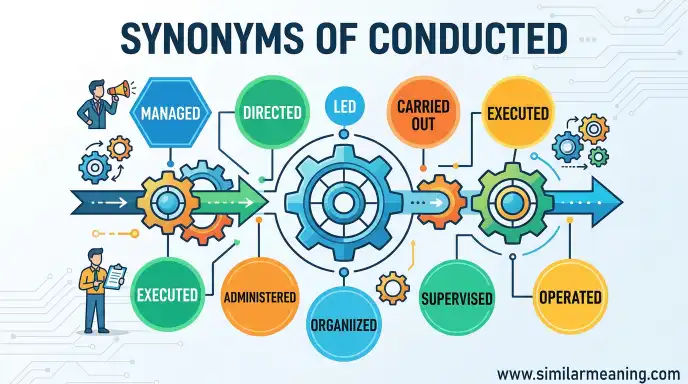
The word conducted means organized, managed, carried out, or led, depending on the context. For example, a teacher conducted an exam, a scientist conducted an experiment, and a manager conducted a meeting. Although the word is useful in many situations, using it too often can make writing sound repetitive.
Learning synonyms of conducted helps English learners, students, teachers, and content writers express ideas more clearly. Each synonym has its own meaning and use. For instance, performed often refers to an action, while managed focuses on control and responsibility. Choosing the right word can improve both formal and everyday English.
This guide explains the meaning, history, pronunciation, and grammar of conducted. It also presents 30 synonyms with simple definitions and examples, helping readers select the best word for academic writing, professional communication, and daily conversations.
Meaning of Conducted
Definition
Conducted (Verb, Past Tense and Past Participle): Conducted means organized, managed, directed, or carried out an activity, task, event, or process.
Examples
- The teacher conducted a test for all students.
- The researchers conducted an experiment to study plant growth.
- The manager conducted a meeting with the staff.
Connotative Meaning
Connotation (the feeling or emotional meaning connected to a word) depends on how conducted is used.
- Positive tone: It can suggest careful planning, effective leadership, or successful work. Example: The team conducted an excellent investigation.
- Negative tone: It can appear in a sentence describing poor or unfair actions. Example: The company conducted an unfair review.
- Neutral tone: It can simply describe an action without expressing praise or criticism. Example: The school conducted an examination on Monday.
Etymology
- Source language: Conducted comes from the verb conduct, which entered English through Old French conduire and Latin conducere.
- Original meaning: The Latin word meant to lead, bring together, or guide.
- Word development: The past tense ending ed changes conduct into conducted.
Short History of Conducted
- Old English (450–1100): The modern word conduct was not commonly used in its present form. English used other words to express ideas such as leading and guiding.
- Middle English (1100–1500): The word entered English through French influence after the Norman Conquest. It developed meanings linked to leading, guiding, and managing.
- Modern English (1500–Present): Conduct gained wider use in formal and everyday English. Conducted became a common form for describing completed actions, research, meetings, experiments, and events.
Pronunciation (US & UK – IPA)
- US: /kənˈdʌktɪd/
- UK: /kənˈdʌktɪd/
Syllables
con duct ed (3 syllables)
Affixation Pattern of Conducted
- Root: Conduct
- Prefix: None
- Suffix: ed, used to form the simple past tense and past participle of the regular verb conduct.
- Word formation: The word belongs to a word family with several grammatical forms:
- Conduct (verb): To organize, manage, or carry out.
- Conduct (noun): A person’s behavior or the way an activity is managed.
- Conducted (verb): Past tense and past participle of conduct.
- Conducting (verb): The present participle of conduct.
- Conductor (noun): A person who directs an orchestra or a material that allows heat or electricity to pass through it.
- Conductive (adjective): Able to conduct heat or electricity.
- Conductivity (noun): The ability to conduct heat or electricity.
- Conducted (adjective, in limited contexts): Describes something that has been guided or carried out, as in a conducted tour.
Synonyms of Conducted
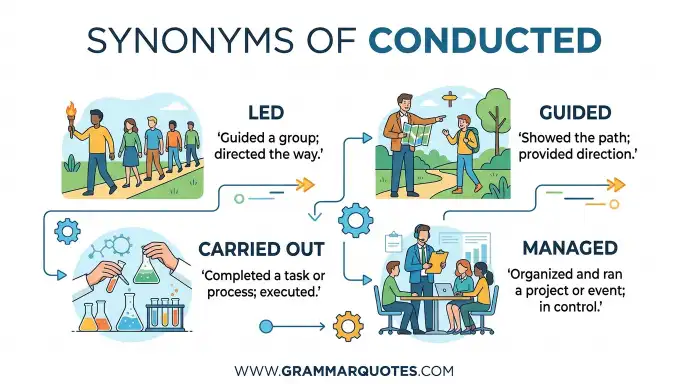
1. Performed (Verb)
US IPA: /pərˈfɔːrmd/ | UK IPA: /pəˈfɔːmd/
Meaning: Carried out an action, task, or activity.
Examples:
- The doctor performed a medical examination.
- The students performed the experiment carefully.
2. Carried Out (Phrasal Verb)
US IPA: /ˌkærid ˈaʊt/ | UK IPA: /ˌkærid ˈaʊt/
Meaning: Completed or performed a planned task or activity.
Examples:
- The team carried out a detailed investigation.
- The workers carried out the instructions.
3. Executed (Verb)
US IPA: /ˈeksɪˌkjuːtɪd/ | UK IPA: /ˈeksɪkjuːtɪd/
Meaning: Put a plan, order, or task into action.
Examples:
- The company executed its marketing plan.
- The engineers executed the design successfully.
4. Managed (Verb)
US IPA: /ˈmænɪdʒd/ | UK IPA: /ˈmænɪdʒd/
Meaning: Controlled or organized an activity, task, or group of people.
Examples:
- Sara managed the project efficiently.
- The supervisor managed the team during the event.
5. Organized (Verb)
US IPA: /ˈɔːrɡənaɪzd/ | UK IPA: /ˈɔːɡənaɪzd/
Meaning: Arranged and planned an event or activity.
Examples:
- The school organized a science fair.
- The club organized a meeting for new members.
6. Led (Verb)
US IPA: /led/ | UK IPA: /led/
Meaning: Guided or directed a person or group.
Examples:
- The teacher led a discussion about climate change.
- Ahmed led the team during the competition.
7. Directed (Verb)
US IPA: /dəˈrektɪd/ | UK IPA: /dɪˈrektɪd/
Meaning: Guided the actions or work of people.
Examples:
- The manager directed the training session.
- The scientist directed the research team.
8. Administered (Verb)
US IPA: /ədˈmɪnɪstərd/ | UK IPA: /ədˈmɪnɪstəd/
Meaning: Managed or supervised an official process or activity.
Examples:
- The school administered the final examination.
- The organization administered the scholarship program.
9. Oversaw (Verb)
US IPA: /ˌoʊvərˈsɔː/ | UK IPA: /ˌəʊvəˈsɔː/
Meaning: Watched over an activity to ensure that it was done correctly.
Examples:
- The director oversaw the construction project.
- The teacher oversaw the students’ work.
10. Supervised (Verb)
US IPA: /ˈsuːpərvaɪzd/ | UK IPA: /ˈsuːpəvaɪzd/
Meaning: Watched and guided people while they worked.
Examples:
- The instructor supervised the laboratory activity.
- The manager supervised the new employees.
11. Carried Through (Phrasal Verb)
US IPA: /ˌkærid ˈθruː/ | UK IPA: /ˌkærid ˈθruː/
Meaning: Continued an action or plan until it was completed.
Examples:
- The team carried through its plan despite delays.
- She carried through the project to the end.
12. Undertook (Verb)
US IPA: /ˌʌndərˈtʊk/ | UK IPA: /ˌʌndəˈtʊk/
Meaning: Accepted responsibility for a task or activity.
Examples:
- The researchers undertook a study of local wildlife.
- He undertook the task with great care.
13. Initiated (Verb)
US IPA: /ɪˈnɪʃieɪtɪd/ | UK IPA: /ɪˈnɪʃieɪtɪd/
Meaning: Started a process, activity, or project.
Examples:
- The school initiated a new reading program.
- The company initiated an investigation into the complaint.
14. Arranged (Verb)
US IPA: /əˈreɪndʒd/ | UK IPA: /əˈreɪndʒd/
Meaning: Planned or organized the details of an event or activity.
Examples:
- The secretary arranged the meeting.
- They arranged a training session for new workers.
15. Facilitated (Verb)
US IPA: /fəˈsɪləˌteɪtɪd/ | UK IPA: /fəˈsɪlɪteɪtɪd/
Meaning: Made an activity or process easier to carry out.
Examples:
- The teacher facilitated a group discussion.
- The new system facilitated communication between departments.
16. Coordinated (Verb)
US IPA: /koʊˈɔːrdəˌneɪtɪd/ | UK IPA: /kəʊˈɔːdɪneɪtɪd/
Meaning: Organized different people or activities so they worked together.
Examples:
- The manager coordinated the conference.
- She coordinated the volunteers during the event.
17. Implemented (Verb)
US IPA: /ˈɪmpləˌmentɪd/ | UK IPA: /ˈɪmplɪmentɪd/
Meaning: Put a plan, policy, or decision into action.
Examples:
- The school implemented a new safety policy.
- The company implemented changes to its website.
18. Delivered (Verb)
US IPA: /dɪˈlɪvərd/ | UK IPA: /dɪˈlɪvəd/
Meaning: Presented a speech, lesson, service, or result.
Examples:
- The professor delivered a lecture on history.
- The trainer delivered a presentation to the staff.
19. Presented (Verb)
US IPA: /prɪˈzentɪd/ | UK IPA: /prɪˈzentɪd/
Meaning: Showed or explained information to an audience.
Examples:
- The researcher presented the findings.
- The student presented a report to the class.
20. Held (Verb)
US IPA: /held/ | UK IPA: /held/
Meaning: Organized or took place in the case of a meeting, event, or discussion.
Examples:
- The school held a parent meeting.
- The committee held a discussion about the new rules.
21. Hosted (Verb)
US IPA: /ˈhoʊstɪd/ | UK IPA: /ˈhəʊstɪd/
Meaning: Organized or provided the setting for an event.
Examples:
- The university hosted an international conference.
- Our school hosted a debate competition.
22. Arranged and Managed (Verb Phrase)
US IPA: /əˈreɪndʒd ænd ˈmænɪdʒd/ | UK IPA: /əˈreɪndʒd ænd ˈmænɪdʒd/
Meaning: Planned and controlled an activity from beginning to end.
Examples:
- The assistant arranged and managed the workshop.
- The team arranged and managed the charity event.
23. Investigated (Verb)
US IPA: /ɪnˈvestɪˌɡeɪtɪd/ | UK IPA: /ɪnˈvestɪɡeɪtɪd/
Meaning: Examined a situation carefully to discover facts.
Examples:
- The police investigated the complaint.
- Scientists investigated the effects of pollution.
24. Examined (Verb)
US IPA: /ɪɡˈzæmɪnd/ | UK IPA: /ɪɡˈzæmɪnd/
Meaning: Looked at or studied something carefully.
Examples:
- The researchers examined the collected data.
- The doctor examined the patient.
25. Researched (Verb)
US IPA: /ˈriːsɜːrtʃt/ | UK IPA: /rɪˈsɜːtʃt/
Meaning: Studied a subject to discover information or understand it better.
Examples:
- The students researched renewable energy.
- The team researched the causes of the problem.
26. Tested (Verb)
US IPA: /ˈtestɪd/ | UK IPA: /ˈtestɪd/
Meaning: Checked something to find out how well it works or what its qualities are.
Examples:
- The engineers tested the new machine.
- The teacher tested the students’ knowledge.
27. Surveyed (Verb)
US IPA: /sərˈveɪd/ | UK IPA: /səˈveɪd/
Meaning: Collected information from people or examined an area.
Examples:
- The researchers surveyed local residents.
- The team surveyed the land before construction.
28. Carried on (Phrasal Verb)
US IPA: /ˌkærid ˈɑːn/ | UK IPA: /ˌkærid ˈɒn/
Meaning: Continued an activity or process.
Examples:
- The workers carried on with the project.
- The researchers carried on their study despite the delay.
29. Governed (Verb)
US IPA: /ˈɡʌvərnd/ | UK IPA: /ˈɡʌvənd/
Meaning: Controlled or directed through rules, authority, or laws.
Examples:
- The council governed the local program.
- The organization was governed by strict regulations.
30. Orchestrated (Verb)
US IPA: /ˈɔːrkəˌstreɪtɪd/ | UK IPA: /ˈɔːkɪstreɪtɪd/
Meaning: Carefully organized several people or activities to achieve a result.
Examples:
- The director orchestrated the entire event.
- The manager orchestrated a complex product launch.
Prototype Meaning
The most typical meaning of conducted is to carry out or manage an activity. When people hear this word, they often imagine a teacher giving an examination, a scientist performing an experiment, or a manager leading a meeting. The word usually suggests that someone has taken responsibility for an organized action. However, its exact meaning depends on the sentence. A person may conduct research, conduct an interview, conduct a meeting, or conduct an orchestra. These activities are different, so the best synonym changes with the context.
Prototype Categorization
The synonyms of conducted can be grouped by their main meanings.
- Performing an action: Performed, executed, carried out, and implemented. These words work well for tasks, plans, and practical activities.
- Leading people: Led, directed, managed, supervised, and oversaw. These words highlight leadership and control.
- Planning events: Organized, arranged, coordinated, held, and hosted. These words are useful for meetings, conferences, and other events.
- Research and investigation: Investigated, examined, researched, surveyed, and tested. These words describe ways of collecting or checking information.
- Starting or continuing work: Initiated, undertook, carried through, and carried on. These words show how an activity begins, proceeds, or reaches completion.
- Making activities easier or presenting information: Facilitated, delivered, and presented. These words suit discussions, lessons, speeches, and reports.
- Authority and complex planning: Administered, governed, and orchestrated. These words often appear in formal or professional writing.
Categorization helps writers choose the most accurate word rather than replacing conducted with a synonym that does not fit. For example, hosted suits a conference, investigated suits a complaint, and performed suits an experiment.
Antonyms of Conducted
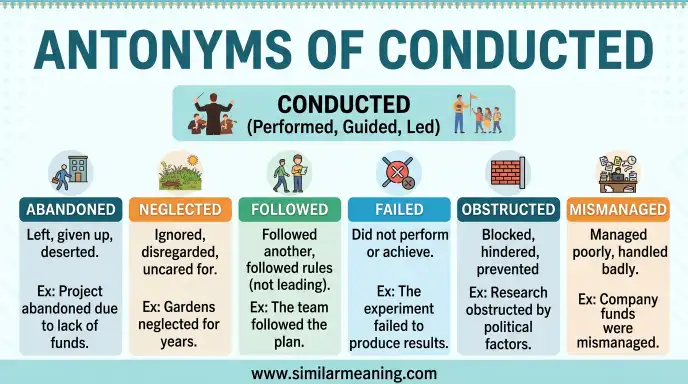
Antonyms depend on the intended meaning of conducted. The following words express opposite or contrasting ideas.
- Abandoned (verb): Left a task or plan before completion. Example: The team abandoned the project.
- Neglected (verb): Failed to give proper attention to a task. Example: The manager neglected the safety checks.
- Halted (verb): Stopped an activity. Example: The school halted the experiment.
- Cancelled (verb): Decided that a planned event would not take place. Example: The organizers cancelled the meeting.
- Disorganized (verb): Made an activity or system less organized. Example: Poor planning disorganized the event.
- Followed (verb): Acted according to instructions rather than directing the activity. Example: The assistant followed the manager’s instructions.
- Mismanaged (verb): Managed something badly or carelessly. Example: The company mismanaged the project.
- Prevented (verb): Stopped something from happening. Example: The storm prevented the team from conducting the test.
Short Questions and Answers
- What does conducted mean?
Conducted means organized, managed, directed, or carried out an activity. - When should conducted be used?
Use conducted when describing a completed activity, such as research, an experiment, an interview, or a meeting. - Is conducted positive or negative?
Conducted is usually neutral. The surrounding words and situation determine if the sentence sounds positive or negative. - How is conducted different from similar words?
Conducted is a broad term. Performed focuses on carrying out an action, managed emphasizes control, led highlights guidance, and organized focuses on planning.
Conclusion
Learning synonyms of conducted can improve vocabulary and make English writing more effective. Words such as performed, managed, organized, directed, and investigated allow writers to express different ideas with greater accuracy. Each synonym has a specific meaning, so choosing the right one is important.
These words can strengthen essays, reports, academic assignments, business emails, and everyday conversations. Understanding pronunciation, grammar, word history, and connotation also helps learners use vocabulary correctly. Instead of repeating conducted in every sentence, try selecting a word that matches the action being described.
For example, use hosted for an event, examined for a careful review, and implemented for a plan put into action. Practice a few synonyms every day, write your own example sentences, and review them often. This simple habit can build confidence and support steady progress in English.
Discover More Articles!
Criticism Synonyms: 30 Words to Express Opinions Clearly
Confused Synonyms: 30 Words to Express Confusion
Rain Heavily Synonyms: 25 Ways to Describe Heavy Rain

Justin Cord Hayes is an Adams Media author and co-author of several vocabulary and thesaurus books. His work focuses on synonyms, antonyms, word choice, and expanding English vocabulary. He co-authored Roget’s Thesaurus of Words for Writers, Roget’s Thesaurus of Words for Students, and Roget’s Thesaurus of Words for Intellectuals. His books are designed to help readers find clearer and more effective words for writing and communication.







1 thought on “Synonyms of Conducted: Best Words to Improve Your Vocabulary”