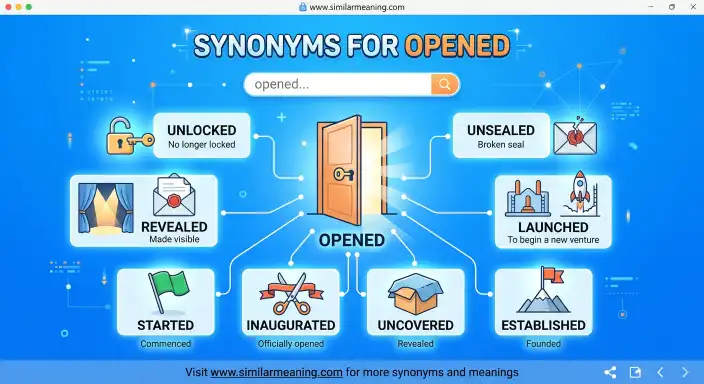
Opened means that something was moved from a closed position to an open one. For example, you may have opened a door to welcome a friend or opened a book to read a story. The word is common in daily English because people use it to describe doors, windows, shops, boxes, books, and many other things.
However, using the same word again and again can make your writing sound repetitive. Learning synonyms for opened helps you express ideas in a clearer and more interesting way. For English learners, these words build vocabulary and improve speaking and writing skills. Content writers can also use them to make articles more natural and engaging.
In this guide, you will learn the meaning of opened, its pronunciation, history, word formation, and 30 useful synonyms. You will also discover examples, antonyms, and word categories to help you choose the right word for each situation.
Meaning of Opened
Definition
Opened (Verb): Opened is the past tense and past participle of open. It means to move something from a closed position to an open one, make something accessible, or begin an activity or event.
Examples
- She opened the window to let fresh air into the room.
- The shop opened early on Monday.
Connotative Meaning
Connotation is the feeling or idea that a word suggests beyond its basic meaning.
- Positive tone: Opened can suggest opportunity, welcome, freedom, or discovery. Example: She opened her heart to new ideas.
- Negative tone: It can suggest exposure, unwanted access, or a breach of privacy. Example: Someone opened my private letter without permission.
- Neutral tone: It can simply describe an action. Example: He opened the box.
Etymology
- Source language: The word opened comes from the verb open, which developed from Old English openian.
- Original meaning: The early verb meant to open, make open, or make accessible.
- Word formation: Opened is formed by adding the regular past tense ending ed to open.
Short History of Opened
- Old English (450–1100): The verb openian was used to describe making something open or accessible.
- Middle English (1100–1500): The verb developed into forms closer to modern open as English spelling and pronunciation changed.
- Modern English (1500–Present): Opened became the standard past tense and past participle form of open. Today, it describes physical actions and figurative ideas, such as opening a business or opening a discussion.
Pronunciation (US and UK – IPA)
- US: /ˈoʊ.pənd/
- UK: /ˈəʊ.pənd/
Syllables
o pened (2 syllables)
Affixation Pattern of Opened
- Root/base: Open
- Prefix: None
- Suffix: ed, which marks the past tense and past participle of a regular verb.
Word Formation of Opened
The base word open produces several related forms:
- Open (verb): To make something accessible.
- Open (adjective): Not closed or blocked.
- Openly (adverb): In an honest or direct way.
- Openness (noun): The quality of being open, honest, or receptive.
- Opened (verb): The past tense and past participle form of open.
- Opening (noun/verb/adjective): The act of opening, the beginning of something, or a space through which something can pass.
- Opener (noun): A tool or person that opens something, or the first item in an event or series.
Synonyms for Opened
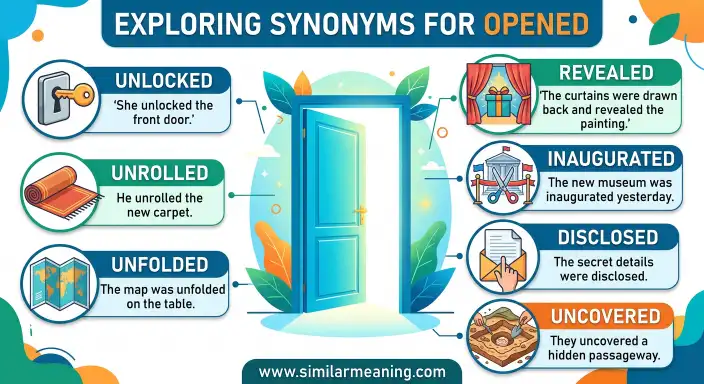
The best synonym depends on what was opened. A door may be unlocked, a shop may commence operations, and a conversation may be initiated. The following 30 words and phrases help you describe these situations accurately.
1. Unlocked (Verb)
US IPA: /ʌnˈlɑːkt/ | UK IPA: /ʌnˈlɒkt/
Meaning: Made something accessible by removing its lock.
Examples:
- She unlocked the door with her key.
- He unlocked the cabinet before taking out the files.
2. Unsealed (Verb)
US IPA: /ʌnˈsiːld/ | UK IPA: /ʌnˈsiːld/
Meaning: Removed a seal or covering that kept something closed.
Examples:
- He unsealed the envelope carefully.
- The worker unsealed the package for inspection.
3. Uncovered (Verb)
US IPA: /ʌnˈkʌvərd/ | UK IPA: /ʌnˈkʌvəd/
Meaning: Removed a cover to reveal what was underneath.
Examples:
- She uncovered the dish before serving dinner.
- The gardener uncovered the plants in the morning.
4. Unfolded (Verb)
US IPA: /ʌnˈfoʊldɪd/ | UK IPA: /ʌnˈfəʊldɪd/
Meaning: Opened something that was folded.
Examples:
- He unfolded the map on the table.
- She unfolded the letter and began reading.
5. Spread (Verb)
US IPA: /sprɛd/ | UK IPA: /spred/
Meaning: Opened or extended something over a wider area.
Examples:
- She spread the blanket on the grass.
- He spread the newspaper across the desk.
6. Extended (Verb)
US IPA: /ɪkˈstɛndɪd/ | UK IPA: /ɪkˈstendɪd/
Meaning: Stretched or moved something outward.
Examples:
- He extended the folding table.
- She extended her arms to welcome the child.
7. Revealed (Verb)
US IPA: /rɪˈviːld/ | UK IPA: /rɪˈviːld/
Meaning: Made something known or visible.
Examples:
- The artist revealed her new painting.
- He revealed the surprise to his family.
8. Exposed (Verb)
US IPA: /ɪkˈspoʊzd/ | UK IPA: /ɪkˈspəʊzd/
Meaning: Made something visible or uncovered.
Examples:
- The wind exposed the roots of the tree.
- The report exposed the truth about the problem.
9. Activated (Verb)
US IPA: /ˈæk.təˌveɪ.tɪd/ | UK IPA: /ˈæk.tɪ.veɪ.tɪd/
Meaning: Made a device, system, or process start working.
Examples:
- She activated the security system.
- He activated the account using his email.
10. Launched (Verb)
US IPA: /lɔːntʃt/ | UK IPA: /lɔːntʃt/
Meaning: Started or introduced something new, such as a product, service, or project.
Examples:
- The company launched its new website.
- They launched a campaign to support local schools.
11. Initiated (Verb)
US IPA: /ɪˈnɪʃiˌeɪtɪd/ | UK IPA: /ɪˈnɪʃieɪtɪd/
Meaning: Started a process, action, or activity.
Examples:
- The teacher initiated a class discussion.
- The team initiated a new research project.
12. Commenced (Verb)
US IPA: /kəˈmɛnst/ | UK IPA: /kəˈmenst/
Meaning: Began an event, process, or activity.
Examples:
- The meeting commenced at nine.
- Construction commenced after the approval.
13. Began (Verb)
US IPA: /bɪˈɡæn/ | UK IPA: /bɪˈɡæn/
Meaning: Started doing something or made an activity begin.
Examples:
- She began her presentation with a question.
- The show began earlier than expected.
14. Started (Verb)
US IPA: /ˈstɑːrtɪd/ | UK IPA: /ˈstɑːtɪd/
Meaning: Made an activity, process, or event begin.
Examples:
- He started the computer.
- The store started business at eight in the morning.
15. Initiated Access (Verb Phrase)
US IPA: /ɪˈnɪʃieɪtɪd ˈæk.ses/ | UK IPA: /ɪˈnɪʃieɪtɪd ˈæk.ses/
Meaning: Began the process of gaining access to a system or resource.
Examples:
- The employee initiated access to the online portal.
- She initiated access to the shared folder.
16. Entered (Verb)
US IPA: /ˈɛn.tərd/ | UK IPA: /ˈen.təd/
Meaning: Went into a room, building, or other place.
Examples:
- He entered the room quietly.
- She entered the shop to buy some bread.
17. Accessed (Verb)
US IPA: /ˈæk.sɛst/ | UK IPA: /ˈæk.sest/
Meaning: Reached or gained the ability to use information, a place, or a system.
Examples:
- She accessed the document online.
- He accessed the building with his entry card.
18. Made Available (Verb Phrase)
US IPA: /meɪd əˈveɪ.lə.bəl/ | UK IPA: /meɪd əˈveɪ.lə.bəl/
Meaning: Allowed something to be used, reached, or obtained.
Examples:
- The school made its library available to students.
- The company made the new service available to customers.
19. Disclosed (Verb)
US IPA: /dɪsˈkloʊzd/ | UK IPA: /dɪsˈkləʊzd/
Meaning: Shared information that was previously private or unknown.
Examples:
- The report disclosed important details.
- She disclosed the results during the meeting.
20. Unlocked Up (Verb Phrase)
US IPA: /ʌnˈlɑːkt ʌp/ | UK IPA: /ʌnˈlɒkt ʌp/
Meaning: This is not a standard synonym for opened. Use unlocked when referring to removing a lock.
Examples:
- He unlocked the front door.
- She unlocked the storage room.
21. Split (Verb)
US IPA: /splɪt/ | UK IPA: /splɪt/
Meaning: Separated something into parts or made an opening by dividing it.
Examples:
- The carpenter split the wood.
- The crack split the surface of the box.
22. Parted (Verb)
US IPA: /ˈpɑːrtɪd/ | UK IPA: /ˈpɑːtɪd/
Meaning: Moved two things apart to create a space.
Examples:
- She parted the curtains to look outside.
- The crowd parted to let the ambulance pass.
23. Lifted (Verb)
US IPA: /ˈlɪftɪd/ | UK IPA: /ˈlɪftɪd/
Meaning: Raised something, often to uncover or reveal what is underneath.
Examples:
- He lifted the lid off the pot.
- She lifted the cover to check the box.
24. Pulled Apart (Verb Phrase)
US IPA: /pʊld əˈpɑːrt/ | UK IPA: /pʊld əˈpɑːt/
Meaning: Separated two connected or joined parts.
Examples:
- He pulled apart the two sections of the toy.
- She pulled apart the curtains to let in sunlight.
25. Spread Open (Verb Phrase)
US IPA: /sprɛd ˈoʊ.pən/ | UK IPA: /spred ˈəʊ.pən/
Meaning: Moved the parts of something outward so that it was fully open.
Examples:
- She spread open the book on the desk.
- He spread open the folded paper.
26. Unzipped (Verb)
US IPA: /ʌnˈzɪpt/ | UK IPA: /ʌnˈzɪpt/
Meaning: Opened something by moving its zipper.
Examples:
- She unzipped her school bag.
- He unzipped the jacket because it was warm.
27. Unbuttoned (Verb)
US IPA: /ʌnˈbʌtənd/ | UK IPA: /ʌnˈbʌtənd/
Meaning: Opened clothing by undoing its buttons.
Examples:
- He unbuttoned his coat.
- She unbuttoned the top of her shirt.
28. Unlatched (Verb)
US IPA: /ʌnˈlætʃt/ | UK IPA: /ʌnˈlætʃt/
Meaning: Released a latch so that something could open.
Examples:
- She unlatched the garden gate.
- He unlatched the small wooden box.
29. Begun (Verb)
US IPA: /bɪˈɡʌn/ | UK IPA: /bɪˈɡʌn/
Meaning: Started; the past participle of begin.
Examples:
- The meeting has begun.
- Construction had begun before the rain started.
30. Inaugurated (Verb)
US IPA: /ɪˈnɔːɡjəˌreɪtɪd/ | UK IPA: /ɪˈnɔːɡjʊreɪtɪd/
Meaning: Formally opened or officially started a building, service, or event.
Examples:
- The mayor inaugurated the new library.
- The university inaugurated its research centre.
Prototype Meaning
The most typical meaning of opened is moving something from a closed position to an open one. People often imagine someone opening a door, window, box, book, or bag. However, the word also has a wider meaning. A business can be opened, a meeting can be opened, and a new opportunity can be opened. The exact meaning depends on the sentence and the situation.
Prototype Categorization
Synonyms for opened can be grouped by their meanings and uses.
- Removing a barrier: Unlocked, unsealed, unlatched, and unzipped.
- Removing a cover: Uncovered, lifted, and exposed.
- Moving parts apart: Parted, unfolded, spread, and pulled apart.
- Beginning an activity: Started, began, commenced, initiated, and begun.
- Making something known: Revealed and disclosed.
- Making something usable: Activated, accessed, and made available.
- Official openings: Launched and inaugurated.
- Entering a place: Entered.
These categories help writers select words that fit the context. For example, unlatched works well for a gate, while launched is more suitable for a new product. Choosing the right synonym improves clarity and prevents awkward sentences.
Antonyms of Opened
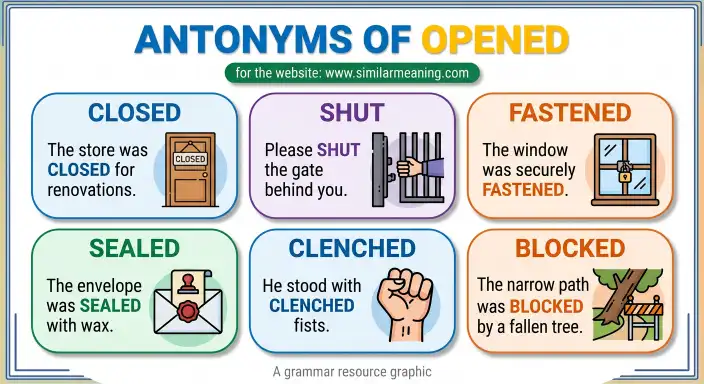
- Closed (verb): Moved something into a position that blocks access. Example: She closed the window.
- Shut (verb): Closed something firmly. Example: He shut the door.
- Sealed (verb): Closed something securely to prevent access. Example: She sealed the envelope.
- Locked (verb): Secured something with a lock. Example: He locked the gate.
- Covered (verb): Put something over another object. Example: She covered the bowl.
- Blocked (verb): Prevented access or movement. Example: A fallen tree blocked the road.
- Concealed (verb): Kept something hidden from view. Example: He concealed the letter.
- Terminated (verb): Brought an activity or process to an end. Example: The company terminated the project.
Short Questions and Answers
- What does opened mean?
Opened means made something open, accessible, or available. It is also the past tense and past participle of open. - When should opened be used?
Use opened when describing an action that happened in the past, such as opening a door, starting a business, or making information available. - Is opened positive or negative?
The word is usually neutral. Its emotional tone depends on the situation. Opening a gift may feel positive, while opening someone’s private letter without permission may feel negative. - How is opened different from similar words?
Unlocked means removing a lock, unsealed means removing a seal, revealed means making something known, and launched means introducing or starting something. These words are related but are not interchangeable in every sentence.
Conclusion
Learning synonyms for opened helps you express ideas with greater accuracy and confidence. Although opened is a common English word, its alternatives can describe more specific actions. For example, unlocked describes removing a lock, uncovered describes removing a cover, and launched describes starting something new.
Understanding each word’s meaning, pronunciation, and tone helps you choose the right expression. This skill is useful for students, English learners, teachers, bloggers, and content writers. It also makes speaking and writing more natural by reducing unnecessary repetition.
To improve your vocabulary, learn a few new words each day and use them in your own sentences. Read English articles, listen to native speakers, and practise choosing synonyms that fit each situation. With regular practice, your English will become clearer, richer, and more effective.
Discover More Articles!
Synonyms of Conducted: Best Words to Improve Your Vocabulary
Synonyms for Addressing: 30 Powerful Words to Improve Your Vocabulary
Serenity Synonyms: 30 Powerful Words to Describe Peace and Calm

Justin Cord Hayes is an Adams Media author and co-author of several vocabulary and thesaurus books. His work focuses on synonyms, antonyms, word choice, and expanding English vocabulary. He co-authored Roget’s Thesaurus of Words for Writers, Roget’s Thesaurus of Words for Students, and Roget’s Thesaurus of Words for Intellectuals. His books are designed to help readers find clearer and more effective words for writing and communication.


4 thoughts on “Synonyms for Opened: 30 Powerful Words to Improve Your Vocabulary”