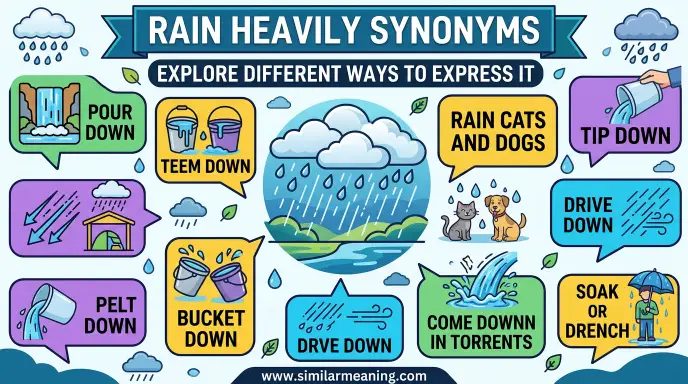
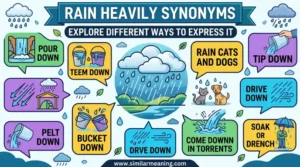
Rain heavily synonyms include pour, downpour, bucket down, lash down, teem, and rain cats and dogs. These expressions describe rain that falls in large amounts or with great force. Some are common in everyday conversations, while others work better in stories, weather reports, and descriptive writing.
For example, you can say, “It is raining heavily,” “The rain is pouring,” or “It is bucketing down.” All three describe heavy rain, but they create slightly different impressions. Pouring is widely understood, while bucketing down is an informal expression used especially in British English.
Learning different ways to describe heavy rain can make your writing more natural and engaging. if you are writing a school essay, describing a storm, or chatting with a friend about the weather, the right phrase helps you express the scene clearly.
In this guide, you will find 25 useful synonyms and expressions for rain heavily, along with meanings, examples, common mistakes, and answers to frequently asked questions.
Quick Answer: What Are the Best Synonyms for Rain Heavily?
Here are some of the best alternatives to rain heavily:
- Pour — rain in large amounts.
- Downpour — a spell of heavy rain.
- Bucket down — rain very heavily; informal.
- Rain cats and dogs — rain extremely heavily; an idiom.
- Lash down — rain forcefully, often in a storm.
- Pelt down — rain heavily and hit surfaces hard.
- Teem down — rain in large quantities.
- Come down in torrents — rain in a powerful, continuous flow.
- Sheet down — rain in a dense, widespread curtain.
- Deluge — a very large amount of water or rain.
Best everyday choice: Use pouring in most situations. For informal British English, try bucketing down. For vivid storytelling, use lashing down or coming down in torrents.
Definition and Meaning of Rain Heavily
To rain heavily means that a large amount of rain falls over a short period or with considerable intensity. Heavy rain can reduce visibility, make roads slippery, and cause water to collect on the ground.
For example:
- It rained heavily throughout the night.
- Rain poured over the rooftops.
- The storm brought a sudden downpour.
The phrase can describe ordinary heavy rainfall or rain associated with a storm. However, not every synonym has exactly the same meaning. Some describe the amount of rain, while others emphasize its force, duration, or appearance.
What Is the Difference Between Heavy Rain and a Downpour?
Heavy rain describes rainfall with high intensity. A downpour is an episode of heavy rain, often sudden or short lived.
Example: “Heavy rain continued for hours, interrupted by a brief downpour.”
25 Synonyms and Expressions for Rain Heavily
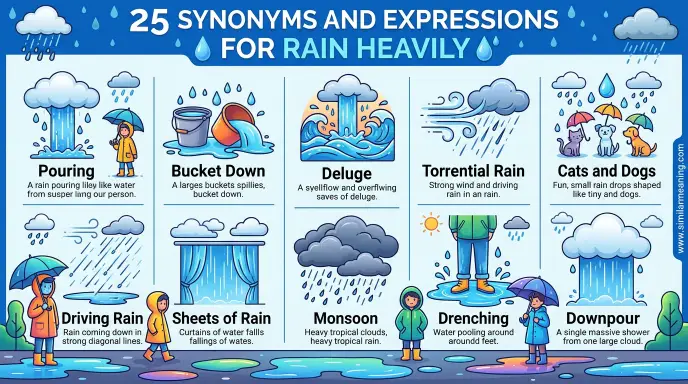
The following expressions are grouped by their meanings and common uses.
1. Common Synonyms for Rain Heavily
These words and phrases are useful in everyday English.
| Synonym or phrase | Meaning | Example |
| 1. Pour | Rain in large amounts | It began to pour after lunch. |
| 2. Rain hard | Rain with strong intensity | It rained hard all afternoon. |
| 3. Rain heavily | Rain in large quantities | It may rain heavily tonight. |
| 4. Downpour | A period of heavy rain | A sudden downpour soaked the streets. |
| 5. Torrential rain | Extremely heavy rainfall | Torrential rain flooded several roads. |
| 6. Cloudburst | A sudden, intense burst of rain | A cloudburst hit the village. |
| 7. Deluge | A very large amount of rain or water | The deluge left the fields underwater. |
When to use these words: Choose pour for everyday speech, downpour for a period of heavy rain, and torrential rain for particularly intense rainfall.
Note that cloudburst usually refers to a sudden, exceptionally heavy burst of rain. It is not simply another word for any rainy day.
2. Informal Expressions for Heavy Rain
These expressions make casual conversations sound more natural.
| Expression | Meaning | Example |
| 8. Bucket down | Rain very heavily | Take an umbrella; it’s bucketing down. |
| 9. Rain cats and dogs | Rain extremely heavily | We stayed indoors because it was raining cats and dogs. |
| 10. Come down in buckets | Rain in very large amounts | The rain came down in buckets. |
| 11. Pour down | Rain heavily | It started to pour down on our way home. |
| 12. Come down hard | Rain with great intensity | The rain came down hard during the match. |
When to use these expressions: They are suitable for conversations, informal messages, and personal stories. Bucket down is especially associated with British English, while rain cats and dogs is a familiar idiom in many varieties of English.
3. Descriptive Expressions for Powerful Rain
These phrases help readers imagine the force and appearance of the rain.
| Expression | Meaning | Example |
| 13. Lash down | Rain forcefully | Rain lashed down against the windows. |
| 14. Pelt down | Rain heavily and strike surfaces | Rain pelted down on the roof. |
| 15. Teem down | Rain in great quantities | Rain teemed down over the fields. |
| 16. Come down in torrents | Fall in powerful streams | Rain came down in torrents. |
| 17. Sheet down | Fall in a dense curtain | Rain sheeted down across the road. |
| 18. Beat down | Strike forcefully; often used for rain or other weather | Rain beat down on the pavement. |
| 19. Hammer down | Fall with great force; less common | Rain hammered down on the metal roof. |
When to use these expressions: Choose lash down or hammer down to emphasize force, pelt down to suggest rain striking surfaces, and sheet down to describe a dense curtain of rain.
4. Weather and Literary Expressions
These expressions are useful in reports, descriptive essays, and fiction.
| Expression | Meaning | Example |
| 20. Torrential downpour | An episode of extremely heavy rain | A torrential downpour delayed traffic. |
| 21. Heavy rainfall | A large amount of rain falling | Heavy rainfall is expected in the region. |
| 22. Rain in torrents | Rain fall in powerful streams | Rain fell in torrents throughout the evening. |
| 23. Pour in streams | Rain flow heavily across surfaces | Water poured in streams from the roof. |
| 24. Rain relentlessly | Rain continuously or without easing | Rain fell relentlessly through the night. |
| 25. Rain in sheets | Rain fall in a dense, widespread curtain | Rain fell in sheets across the landscape. |
When to use these expressions: Heavy rainfall is suitable for factual writing, while rain in sheets and rain relentlessly can make descriptions more vivid. Pour in streams describes the resulting flow of water rather than serving as a direct synonym in every sentence.
Which Synonym for Rain Heavily Should You Choose?
The best phrase depends on your audience and the situation you are describing.
| Situation | Best choice | Example | |
| Everyday conversation | Pouring | It’s pouring outside. | |
| Informal British English | Bucketing down | It’s bucketing down again. | |
| Extremely heavy rain | Torrential rain | Torrential rain hit the town. | |
| A sudden burst of rain | Downpour | A sudden downpour caught us by surprise. | |
| Descriptive storytelling | Lash down | Rain lashed down on the empty street. | |
| Weather reporting | Heavy rainfall | Heavy rainfall is expected this evening. | |
| Vivid, dramatic description | Come down in torrents | Rain came down in torrents. | |
| A familiar idiom | Rain cats and dogs | It was raining cats and dogs. |
What Is a More Powerful Word Than Rain Heavily?
Torrential is a strong word for describing very heavy rain. You can write “torrential rain” or “rain fell torrentially,” although the first form is more common.
For an especially vivid description, try:
- “Rain lashed down against the windows.”
- “Rain came down in torrents.”
- “A sudden deluge swept across the area.”
Use these phrases when the rain is genuinely intense. They may exaggerate the weather if used to describe ordinary rainfall.
What Is a Formal Synonym for Rain Heavily?
Experience heavy rainfall and receive torrential rainfall are suitable for formal or weather related writing, depending on the sentence.
For example:
- Everyday: “It poured all night.”
- Formal: “The area experienced heavy rainfall throughout the night.”
How to Use Rain Heavily Synonyms in Different Types of Writing
Different contexts call for different expressions. Here is how to choose the right one.
1. Everyday Conversations
Use simple, familiar phrases when speaking to friends or family.
Examples:
- It’s pouring outside.
- It’s raining really hard.
- It’s bucketing down.
- The rain is coming down in buckets.
These phrases are natural and easy to understand.
2. School Essays
In an essay, combine clear language with a few descriptive expressions.
Example: “Dark clouds gathered over the town, and soon rain began to pour. Within minutes, a heavy downpour covered the streets.”
This approach is more engaging than repeating “it was raining heavily” in every sentence.
3. Stories and Creative Writing
Choose words that help readers picture the scene.
Example: “Rain lashed against the windows as thunder rolled across the sky. Water streamed down the glass, blurring the lights outside.”
Expressions such as lashed, pelted, and came down in torrents can add movement and atmosphere to a scene.
4. Weather Reports
Use accurate, straightforward descriptions in reports.
Example: “Heavy rainfall is expected in the northern region this evening, with a possibility of localized flooding.”
Terms such as heavy rainfall, torrential rain, and downpour are more suitable for factual reporting than playful idioms.
Common Mistakes When Using Rain Heavily Synonyms
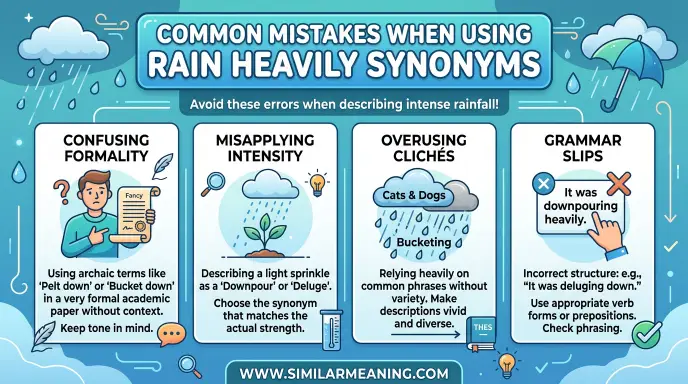
Although many expressions have similar meanings, they are not always interchangeable.
1. Confusing Rain With a Downpour
Rain describes the weather or the act of water falling from clouds. A downpour is a particular episode of heavy rain.
- Less precise: “The weather was a downpour all day.”
- Better: “There was a downpour in the afternoon.”
2. Using “Rain Cats and Dogs” Incorrectly
The correct expression is “rain cats and dogs.” It is an idiom, so the words should not be interpreted literally.
- Correct: “It was raining cats and dogs.”
- Incorrect: “It was raining cats and dog.”
3. Using “Torrential” for Light Rain
Torrential describes very heavy rain, not drizzle or light showers.
- Incorrect: “Torrential rain fell lightly for two minutes.”
- Better: “A light shower lasted for two minutes.”
4. Confusing “Lash Down” With “Pour Down”
Both describe heavy rain, but lash down emphasizes forceful impact, while pour down focuses more generally on a large amount of rain.
- “Rain poured down from the clouds.”
- “Rain lashed down against the windows.”
5. Repeating the Same Phrase Too Often
Using “rain heavily” in every sentence can make writing repetitive.
Instead, vary your language naturally:
“The rain began to pour. Soon, a heavy downpour covered the road, and water streamed along the pavement.”
Do not replace every instance with a complicated word. Simple language is often the clearest choice.
Everyday Examples of Rain Heavily Synonyms
Here are 15 examples you can use as models for your own writing.
- Pour: It started to pour just as we left the house.
- Downpour: A sudden downpour interrupted the outdoor event.
- Bucket down: It’s bucketing down, so let’s wait inside.
- Rain cats and dogs: It rained cats and dogs during our journey.
- Lash down: Rain lashed down on the roof all night.
- Pelt down: Rain pelted down on the parked cars.
- Torrential rain: Torrential rain made driving difficult.
- Cloudburst: A cloudburst flooded the narrow street.
- Come down in buckets: Rain came down in buckets during the afternoon.
- Come down in torrents: Rain came down in torrents after the storm began.
- Sheet down: Rain sheeted down across the open field.
- Rain in sheets: Rain fell in sheets, hiding the distant hills.
- Heavy rainfall: Heavy rainfall affected several nearby villages.
- Rain relentlessly: Rain fell relentlessly until morning.
- Hammer down: Rain hammered down on the tin roof.
These examples show how you can describe the same general weather condition in different ways without losing clarity.
Rain Heavily Synonyms: Frequently Asked Questions
1. What is another word for rain heavily?
Pour is one of the most common alternatives. You can say “It’s pouring” instead of “It’s raining heavily.”
2. What is a synonym for very heavy rain?
Torrential rain, downpour, deluge, and cloudburst can describe very heavy rainfall. Each has a slightly different meaning.
3. What is a slang term for heavy rain?
Bucket down and come down in buckets are informal expressions for heavy rain. “It’s bucketing down” is common in British English.
4. What does “raining cats and dogs” mean?
It is an idiom meaning that it is raining extremely heavily. For example, “We cancelled the picnic because it was raining cats and dogs.”
5. What is a formal way to say rain heavily?
You can say “experience heavy rainfall” or “receive torrential rainfall.” In most factual contexts, “heavy rainfall occurred” is also clear and appropriate.
6. What is the difference between a downpour and torrential rain?
A downpour is a period of heavy rain, often sudden. Torrential rain emphasizes the intensity and large volume of the rainfall.
7. What is a literary synonym for rain heavily?
Expressions such as lash down, pelt down, rain in sheets, and come down in torrents can create vivid descriptions in stories and poems.
8. Can I use “pouring” instead of “raining heavily”?
Yes. “It’s pouring” is a natural and widely understood way to say that it is raining heavily.
9. What is the opposite of rain heavily?
Depending on the context, opposites or contrasting expressions include drizzle, rain lightly, ease off, and stop raining. A drizzle is light rain, while “ease off” means that the rain is becoming less intense.
10. How can I avoid repeating “rain heavily” in an essay?
Use suitable alternatives such as pour, downpour, torrential rain, or lash down. Choose expressions based on the scene, and avoid using dramatic terms when the rain is only light.
Conclusion
Learning synonyms for rain heavily gives you more ways to describe weather in everyday conversations, essays, stories, and reports. Words such as pour, downpour, and torrential rain are useful in many situations, while expressions like bucket down, lash down, and rain cats and dogs add variety and personality.
The key is to choose an expression that matches the amount and force of the rain. Use simple words for everyday communication, precise terms for weather reports, and vivid phrases for creative writing. With these 25 alternatives, you can describe heavy rain more naturally and avoid repeating the same phrase.
Discover More Articles!
Synonyms for Analytics: 30 Words to Improve Your Vocabulary
Interdisciplinary Synonyms: 30 Words to Expand Your Vocabulary
30 Synonyms for Cheer to Brighten Your Vocabulary






3 thoughts on “Rain Heavily Synonyms: 25 Ways to Describe Heavy Rain”