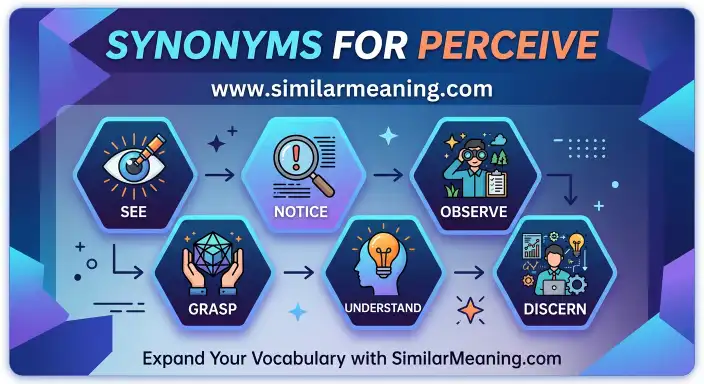
Perceive means to notice, recognize, or understand something through your senses or mind. For example, a student may perceive a teacher’s advice as helpful, while another student may perceive it as criticism. People use this word in everyday conversations, education, psychology, and professional writing.
Learning synonyms for perceive helps you express ideas clearly, improve your English vocabulary, and avoid repeating the same words. It also helps content writers choose accurate words for different situations. In this article, you will learn the meaning of perceive, its pronunciation, history, word forms, and 30 useful synonyms.
Each synonym includes a simple definition, American and British pronunciation, and example sentences to help you understand how to use it naturally.
Meaning of Perceive
Definition
Perceive (Verb): To notice, recognize, or understand something through your senses, thoughts, or experiences.
Examples
- I perceive a change in his attitude.
- Children often perceive the world differently from adults.
Connotative Meaning of Perceive
Connotation (the feeling or idea a word suggests beyond its basic meaning) depends on the context in which the word is used.
- Positive tone: Perceive can suggest awareness, insight, or a clear understanding.
- Negative tone: It can suggest a mistaken impression or an unfair judgment.
- Neutral tone: It can simply mean noticing or becoming aware of something.
Etymology of Perceive
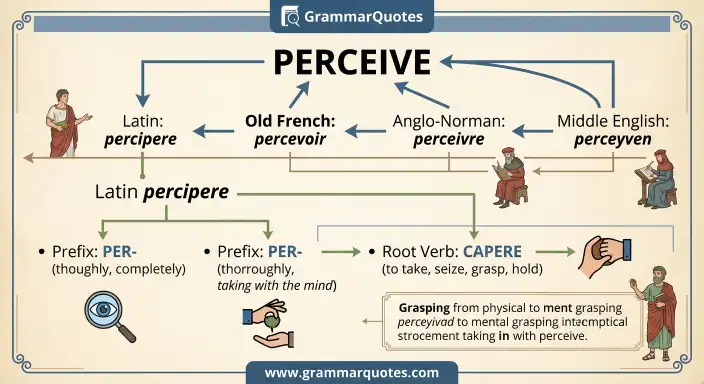
- Source language: Latin percipere, meaning “to take in,” “to grasp,” or “to understand.”
- French influence: Old French perceivre helped shape the English word.
- Original idea: Taking in information through the senses or the mind.
Short History of Perceive
- Old English (450–1100): The modern word perceive was not a regular part of Old English vocabulary. Other words expressed ideas such as seeing, noticing, and understanding.
- Middle English (1100–1500): The word entered English through French influence and became associated with noticing and understanding.
- Modern English (1500–Present): Perceive became common in everyday speech, literature, science, psychology, and academic writing.
Pronunciation of Perceive (US and UK)
- US IPA: /pərˈsiːv/
- UK IPA: /pəˈsiːv/
Syllables
per ceive
The word has two syllables, with the main stress on the second syllable.
Affixation Pattern of Perceive
- Root: ceive, connected historically with the Latin idea of taking or receiving.
- Prefix: per , part of the word’s historical formation.
- Suffix: None in the base verb perceive.
- Word formation: Perceive entered English through French from Latin.
Words Formed From Perceive
- Perceive (verb): To notice or understand something.
- Perceived (verb/adjective): Noticed or understood in a particular way.
- Perceives (verb): The third person singular form.
- Perceiving (verb): The present participle or gerund form.
- Perception (noun): The way something is noticed or understood.
- Perceptive (adjective): Quick to notice or understand things.
- Perceptively (adverb): In a way that shows good understanding.
- Perceptiveness (noun): The quality of noticing things clearly.
- Perceptual (adjective): Related to perception.
- Perceptible (adjective): Able to be noticed.
- Imperceptible (adjective): Too small or subtle to be noticed easily.
- Imperceptibly (adverb): In a way that is difficult to notice.
30 Synonyms for Perceive
1. Notice (Verb)
US IPA: /ˈnoʊtɪs/ | UK IPA: /ˈnəʊtɪs/
Meaning: To become aware of something by seeing, hearing, or observing it.
Examples:
- I noticed a small crack in the wall.
- Did you notice her new haircut?
2. Observe (Verb)
US IPA: /əbˈzɝːv/ | UK IPA: /əbˈzɜːv/
Meaning: To watch something carefully to gain information.
Examples:
- Scientists observe changes in the weather.
- She observed how the children worked together.
3. Recognize (Verb)
US IPA: /ˈrekəɡnaɪz/ | UK IPA: /ˈrekəɡnaɪz/
Meaning: To identify someone or something known from before.
Examples:
- I recognized his voice immediately.
- She recognized the importance of regular practice.
4. Realize (Verb)
US IPA: /ˈriːəlaɪz/ | UK IPA: /ˈrɪəlaɪz/
Meaning: To become aware of or understand something clearly.
Examples:
- I realized that I had made a mistake.
- He realized why the plan had failed.
5. Understand (Verb)
US IPA: /ˌʌndərˈstænd/ | UK IPA: /ˌʌndəˈstænd/
Meaning: To know the meaning of something or how it works.
Examples:
- I understand your concern.
- She understands the lesson very well.
6. Discern (Verb)
US IPA: /dɪˈsɝːn/ | UK IPA: /dɪˈsɜːn/
Meaning: To notice or recognize something that may be difficult to see or understand.
Examples:
- He could discern a faint sound in the distance.
- It was hard to discern the truth from the rumors.
7. Detect (Verb)
US IPA: /dɪˈtekt/ | UK IPA: /dɪˈtekt/
Meaning: To discover or notice something hidden or not obvious.
Examples:
- The machine can detect smoke.
- She detected a slight change in his voice.
8. Identify (Verb)
US IPA: /aɪˈdentɪfaɪ/ | UK IPA: /aɪˈdentɪfaɪ/
Meaning: To recognize or establish exactly what someone or something is.
Examples:
- The police identified the missing item.
- Can you identify the main problem?
9. See (Verb)
US IPA: /siː/ | UK IPA: /siː/
Meaning: To use your eyes or understand something mentally.
Examples:
- I can see a bird in the tree.
- Now I see why you were worried.
10. Sense (Verb)
US IPA: /sens/ | UK IPA: /sens/
Meaning: To feel or recognize something without always having clear proof.
Examples:
- I sensed that something was wrong.
- She sensed excitement in the crowd.
11. Feel (Verb)
US IPA: /fiːl/ | UK IPA: /fiːl/
Meaning: To experience a physical sensation or become aware of an emotion.
Examples:
- I feel the cold air on my face.
- He felt that the decision was unfair.
12. Appreciate (Verb)
US IPA: /əˈpriːʃieɪt/ | UK IPA: /əˈpriːʃieɪt/
Meaning: To recognize the value, importance, or quality of something.
Examples:
- I appreciate your honest advice.
- She appreciates the effort her team makes.
13. Comprehend (Verb)
US IPA: /ˌkɑːmprɪˈhend/ | UK IPA: /ˌkɒmprɪˈhend/
Meaning: To understand something fully.
Examples:
- The students struggled to comprehend the passage.
- He could not comprehend the scale of the problem.
14. Interpret (Verb)
US IPA: /ɪnˈtɝːprət/ | UK IPA: /ɪnˈtɜːprɪt/
Meaning: To explain or understand the meaning of something.
Examples:
- People may interpret the message differently.
- She interpreted his silence as disagreement.
15. Infer (Verb)
US IPA: /ɪnˈfɝː/ | UK IPA: /ɪnˈfɜː/
Meaning: To reach a conclusion based on evidence or clues.
Examples:
- We can infer the answer from the details.
- He inferred that she was tired from her expression.
16. Discover (Verb)
US IPA: /dɪˈskʌvər/ | UK IPA: /dɪˈskʌvə/
Meaning: To find or learn something that was not known before.
Examples:
- They discovered a new way to solve the problem.
- I discovered that the shop closes early.
17. Acknowledge (Verb)
US IPA: /əkˈnɑːlɪdʒ/ | UK IPA: /əkˈnɒlɪdʒ/
Meaning: To accept or show that something exists or is true.
Examples:
- He acknowledged the risks of the plan.
- She acknowledged that her answer was incorrect.
18. Register (Verb)
US IPA: /ˈredʒɪstər/ | UK IPA: /ˈredʒɪstə/
Meaning: To be noticed or understood by the mind or senses.
Examples:
- The warning did not register with him at first.
- Her words slowly registered in my mind.
19. Apprehend (Verb)
US IPA: /ˌæprɪˈhend/ | UK IPA: /ˌæprɪˈhend/
Meaning: To understand or grasp an idea, often with some difficulty.
Examples:
- The students struggled to apprehend the theory.
- She quickly apprehended the meaning of the message.
20. Grasp (Verb)
US IPA: /ɡræsp/ | UK IPA: /ɡrɑːsp/
Meaning: To understand something clearly.
Examples:
- He grasped the main idea quickly.
- I finally grasped how the system works.
21. Witness (Verb)
US IPA: /ˈwɪtnəs/ | UK IPA: /ˈwɪtnəs/
Meaning: To see an event happen.
Examples:
- We witnessed a beautiful sunrise.
- She witnessed the disagreement between the two friends.
22. Behold (Verb)
US IPA: /bɪˈhoʊld/ | UK IPA: /bɪˈhəʊld/
Meaning: To see or look at something, often with wonder or attention.
Examples:
- The visitors beheld the ancient building.
- We beheld the mountains in the morning light.
23. Make Out (Phrasal Verb)
US IPA: /meɪk aʊt/ | UK IPA: /meɪk aʊt/
Meaning: To see, hear, or understand something that is difficult to distinguish.
Examples:
- I could barely make out the sign in the fog.
- She could make out a voice from the next room.
24. Take In (Phrasal Verb)
US IPA: /teɪk ɪn/ | UK IPA: /teɪk ɪn/
Meaning: To absorb or understand information, sights, or experiences.
Examples:
- It took me a moment to take in the news.
- The visitors stopped to take in the view.
25. Make Sense of (Phrase)
US IPA: /meɪk sens əv/ | UK IPA: /meɪk sens əv/
Meaning: To understand something that seems confusing.
Examples:
- I tried to make sense of the instructions.
- She made sense of the complicated report.
26. Become Aware (Verb Phrase)
US IPA: /bɪˈkʌm əˈwer/ | UK IPA: /bɪˈkʌm əˈweə/
Meaning: To begin to know or notice that something exists or is happening.
Examples:
- He became aware of the noise outside.
- She became aware of the impact of her words.
27. View (Verb)
US IPA: /vjuː/ | UK IPA: /vjuː/
Meaning: To consider or understand someone or something in a particular way.
Examples:
- Many people view education as a path to opportunity.
- She viewed the change as a chance to learn.
28. Consider (Verb)
US IPA: /kənˈsɪdər/ | UK IPA: /kənˈsɪdə/
Meaning: To think carefully about something or regard it in a particular way.
Examples:
- We considered every possible solution.
- She considers him a reliable friend.
29. Detect (Verb: Notice a Sign)
US IPA: /dɪˈtekt/ | UK IPA: /dɪˈtekt/
Meaning: To become aware of a sign or change that is not immediately obvious.
Examples:
- The doctor detected a small change.
- I detected doubt in his answer.
30. Perceive as (Verb Phrase)
US IPA: /pərˈsiːv æz/ | UK IPA: /pəˈsiːv æz/
Meaning: To understand or regard someone or something in a particular way.
Examples:
- Many people perceive her as a strong leader.
- He perceived the comment as an insult.
Prototype Meaning of Perceive
The most typical meaning of perceive is to notice or become aware of something through the senses or the mind. People often imagine someone seeing a change, hearing a sound, sensing an emotion, or understanding a situation. For example, a teacher may perceive that a student is confused by noticing the student’s expression. The word can also describe how people interpret events based on their beliefs and experiences. Its central idea is becoming aware of something, if through direct observation or mental understanding.
Prototype Categorization of Perceive
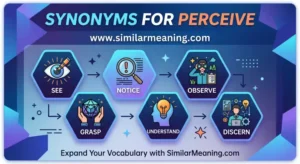
Synonyms for perceive can be grouped according to their main meanings.
- Noticing and observation: Notice, observe, see, witness, and detect. These words focus on becoming aware of something.
- Understanding and comprehension: Understand, comprehend, grasp, and apprehend. These words focus on knowing what something means.
- Recognition and identification: Recognize and identify. These words describe knowing who or what something is.
- Senses and intuition: Sense and feel. These words describe awareness through physical sensations or intuitive feelings.
- Interpretation and reasoning: Interpret, infer, and make sense of. These words focus on explaining meaning or drawing conclusions.
- Discovery and awareness: Discover, register, and become aware. These words describe learning about something or noticing it.
- Value and viewpoint: Appreciate, consider, and view. These words describe recognizing importance or forming an opinion.
Grouping synonyms helps writers choose the right word for each situation. For example, notice works well for a small detail, comprehend suits a difficult idea, and infer is useful when a conclusion comes from clues.
Antonyms of Perceive
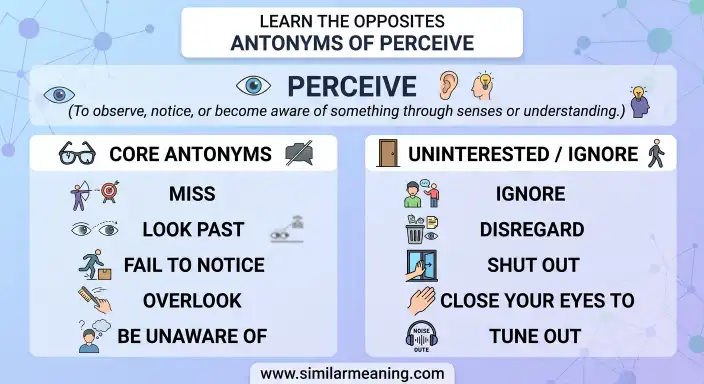
Antonyms are words with opposite or contrasting meanings. The best choice depends on if perceive means noticing, understanding, or recognizing something.
- Overlook (verb): To fail to notice something. Example: She overlooked an important detail.
- Miss (verb): To fail to see, hear, or notice something. Example: I missed the sign on the door.
- Ignore (verb): To pay no attention to something. Example: He ignored the warning.
- Misunderstand (verb): To understand something incorrectly. Example: I misunderstood the teacher’s instructions.
- Misinterpret (verb): To understand a message or action in the wrong way. Example: She misinterpreted his comment.
- Disregard (verb): To treat something as unimportant or pay no attention to it. Example: They disregarded the advice.
- Misread (verb): To read or interpret something incorrectly. Example: He misread her expression.
- Remain unaware (verb phrase): To continue not knowing about something. Example: They remained unaware of the change.
- Neglect (verb): To fail to give proper attention to something. Example: The team neglected an important warning.
- Confuse (verb): To make something difficult to understand. Example: The unclear instructions confused the students.
Short Questions and Answers
- What does perceive mean?
Perceive means to notice, recognize, or understand something through the senses or the mind. - When should perceive be used?
Use perceive when describing how someone notices something or understands a person, event, or situation. - Is perceive positive or negative?
The word is usually neutral. Its tone depends on the situation and the judgment being described. - How is perceive different from similar words?
Notice focuses on awareness, understand focuses on meaning, and infer focuses on reaching a conclusion from evidence.
Conclusion
Learning the meaning of perceive and its synonyms can improve your English vocabulary and help you express ideas with greater accuracy. Words such as notice, recognize, understand, and discern may look similar, but each has a different use.
Choosing the right synonym makes your writing clearer, strengthens your speaking skills, and helps you avoid repetition. It also allows you to describe thoughts, feelings, observations, and judgments in a more natural way. English learners and content writers can benefit from practicing these words in real sentences.
Read a few examples each day, learn their pronunciation, and use new words in your own writing. With regular practice, you can build confidence and communicate more effectively.
Discover More Articles!
Synonyms for Proceeded: 30 Powerful Words to Improve Your Vocabulary
Synonyms of Stated: 30 Powerful Words to Improve Your Vocabulary
Synonyms for Opened: 30 Powerful Words to Improve Your Vocabulary

Justin Cord Hayes is an Adams Media author and co-author of several vocabulary and thesaurus books. His work focuses on synonyms, antonyms, word choice, and expanding English vocabulary. He co-authored Roget’s Thesaurus of Words for Writers, Roget’s Thesaurus of Words for Students, and Roget’s Thesaurus of Words for Intellectuals. His books are designed to help readers find clearer and more effective words for writing and communication.


2 thoughts on “Synonyms for Perceive: Best Words to Improve Your Vocabulary”