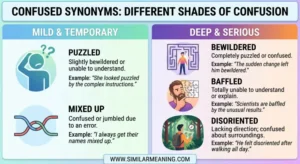
Common confused synonyms include puzzled, bewildered, perplexed, unsure, uncertain, and baffled. These words describe different forms of confusion, but they do not all express the same feeling. Some suggest a lack of understanding, while others describe doubt, uncertainty, or emotional distress.
For example, you may feel puzzled by a difficult question, uncertain about an important decision, or bewildered by an unexpected situation. Choosing the right word helps you explain exactly what you mean.
The best synonym also depends on the context. In everyday conversation, unsure and puzzled sound natural. In academic writing, perplexed may fit better. A story, bewildered can show that a character feels completely lost or overwhelmed.
This guide explores 30 useful synonyms for confused, including their meanings, examples, and differences. You will also learn how to choose the right word for daily conversations, professional writing, emotional situations, and creative work.
Confused Synonyms: Quick Answer
The best synonyms for confused include puzzled, bewildered, perplexed, baffled, unsure, uncertain, disoriented, and mixed up.
Use puzzled when something is difficult to understand, unsure when you lack confidence or certainty, and bewildered when a situation leaves you deeply confused. For formal writing, perplexed and uncertain can be useful alternatives.
What Does Confused Mean?
Confused is an adjective that describes a person who does not understand something clearly, feels uncertain, or struggles to make sense of a situation.
It can describe a temporary lack of understanding, difficulty making a decision, or a feeling of being mentally overwhelmed.
1. Confused Means Unable to Understand Something
A person may feel confused when information is unclear or difficult to follow.
Example: I was confused by the teacher’s explanation.
This means the explanation was difficult for the speaker to understand.
2. Confused Means Unsure About a Decision
The word can also describe someone who does not know what choice to make.
Example: She felt confused about which course to choose.
Here, confused expresses uncertainty about a decision.
3. Confused Means Mentally or Emotionally Unsettled
Sometimes confusion comes from an unexpected event or mixed emotions.
Example: He looked confused when everyone changed the plan.
The person may be struggling to understand what is happening or why it happened.
Remember: Confused can refer to a lack of understanding, uncertainty, or difficulty processing a situation. The best synonym depends on which meaning you want to express.
30 Best Confused Synonyms and Their Meanings
The following words offer different ways to express confusion. Each one has a slightly different meaning or tone.
Common Confused Synonyms
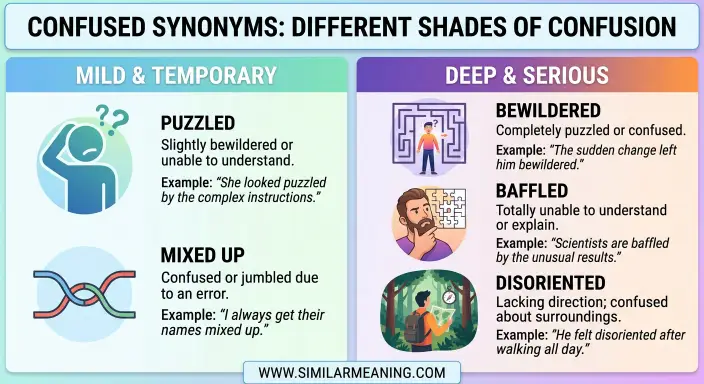
<text>1. Puzzled</text>
Meaning: Unable to understand something easily or explain why it happened.
Example: I was puzzled by his unusual answer.
Best for: Everyday conversations and questions that are difficult to understand.
<text>2. Bewildered</text>
Meaning: Completely confused by something unexpected or difficult to understand.
Example: She looked bewildered when the instructions suddenly changed.
Best for: Strong confusion caused by surprising or complicated situations.
<text>3. Perplexed</text>
Meaning: Confused because something is difficult to explain or solve.
Example: The researcher was perplexed by the unexpected results.
Best for: Formal writing, academic discussions, and thoughtful descriptions.
<text>4. Baffled</text>
Meaning: Completely unable to understand something.
Example: We were baffled by the strange computer error.
Best for: Problems or events that seem impossible to explain.
<text>5. Uncertain</text>
Meaning: Not sure about something or unable to predict what will happen.
Example: He was uncertain about his final decision.
Best for: Choices, predictions, and situations with unclear outcomes.
Synonyms for Doubt and Uncertainty
These words work when confusion involves hesitation, doubt, or a lack of confidence.
<text>11. Doubtful</text>
Meaning: Feeling uncertain about if something is true or likely to happen.
Example: She was doubtful about the accuracy of the report.
Best for: Questions of truth, reliability, or possibility.
<text>12. Hesitant</text>
Meaning: Slow to act or speak because of uncertainty or nervousness.
Example: He was hesitant to accept the offer.
Best for: Decisions and actions that require confidence.
<text>13. Indecisive</text>
Meaning: Unable to make a decision easily.
Example: I became indecisive when choosing between the two universities.
Best for: Situations involving multiple choices.
<text>14. Ambivalent</text>
Meaning: Having mixed or conflicting feelings about something.
Example: She felt ambivalent about moving to another city.
Best for: Emotional situations in which a person has both positive and negative feelings.
<text>15. Skeptical</text>
Meaning: Doubting if something is true, reasonable, or trustworthy.
Example: The manager was skeptical of the unusual claim.
Best for: Evaluating claims, evidence, and information.
<text>16. Unsettled</text>
Meaning: Feeling uncertain, uneasy, or not mentally at ease.
Example: I felt unsettled by the sudden change in plans.
Best for: Situations that cause uncertainty or discomfort.
<text>17. Tentative</text>
Meaning: Not fully certain, confident, or final.
Example: We made a tentative plan for the weekend.
Best for: Preliminary decisions, suggestions, and arrangements.
<text>18. Undecided</text>
Meaning: Not having made a final choice.
Example: He was still undecided about which subject to study.
Best for: Choices that have not yet been settled.
Synonyms for Deep or Intense Confusion
These words express stronger confusion or difficulty understanding a situation.
<text>19. Nonplussed</text>
Meaning: So surprised or confused that you do not know how to respond.
Example: She was nonplussed by the unexpected question.
Best for: Formal or literary descriptions of surprise and confusion. Note that the word’s usage can vary, and some speakers also use it to mean unfazed.
<text>20. At a Loss</text>
Meaning: Unable to understand what to do or say.
Example: I was at a loss for words after hearing the news.
Best for: Situations in which someone cannot find an answer or response.
<text>21. Stumped</text>
Meaning: Unable to solve a problem or answer a question.
Example: The difficult riddle left the whole class stumped.
Best for: Puzzles, questions, and challenging problems.
<text>22. Flummoxed</text>
Meaning: Completely confused or puzzled.
Example: The complicated directions flummoxed the travelers.
Best for: Informal or expressive writing.
<text>23. Muddled</text>
Meaning: Confused, disorganized, or not clearly thought out.
Example: His explanation became muddled halfway through.
Best for: Ideas, explanations, thinking, and plans that lack clarity.
<text>24. Disconcerted</text>
Meaning: Unsettled or confused by something unexpected.
Example: She seemed disconcerted by the sudden criticism.
Best for: Situations involving surprise, discomfort, or loss of composure.
Informal and Context Specific Alternatives
<text>25. Mixed Up</text>
Meaning: Confused about facts, details, or arrangements.
Example: I got the dates mixed up.
Best for: Casual conversations and simple everyday mistakes.
<text>26. Perplexing</text>
Meaning: Difficult to understand or explain.
Example: The case presented a perplexing problem.
Best for: Formal descriptions of confusing questions or situations.
<text>27. Unclear</text>
Meaning: Not easy to understand or interpret.
Example: The instructions were unclear.
Best for: Describing information, messages, rules, or explanations.
<text>28. Discombobulated</text>
Meaning: Confused or thrown into a state of disorder.
Example: I felt discombobulated after the schedule changed three times.
Best for: Informal, humorous, or expressive writing.
<text>29. Foggy</text>
Meaning: Not clear or easy to think about; often used informally for unclear thoughts or memory.
Example: My thinking felt foggy after a long day.
Best for: Informal descriptions of unclear thinking. It is not an exact substitute for confused in every context.
<text>30. At Sea</text>
Meaning: Unsure about what to do or how to understand something.
Example: I was at sea when I first used the new software.
Best for: Informal expressions of uncertainty or lack of direction.
Confused Synonyms by Context
Different situations call for different words. Use this table to choose a synonym that fits your meaning.
| Context | Best synonyms | Example |
| Difficult question | Puzzled, baffled, stumped | I was stumped by the final question. |
| Complicated explanation | Perplexed, muddled | The explanation left us perplexed. |
| Difficult decision | Unsure, uncertain, undecided | She was unsure about her choice. |
| Mixed emotions | Ambivalent, unsettled | He felt ambivalent about the move. |
| Unexpected event | Bewildered, mystified | They were bewildered by the sudden announcement. |
| Stressful situation | Flustered, disconcerted | I became flustered during the interview. |
| Unclear information | Unclear, muddled | The instructions were unclear. |
| Informal conversation | Mixed up, stumped, at a loss | I’m mixed up about the dates. |
Tip: Choose the word that explains why the person feels confused. This makes your writing more precise.
Confused Synonyms for Different Writing Styles
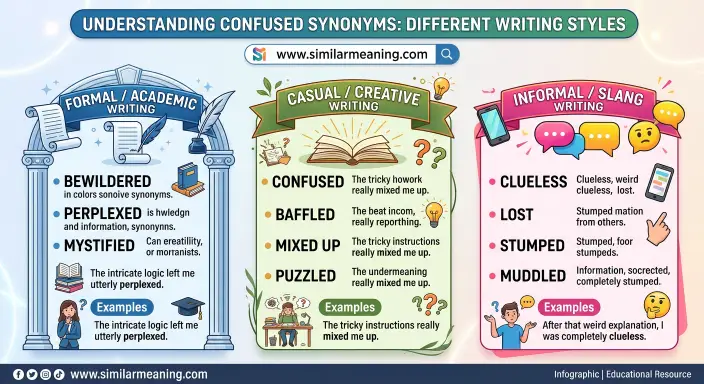
1. Everyday Conversation
In casual speech, simple words often sound more natural than formal alternatives.
Try puzzled, unsure, mixed up, or stumped.
Example: I’m a little confused about where we are meeting.
You could also write:
I’m not sure where we’re meeting.
The second sentence sounds natural and direct.
2. Academic Writing
In essays, reports, or research discussions, perplexed, uncertain, and unclear can help express specific problems.
Example: The researchers were perplexed by the unexpected findings.
Alternatively:
The results remained unclear.
Notice that perplexed describes the researchers, while unclear describes the results.
3. Business and Professional Writing
For professional communication, it is often better to identify what needs clarification rather than simply saying you are confused.
Example: I am uncertain about the deadline stated in the email.
A clearer workplace alternative is:
Could you clarify the deadline mentioned in the email?
This approach identifies the problem and asks for useful information.
4. Creative Writing
Writers can use bewildered, mystified, flummoxed, or disconcerted to create different moods.
Example: The traveler stood bewildered in the unfamiliar city.
This sentence conveys stronger confusion than “The traveler was unsure.”
5. Emotional Situations
When someone has mixed feelings, ambivalent may be more accurate than confused.
Example: She felt ambivalent about accepting the invitation.
This means she had conflicting feelings, not simply that she failed to understand the invitation.
Common Mistakes When Using Confused Synonyms
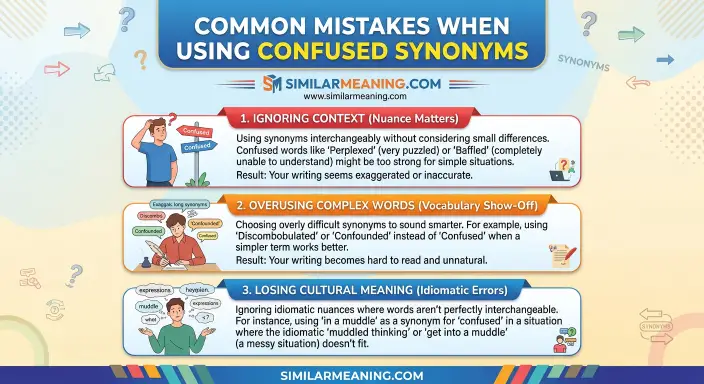
Mistake 1: Treating Every Synonym as an Exact Match
Words such as uncertain, puzzled, and ambivalent describe different situations.
Incorrect choice: He was ambivalent about how to solve the math problem.
This may be unsuitable if he simply cannot understand the problem.
Better: He was puzzled by the math problem.
Use ambivalent when someone has mixed feelings about a decision or situation.
Mistake 2: Confusing “Confused” With “Confusing”
These words have different grammatical roles and meanings.
- Confused: Describes the person experiencing confusion.
- Confusing: Describes something that causes confusion.
Example: I was confused by the confusing instructions.
The person feels confused, while the instructions are confusing.
Mistake 3: Using Formal Words in Casual Conversations
Words such as perplexed, nonplussed, and discombobulated may sound overly formal or unusual in simple everyday speech.
Instead of saying:
I am utterly perplexed by this message.
You could say:
I’m confused by this message.
Choose vocabulary that matches your audience and tone.
Mistake 4: Using “Skeptical” When You Mean “Confused”
Skeptical means you doubt a claim or are not convinced that it is true.
Example: She was skeptical of the advertisement’s promises.
This does not necessarily mean she failed to understand the advertisement. She may understand it perfectly but doubt its claims.
Mistake 5: Using “Indecisive” for Every Uncertain Feeling
Indecisive usually describes difficulty making choices.
Example: He was indecisive about which phone to buy.
If the person does not understand the phone’s instructions, confused or puzzled may be more appropriate.
Memory tip: Match the synonym to the cause of confusion: lack of understanding, uncertainty, mixed feelings, or difficulty making a decision.
Everyday Examples of Confused Synonyms
1. Daily Conversation
- I was puzzled by his answer.
- I’m unsure about the meeting time.
- She looked bewildered when the lights went out.
- I’m mixed up about which bus to take.
These examples use natural expressions for everyday situations.
2. School and Academic Writing
- The student was perplexed by the difficult equation.
- The instructions were unclear.
- The class was stumped by the final riddle.
- The researcher remained uncertain about the conclusion.
Each example describes a different type of difficulty.
3. Emails and Business Writing
- I am uncertain about the proposed schedule.
- Could you clarify this point?
- The report contains a few unclear statements.
- We are still undecided about the final design.
These sentences are useful when discussing details, decisions, and information at work.
4. Stories and Creative Writing
- The traveler was bewildered by the unfamiliar surroundings.
- The mysterious message left her mystified.
- He stood at a loss for words.
- The complicated puzzle left everyone flummoxed.
These alternatives help writers express different levels of confusion.
5. Social Media and Informal Messages
- I’m so confused right now.
- That explanation has me stumped.
- I’m a little mixed up about the plans.
- I’m still unsure what to choose.
For short posts and casual messages, simple language is often the clearest option.
Quick Comparison Table: Confused Synonyms
| Word | Main meaning | Tone | Example |
| Puzzled | Unable to understand something | Neutral | I was puzzled by the question. |
| Bewildered | Deeply confused | Strong or expressive | He looked bewildered. |
| Perplexed | Finding something difficult to explain | Formal | The team was perplexed. |
| Baffled | Completely unable to understand | Direct | We were baffled by the error. |
| Unsure | Not confident or certain | Everyday | I’m unsure about the answer. |
| Uncertain | Lacking certainty | Neutral or formal | The outcome remains uncertain. |
| Ambivalent | Having mixed feelings | Formal | She felt ambivalent about moving. |
| Flustered | Confused or nervous under pressure | Emotional | He became flustered. |
| Stumped | Unable to solve or answer something | Informal | The riddle stumped me. |
| Muddled | Confused or lacking clarity | Neutral | His thoughts were muddled. |
Key Takeaways
- Puzzled, perplexed, bewildered, and baffled are common synonyms for confused.
- Use unsure or uncertain when you lack confidence or certainty.
- Use ambivalent when you have mixed feelings.
- Use stumped when you cannot solve a problem or answer a question.
- Confused describes the person experiencing confusion; confusing describes what causes it.
- Words such as perplexed and bewildered can sound stronger or more formal than confused.
- Choose synonyms based on meaning, context, and tone rather than replacing words without considering their differences.
Frequently Asked Questions
1. What are the best synonyms for confused?
Some of the best synonyms are puzzled, bewildered, perplexed, baffled, unsure, and uncertain. The best choice depends on the situation. Use puzzled for something difficult to understand and uncertain when you do not know what will happen or which option is correct.
2. What is a stronger word for confused?
Bewildered and baffled are strong alternatives. Bewildered suggests deep confusion, often caused by an unexpected situation. Baffled emphasizes being unable to understand or explain something. For example, “The team was baffled by the mysterious error.”
3. What is a formal synonym for confused?
Perplexed is a useful formal synonym. Uncertain and unclear can also work, depending on the sentence. For example, “The researchers were perplexed by the findings” sounds suitable for formal writing.
4. What is a simple word for confused?
Puzzled and unsure are simple, natural alternatives. Use puzzled when something does not make sense and unsure when you lack confidence or certainty. Both work well in everyday conversations.
5. What is the difference between confused and perplexed?
Both words describe difficulty understanding something. However, perplexed often sounds more formal and emphasizes a problem that is difficult to explain or solve. Confused is more common and can describe a wider range of situations.
6. What is the difference between confused and bewildered?
Confused is a general term for a lack of understanding or certainty. Bewildered usually describes stronger confusion, often caused by something unexpected or overwhelming. For example, someone may be confused by directions but bewildered by a sudden, unexplained change.
7. What is a synonym for confused in a relationship?
Words such as uncertain, conflicted, ambivalent, and unsure may fit when someone has doubts or mixed feelings about a relationship. Ambivalent is especially useful when a person feels both positive and negative emotions about the same situation.
8. What is the difference between confused and confusing?
Confused describes the person who does not understand something, while confusing describes the thing that causes the difficulty. For example, “I was confused by the confusing instructions.” The person is confused, and the instructions are confusing.
9. What is a synonym for confused in academic writing?
Perplexed, uncertain, and unclear are useful options in academic writing. Use perplexed for a person who struggles to explain a result, uncertain for a lack of confidence, and unclear for information that is difficult to understand.
10. What is the difference between confused and indecisive?
Confused often means that someone does not understand something clearly. Indecisive means that someone struggles to make a choice. A person may be indecisive about which course to choose even when they understand all the available options.
Conclusion: Choosing the Right Confused Synonym
There are many ways to express confusion in English, but the best synonym depends on what you want to communicate. Puzzled, bewildered, perplexed, and baffled describe different levels or types of difficulty understanding something. Words such as unsure, uncertain, and undecided focus more on doubt and decision making.
If you want to describe mixed feelings, ambivalent may be more precise. If someone cannot solve a problem, stumped is a natural informal choice. For formal writing, perplexed can add precision, while unclear works well when describing information rather than a person.
The key is to understand each word’s meaning before using it. A good synonym should make your sentence clearer and more natural, not simply make it sound more complicated.
Choose the word that explains the kind of confusion you mean, and your writing will become more precise, expressive, and effective.
Discover More Articles!
Rain Heavily Synonyms: 25 Ways to Describe Heavy Rain
Criticism Synonyms: 30 Words to Express Opinions Clearly
Sweetheart Synonyms: 30 Words for Every Meaning

Justin Cord Hayes is an Adams Media author and co-author of several vocabulary and thesaurus books. His work focuses on synonyms, antonyms, word choice, and expanding English vocabulary. He co-authored Roget’s Thesaurus of Words for Writers, Roget’s Thesaurus of Words for Students, and Roget’s Thesaurus of Words for Intellectuals. His books are designed to help readers find clearer and more effective words for writing and communication.