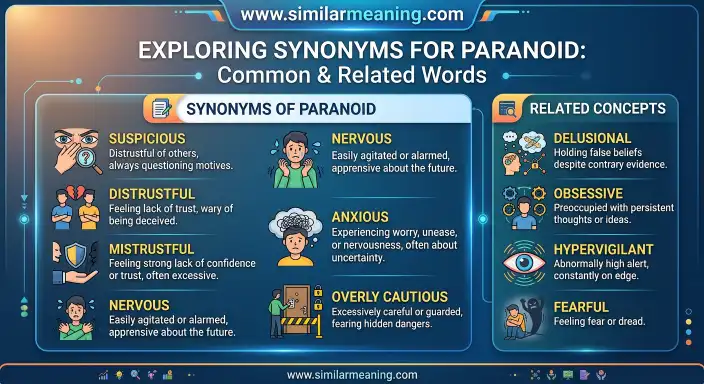
Paranoid synonyms are words that describe excessive suspicion, fear, distrust, or the feeling that others may be trying to harm or deceive someone. Common synonyms for paranoid include suspicious, distrustful, mistrustful, wary, apprehensive, and fearful.
However, each word has a slightly different meaning. For example, suspicious suggests that something seems wrong, while wary means being careful because of a possible risk. Distrustful describes a lack of trust in other people.
Choosing the right synonym depends on the situation. In everyday conversation, you might use overly suspicious to describe someone who doubts others without enough evidence. In professional writing, mistrustful or apprehensive may communicate the intended meaning more precisely. Some words, such as anxious and fearful, focus more on worry than suspicion.
This guide explores 30 synonyms for paranoid, explains their meanings, groups them by context, and provides useful examples. if you are writing an essay, improving your vocabulary, or looking for a more natural alternative, these words can help you express suspicion and fear clearly.
Quick Answer: What Are the Best Synonyms for Paranoid?
The best synonyms for paranoid include suspicious, distrustful, mistrustful, wary, apprehensive, fearful, and overly suspicious. The closest choice depends on if you mean distrust, fear, or excessive suspicion.
| Synonym | Meaning | Example |
| Suspicious | Believing something may be wrong | He became suspicious of the offer. |
| Distrustful | Unwilling to trust others | She was distrustful of strangers. |
| Mistrustful | Doubting someone’s honesty | He remained mistrustful of their promises. |
| Wary | Careful because of possible danger | They were wary of the unfamiliar road. |
| Apprehensive | Worried about what may happen | She felt apprehensive before the meeting. |
| Fearful | Feeling afraid | He was fearful of being misunderstood. |
| Overly suspicious | Doubting others too much | He became overly suspicious of harmless comments. |
Best overall synonym: Suspicious is a useful general alternative, while distrustful is more specific when the main idea is a lack of trust.
What Does Paranoid Mean?
Paranoid is an adjective used to describe someone who feels excessively suspicious, threatened, or worried that other people may be acting against them. In casual conversation, it can also describe unnecessary fear about a situation.
The word is often used informally, but it can also have a more specific meaning in mental health contexts. It is important not to label someone as paranoid simply because they are cautious, worried, or disagree with others.
Definition of Paranoid
According to its general everyday meaning, paranoid describes excessive suspicion or fear that others may intend harm, deceive someone, or act unfairly toward them.
Examples:
- He became paranoid when he thought everyone was discussing him.
- She felt paranoid about sharing personal information online.
- I was being paranoid about missing the train, even though I had plenty of time.
In these examples, the word communicates suspicion or worry that may be stronger than the situation requires.
Paranoid: Synonyms and Meaning
Different synonyms highlight different parts of the word’s meaning.
- Suspicious: Believing something may be wrong or dishonest.
- Distrustful: Finding it difficult to trust people.
- Mistrustful: Doubting another person’s honesty or intentions.
- Wary: Being careful because a risk may exist.
- Apprehensive: Feeling worried about a future event.
- Fearful: Experiencing fear or concern.
- Overly suspicious: Doubting others more than the available evidence supports.
These words are related, but they are not always interchangeable. A person can be wary without being paranoid, and someone can be fearful without suspecting anyone of wrongdoing.
30 Best Synonyms for Distrustful
Here are 30 words and phrases that can replace paranoid in suitable contexts. Some are close synonyms, while others describe a related feeling or behavior.
| No. | Synonym | Meaning |
| 1 | Suspicious | Doubting if something is honest or safe |
| 2 | Distrustful | Unwilling to trust other people |
| 3 | Mistrustful | Doubting someone’s honesty or intentions |
| 4 | Wary | Careful because of possible risk |
| 5 | Apprehensive | Worried about what may happen |
| 6 | Fearful | Feeling afraid |
| 7 | Doubtful | Unsure if something is true |
| 8 | Uneasy | Feeling uncomfortable or worried |
| 9 | Anxious | Feeling nervous or concerned |
| 10 | Guarded | Careful about sharing thoughts or information |
| 11 | Cautious | Taking care to avoid danger or mistakes |
| 12 | Skeptical | Not easily convinced without evidence |
| 13 | Insecure | Lacking confidence or feeling uncertain |
| 14 | Concerned | Worried about a possible problem |
| 15 | Nervous | Feeling tense or uneasy |
| 16 | Defensive | Acting to protect oneself from criticism or threat |
| 17 | Jumpy | Easily startled or nervous |
| 18 | Overcautious | More careful than necessary |
| 19 | Overly suspicious | Doubting others excessively |
| 20 | Suspicious minded | Inclined to suspect others |
| 21 | Distrusting | Showing a lack of trust |
| 22 | Untrusting | Not readily placing trust in others |
| 23 | Watchful | Paying close attention for possible danger |
| 24 | On guard | Alert and prepared for a possible threat |
| 25 | Doubting | Questioning if something is true |
| 26 | Fear ridden | Strongly affected by fear |
| 27 | Alarmed | Suddenly worried or frightened |
| 28 | Troubled | Disturbed or worried |
| 29 | Trepidatious | Nervous or apprehensive about what lies ahead |
| 30 | Convinced of danger | Believing a threat exists, if or not the evidence supports it |
Important: These words have different shades of meaning. Suspicious, distrustful, and mistrustful are among the closest alternatives when the intended meaning is distrust. Words such as nervous, concerned, and cautious may describe related feelings without implying excessive suspicion.
Synonyms for Paranoid Based on Context
The best synonym depends on what you want to communicate. Grouping words by meaning can make your writing more precise.
1. Synonyms for Paranoid Meaning Suspicious
Use these words when someone doubts another person’s intentions or believes something may be wrong.
- Suspicious: He was suspicious of the unexpected message.
- Distrustful: She remained distrustful of the stranger.
- Mistrustful: They were mistrustful of the sudden offer.
- Skeptical: I was skeptical of the promise because it sounded unrealistic.
- Suspicious minded: His suspicious minded approach made cooperation difficult.
These words are useful in stories, discussions about relationships, and descriptions of uncertain situations.
2. Synonyms for Paranoid Meaning Fearful or Anxious
These alternatives emphasize worry or fear rather than distrust.
- Apprehensive: She felt apprehensive about the interview.
- Fearful: He was fearful of making a serious mistake.
- Anxious: I felt anxious while waiting for the result.
- Uneasy: Something about the conversation made her uneasy.
- Nervous: He was nervous before speaking to the group.
- Trepidatious: She was trepidatious about starting a new job.
These words are suitable when a person feels worried but is not necessarily suspicious of others.
3. Synonyms for Paranoid Meaning Cautious
Sometimes people described as paranoid are simply being careful. In such cases, a less negative word may be more appropriate.
- Wary: The travelers were wary of unfamiliar offers.
- Cautious: He was cautious when sharing financial information.
- Guarded: She was guarded when discussing her private life.
- Watchful: The security team remained watchful throughout the event.
- Overcautious: He was overcautious about checking every detail.
- On guard: The team stayed on guard against possible mistakes.
These words can describe sensible caution as well as excessive concern, depending on the context.
4. Synonyms for Paranoid Meaning Distrustful
When the main idea is difficulty trusting other people, these words may fit better.
- Distrustful: He was distrustful of people he had just met.
- Mistrustful: She became mistrustful after several broken promises.
- Untrusting: He was untrusting of strangers.
- Distrusting: The character was distrusting of anyone offering help.
- Suspicious: They were suspicious of the unexplained changes.
Use distrustful or mistrustful when you want to emphasize a lack of confidence in someone’s honesty or intentions.
5. Synonyms for Paranoid in Informal Writing
In casual conversations, people may use simpler expressions instead of paranoid.
- Overthinking: You’re overthinking what that message means.
- Overly suspicious: He was overly suspicious of a harmless joke.
- Jumpy: She felt jumpy after hearing the sudden noise.
- On edge: I was on edge while waiting for the announcement.
- Too worried: He was too worried about a small mistake.
These phrases are often more natural in everyday conversation, but their meanings are not identical to paranoid.
Positive and Negative Alternatives to Paranoid
Not every synonym has the same emotional tone. Some words suggest sensible care, while others suggest excessive worry or distrust.
| More neutral or positive | More negative or intense |
| Cautious | Overly suspicious |
| Wary | Distrustful |
| Watchful | Suspicious minded |
| Skeptical | Fear ridden |
| Careful | Excessively fearful |
| Guarded | Mistrustful |
| Alert | Paranoid |
For example, saying someone is cautious may suggest that they think carefully before making a decision. Calling them overly suspicious suggests that they may doubt others without sufficient reason.
Which Word Sounds More Polite?
If you want to describe someone without sounding harsh, consider using cautious, wary, uneasy, or concerned, provided the word accurately reflects the situation.
Examples:
- Harsh: He is paranoid about every email.
- More neutral: He is cautious about opening unfamiliar emails.
- Harsh: She is paranoid that everyone is judging her.
- More neutral: She feels uneasy in situations where she thinks others may judge her.
The best word is the one that describes the behavior accurately without making an unfair judgment about the person.
Common Mistakes When Using Paranoid Synonyms
Although many synonyms for paranoid are related, they do not all mean the same thing. Using the wrong word can change the tone or meaning of a sentence.
| Common mistake | Better choice | Why |
| Using cautious to mean excessive suspicion | Overly suspicious | Cautious often describes reasonable care |
| Using anxious when distrust is the main idea | Distrustful | Anxiety emphasizes worry, not necessarily mistrust |
| Using skeptical to describe every fear | Suspicious or fearful, depending on context | Skepticism involves questioning claims |
| Using fearful when someone doubts another’s honesty | Mistrustful | Mistrust focuses on confidence in others |
| Treating guarded and paranoid as identical | Choose based on context | Guarded describes careful behavior or limited openness |
Mistake 1: Confusing Suspicious With Anxious
Suspicious means that someone doubts something or believes there may be a hidden problem. Anxious means that someone feels worried or nervous.
- Suspicious: She was suspicious of the stranger’s explanation.
- Anxious: She was anxious about the upcoming interview.
Mistake 2: Confusing Cautious With Paranoid
A cautious person takes sensible steps to reduce risk. The word paranoid usually suggests excessive suspicion or fear.
- Cautious: He checked the website before entering his details.
- Overly suspicious: He doubted every website, even familiar and reliable ones.
Mistake 3: Using a Strong Word When a Mild One Is Better
Calling someone paranoid may sound judgmental. If the person is simply uncertain, uneasy, concerned, or wary may be more accurate.
Memory tip: Choose a synonym based on the main feeling: suspicious for doubt, distrustful for a lack of trust, anxious for worry, and cautious for care.
Everyday Examples of Paranoid Synonyms
These examples show how different alternatives can fit naturally into sentences.
1. In Daily Conversation
- He became suspicious when the story kept changing.
- She was wary of accepting help from someone she did not know.
- I felt uneasy when the conversation turned uncomfortable.
- They were distrustful after the agreement was broken.
- He was nervous about speaking in front of a crowd.
2. In Academic Writing
- The character becomes mistrustful of those around him.
- The narrator appears suspicious of the other characters’ motives.
- Her apprehension reflects uncertainty about the outcome.
- The author portrays a guarded individual who struggles to share personal information.
In academic writing, choose the word that matches the evidence in the text rather than relying on a general synonym.
3. In Business Communication
- The client was skeptical of the proposal and requested more evidence.
- The manager remained cautious about approving the investment.
- The team was wary of unexpected changes to the contract.
- The customer became concerned about the unexplained charge.
These alternatives communicate uncertainty or concern without unnecessarily labeling someone as paranoid.
4. In Stories and Fiction
- The detective grew suspicious when the witness changed his story.
- The character became mistrustful after being deceived.
- She felt apprehensive as she approached the unfamiliar building.
- He remained on guard, unsure if the stranger could be trusted.
These words help writers create tension while giving each character a distinct emotional response.
5. In Blogs and Social Media
- Being cautious online can help protect your personal information.
- It is useful to be skeptical of claims without reliable evidence.
- Feeling uneasy does not always mean that something is wrong.
- Try to separate reasonable caution from excessive suspicion.
These examples show that choosing a precise synonym can make a message clearer and more balanced.
Paranoid Synonyms: Quick Comparison Table
Use this table to choose the closest word for your sentence.
| Word | Main idea | Best used when |
| Suspicious | Doubt about intentions or honesty | Something seems wrong |
| Distrustful | Lack of trust | Someone finds it difficult to trust others |
| Mistrustful | Doubt about reliability | Someone questions another person’s intentions |
| Wary | Careful alertness | A possible risk needs attention |
| Apprehensive | Future focused worry | Someone feels nervous about what may happen |
| Anxious | Worry or nervousness | Someone feels tense or concerned |
| Fearful | Fear | Someone is afraid of a situation |
| Skeptical | Doubt about a claim | Evidence is missing or unconvincing |
| Guarded | Limited openness | Someone avoids revealing too much |
| Cautious | Careful decision making | Someone wants to avoid unnecessary risks |
Best overall choices: Use suspicious for general doubt, distrustful for a lack of trust, and wary when the person is being careful about a possible risk.
Key Takeaways
- Paranoid synonyms include suspicious, distrustful, mistrustful, wary, apprehensive, and fearful.
- Suspicious is a useful general alternative when someone doubts another person’s intentions.
- Distrustful and mistrustful focus on a lack of trust.
- Wary and cautious often describe careful behavior and may sound less negative.
- Anxious and apprehensive focus more on worry than suspicion.
- Not every synonym is interchangeable with paranoid.
- Choose words according to context, tone, and intended meaning.
- Avoid using a strong label when a more precise, neutral word describes the situation better.
The best synonym is not always the most dramatic one. A precise word helps readers understand if someone is doubtful, fearful, careful, or unwilling to trust others.
People Also Ask About Paranoid Synonyms
1. What is the best synonym for paranoid?
Suspicious is a useful general synonym. Distrustful is better when the main idea is a lack of trust, while wary suggests carefulness about a possible risk.
2. What is another word for paranoid?
Other words include mistrustful, apprehensive, fearful, anxious, skeptical, and overly suspicious. The best choice depends on the sentence.
3. What is a polite word for paranoid?
Depending on the context, cautious, wary, uneasy, or concerned may sound more neutral. Use the word that most accurately describes the person’s behavior.
4. What is the opposite of paranoid?
Possible opposites include trusting, confident, relaxed, and unconcerned, depending on the intended meaning. There is no single opposite that fits every context.
5. What is the difference between paranoid and suspicious?
Suspicious means doubting someone’s intentions or believing something may be wrong. Paranoid often suggests excessive suspicion or a stronger sense of being threatened.
Frequently Asked Questions (FAQs)
1. What are five common synonyms for paranoid?
Five useful synonyms are suspicious, distrustful, mistrustful, wary, and apprehensive. Each expresses a different shade of doubt, distrust, or worry.
2. Is anxious a synonym for paranoid?
Sometimes, depending on the context, but the words are not exact synonyms. Anxious focuses on worry or nervousness, while paranoid usually involves excessive suspicion or a sense of being threatened.
3. Is wary the same as paranoid?
No. Wary means careful because a risk may exist. Paranoid generally suggests excessive suspicion or fear. A person can be wary without being paranoid.
4. What is a professional alternative to paranoid?
Depending on the situation, use skeptical, cautious, distrustful, or concerned. These words can communicate doubt or worry more precisely in professional writing.
5. Can suspicious and paranoid be used interchangeably?
Not always. Suspicious is usually more specific to doubt about intentions or honesty, while paranoid can suggest excessive suspicion or fear. Consider the context before choosing one.
Conclusion
Learning paranoid synonyms helps you describe suspicion, distrust, fear, and worry more accurately. Words such as suspicious, distrustful, and mistrustful are useful when someone doubts another person’s intentions. Wary and cautious are better when the main idea is carefulness, while anxious, fearful, and apprehensive focus more on emotional discomfort or concern.
Although these words are related, they do not all carry the same meaning or tone. Calling someone paranoid may suggest excessive suspicion, while describing that person as wary may simply mean they are being careful. In professional writing, academic essays, and everyday communication, selecting the right word can make your message more respectful and precise.
The most useful approach is to consider what you actually mean before choosing a synonym. Are you describing doubt, a lack of trust, fear, or reasonable caution? Once you identify the main idea, choosing an appropriate alternative becomes much easier. Use synonyms to improve accuracy, not just to replace a word. This will help make your writing clearer, more natural, and more engaging for readers.
Discover More Articles!
Sweetheart Synonyms: 30 Words for Every Meaning
Confused Synonyms: 30 Words to Express Confusion
Synonyms for Learns: 30 Words With Meanings and Examples

Justin Cord Hayes is an Adams Media author and co-author of several vocabulary and thesaurus books. His work focuses on synonyms, antonyms, word choice, and expanding English vocabulary. He co-authored Roget’s Thesaurus of Words for Writers, Roget’s Thesaurus of Words for Students, and Roget’s Thesaurus of Words for Intellectuals. His books are designed to help readers find clearer and more effective words for writing and communication.