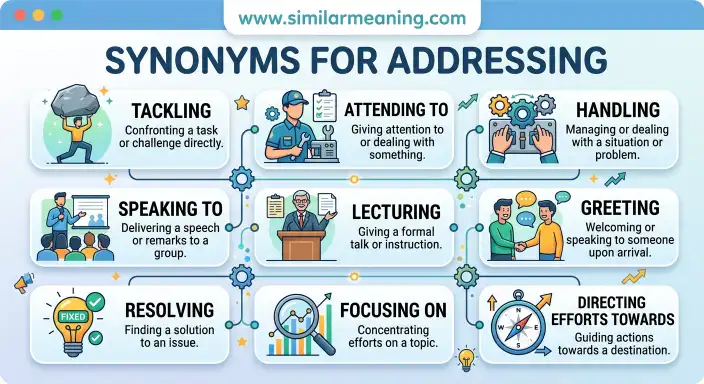
The word addressing can mean speaking to someone, dealing with a problem, or discussing an important topic. For example, a teacher may be addressing students in a classroom, while a manager may be addressing a complaint at work. The meaning changes with the situation.
This word is common in everyday conversations, academic writing, business reports, and formal speeches. Learning synonyms for addressing helps English learners express ideas clearly and avoid repeating the same words. It also helps content writers create natural, engaging, and professional content.
However, not every synonym has the same meaning. Words such as discussing, tackling, handling, and resolving serve different purposes. In this guide, you will learn 30 synonyms for addressing, their meanings, US and UK pronunciations, and example sentences. You will also explore the word’s history, grammar, connotations, antonyms, and common uses.
Meaning of Addressing
Definition
Addressing (verb, present participle or gerund): Speaking to someone, discussing a subject, dealing with a problem, or directing a message to a person.
Examples
- The principal is addressing the students in the school hall.
- The company is addressing customer complaints.
Connotative Meaning of Addressing
What Does Connotation Mean?
Connotation is the feeling or idea that a word suggests beyond its basic meaning.
- Positive tone: Addressing can suggest responsibility, confidence, and a willingness to solve problems.
- Negative tone: It can suggest confrontation when someone addresses a difficult issue or challenges another person.
- Neutral tone: It can simply describe speaking to someone or discussing a subject.
Etymology of Addressing
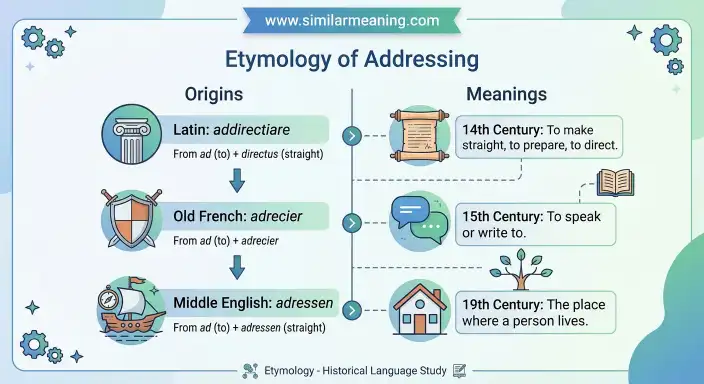
Origin of the Word
- Source language: Address entered English through Old French adresser.
- Latin connection: The French word is associated with Latin directus, meaning straight or direct.
- Original sense: The word developed meanings related to directing or guiding something.
- Modern meaning: Today, addressing can mean speaking to someone, dealing with an issue, or directing a letter to its recipient.
Short History of Addressing
Old English (450–1100): The modern word address was not commonly used in Old English. Speakers used other words to describe speaking, directing, and giving instructions.
Middle English (1100–1500): French influence helped introduce address into English. The word developed meanings related to directing and speaking to someone.
Modern English (1500–Present): Address gained wider uses in speeches, letters, formal communication, and problem solving. Addressing became the standard ing form of the verb.
Pronunciation of Addressing
US and UK Pronunciation
- US: /əˈdres.ɪŋ/
- UK: /əˈdres.ɪŋ/
Syllables
ad dress ing — 3 syllables.
Affixation Pattern of Addressing
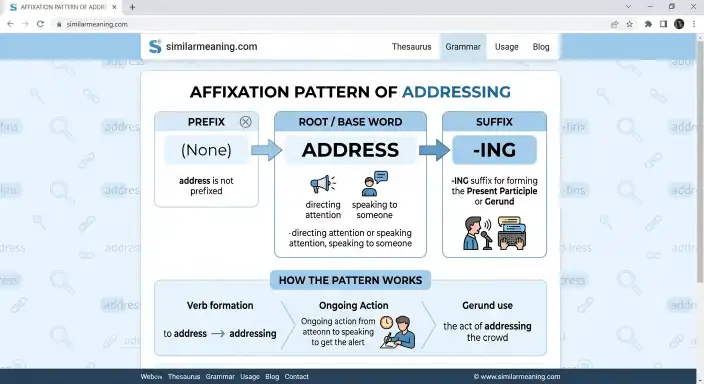
Root, Prefix, and Suffix
- Root/base: Address
- Prefix: None
- Suffix: ing, used to form the present participle and gerund.
Word Formation of Addressing
- Address (verb): To speak to someone or deal with an issue.
- Addressing (verb): Speaking to someone or dealing with a matter.
- Addressed (verb): Spoke to someone or dealt with an issue in the past.
- Address (noun): A location or a formal speech.
- Addressee (noun): The person who receives a letter or message.
- Addressable (adjective): Able to be identified or reached.
- Address book (noun phrase): A collection of names and contact details.
30 Synonyms for Addressing
1. Discussing (Verb)
US: /dɪˈskʌs.ɪŋ/ | UK: /dɪˈskʌs.ɪŋ/
Meaning: Talking about a subject to share ideas or information.
Examples:
- We are discussing the new school rules.
- The team is discussing ways to improve its service.
2. Tackling (Verb)
US: /ˈtæk.əl.ɪŋ/ | UK: /ˈtæk.əl.ɪŋ/
Meaning: Making an effort to deal with a difficult problem.
Examples:
- The city is tackling traffic problems.
- She is tackling a difficult task at work.
3. Handling (Verb)
US: /ˈhæn.dəl.ɪŋ/ | UK: /ˈhæn.dəl.ɪŋ/
Meaning: Managing a task, situation, or problem.
Examples:
- He is handling customer complaints.
- The manager is handling the situation carefully.
4. Dealing With (Verb Phrase)
US: /ˈdiː.lɪŋ wɪð/ | UK: /ˈdiː.lɪŋ wɪð/
Meaning: Taking action to manage a situation or problem.
Examples:
- We are dealing with a serious issue.
- She is dealing with customer requests today.
5. Speaking To (Verb Phrase)
US: /ˈspiː.kɪŋ tuː/ | UK: /ˈspiː.kɪŋ tuː/
Meaning: Talking directly to a person.
Examples:
- The teacher is speaking to the class.
- She is speaking to her supervisor about the schedule.
6. Talking To (Verb Phrase)
US: /ˈtɔː.kɪŋ tuː/ | UK: /ˈtɔː.kɪŋ tuː/
Meaning: Having a conversation with someone.
Examples:
- He is talking to his friend after school.
- The manager is talking to the staff about the changes.
7. Consulting (Verb)
US: /kənˈsʌl.tɪŋ/ | UK: /kənˈsʌl.tɪŋ/
Meaning: Asking someone for advice or professional guidance.
Examples:
- She is consulting a lawyer about the contract.
- The doctor is consulting other specialists.
8. Confronting (Verb)
US: /kənˈfrʌn.tɪŋ/ | UK: /kənˈfrʌn.tɪŋ/
Meaning: Facing a difficult problem or challenging someone directly.
Examples:
- The team is confronting a major challenge.
- He is confronting the issue instead of ignoring it.
9. Resolving (Verb)
US: /rɪˈzɑːl.vɪŋ/ | UK: /rɪˈzɒl.vɪŋ/
Meaning: Finding a solution to a problem or disagreement.
Examples:
- They are resolving a disagreement between colleagues.
- The company is resolving customer complaints.
10. Managing (Verb)
US: /ˈmæn.ɪ.dʒɪŋ/ | UK: /ˈmæn.ɪ.dʒɪŋ/
Meaning: Organizing or controlling a task, situation, or responsibility.
Examples:
- She is managing a busy office.
- The team is managing several projects at once.
11. Examining (Verb)
US: /ɪɡˈzæm.ɪ.nɪŋ/ | UK: /ɪɡˈzæm.ɪ.nɪŋ/
Meaning: Looking at something carefully to understand it.
Examples:
- Researchers are examining the results.
- The committee is examining the new proposal.
12. Exploring (Verb)
US: /ɪkˈsplɔːr.ɪŋ/ | UK: /ɪkˈsplɔː.rɪŋ/
Meaning: Investigating a subject or considering different possibilities.
Examples:
- The students are exploring climate change.
- The company is exploring new business ideas.
13. Investigating (Verb)
US: /ɪnˈvɛs.təˌɡeɪ.tɪŋ/ | UK: /ɪnˈves.tɪ.ɡeɪ.tɪŋ/
Meaning: Studying a situation to discover facts or causes.
Examples:
- The police are investigating the incident.
- The school is investigating the complaint.
14. Considering (Verb)
US: /kənˈsɪd.ər.ɪŋ/ | UK: /kənˈsɪd.ər.ɪŋ/
Meaning: Thinking carefully about an idea or possible action.
Examples:
- The committee is considering the proposal.
- She is considering several solutions to the problem.
15. Reviewing (Verb)
US: /rɪˈvjuː.ɪŋ/ | UK: /rɪˈvjuː.ɪŋ/
Meaning: Looking at something again to assess or understand it.
Examples:
- The manager is reviewing the team’s performance.
- We are reviewing the safety procedures.
16. Covering (Verb)
US: /ˈkʌv.ər.ɪŋ/ | UK: /ˈkʌv.ər.ɪŋ/
Meaning: Including or discussing a subject as part of a wider topic.
Examples:
- The lesson is covering basic grammar rules.
- The report is covering several important issues.
17. Approaching (Verb)
US: /əˈproʊ.tʃɪŋ/ | UK: /əˈprəʊ.tʃɪŋ/
Meaning: Beginning to deal with a subject or problem in a particular way.
Examples:
- She is approaching the problem with care.
- The team is approaching the task from a new angle.
18. Responding To (Verb Phrase)
US: /rɪˈspɑːn.dɪŋ tuː/ | UK: /rɪˈspɒn.dɪŋ tuː/
Meaning: Giving an answer or reaction to something.
Examples:
- The company is responding to customer feedback.
- He is responding to questions from the audience.
19. Answering (Verb)
US: /ˈæn.sər.ɪŋ/ | UK: /ˈɑːn.sər.ɪŋ/
Meaning: Giving a reply to a question or request.
Examples:
- The speaker is answering questions from students.
- She is answering an email from her teacher.
20. Articulating (Verb)
US: /ɑːrˈtɪk.jəˌleɪ.tɪŋ/ | UK: /ɑːˈtɪk.jə.leɪ.tɪŋ/
Meaning: Expressing an idea or feeling clearly in words.
Examples:
- He is articulating his views with confidence.
- The writer is articulating a complex idea simply.
21. Presenting (Verb)
US: /prɪˈzen.tɪŋ/ | UK: /prɪˈzen.tɪŋ/
Meaning: Showing or explaining information to an audience.
Examples:
- The student is presenting her research.
- The team is presenting its findings to the director.
22. Raising (Verb)
US: /ˈreɪ.zɪŋ/ | UK: /ˈreɪ.zɪŋ/
Meaning: Bringing a subject, question, or concern to people’s attention.
Examples:
- She is raising an important question.
- The employee is raising concerns about safety.
23. Highlighting (Verb)
US: /ˈhaɪˌlaɪ.tɪŋ/ | UK: /ˈhaɪˌlaɪ.tɪŋ/
Meaning: Drawing attention to an important point.
Examples:
- The report is highlighting the main risks.
- He is highlighting the need for better planning.
24. Acknowledging (Verb)
US: /əkˈnɑː.lɪ.dʒɪŋ/ | UK: /əkˈnɒl.ɪ.dʒɪŋ/
Meaning: Recognizing or accepting that something is true or important.
Examples:
- The manager is acknowledging the team’s efforts.
- She is acknowledging the problem openly.
25. Treating (Verb)
US: /ˈtriː.tɪŋ/ | UK: /ˈtriː.tɪŋ/
Meaning: Dealing with a subject or situation in a particular way.
Examples:
- The article is treating the topic with care.
- The teacher is treating the subject in detail.
26. Rectifying (Verb)
US: /ˈrek.təˌfaɪ.ɪŋ/ | UK: /ˈrek.tɪ.faɪ.ɪŋ/
Meaning: Correcting something that is wrong or inaccurate.
Examples:
- The company is rectifying the errors in its report.
- The team is rectifying the problem before launch.
27. Delivering (Verb)
US: /dɪˈlɪv.ər.ɪŋ/ | UK: /dɪˈlɪv.ər.ɪŋ/
Meaning: Giving or presenting a speech, message, or formal statement.
Examples:
- The principal is delivering a speech.
- She is delivering a presentation to the team.
28. Explaining (Verb)
US: /ɪkˈspleɪ.nɪŋ/ | UK: /ɪkˈspleɪ.nɪŋ/
Meaning: Making an idea or situation easier to understand.
Examples:
- The teacher is explaining the lesson.
- He is explaining the reasons for the delay.
29. Voicing (Verb)
US: /ˈvɔɪ.sɪŋ/ | UK: /ˈvɔɪ.sɪŋ/
Meaning: Expressing an opinion, concern, or feeling aloud.
Examples:
- The students are voicing their concerns.
- She is voicing her opinion during the meeting.
30. Responding (Verb)
US: /rɪˈspɑːn.dɪŋ/ | UK: /rɪˈspɒn.dɪŋ/
Meaning: Reacting to a question, statement, event, or situation.
Examples:
- The director is responding to the team’s questions.
- The company is responding to recent feedback.
Prototype Meaning of Addressing
The most common meaning of addressing is speaking to someone or dealing with a subject or problem. People may imagine a teacher speaking to a classroom, a leader giving a speech, or a manager trying to solve a complaint. The meaning depends on the words around it. For example, “addressing the audience” means speaking to people, while “addressing a problem” means taking steps to deal with it.
Prototype Categorization of Addressing
Synonyms for addressing can be grouped by their main purpose. This helps writers choose the most accurate word for each situation.
- Speaking to people: Speaking to, talking to, delivering, presenting.
- Discussing a topic: Discussing, covering, exploring, explaining.
- Solving a problem: Tackling, handling, resolving, rectifying.
- Examining an issue: Examining, investigating, reviewing, considering.
- Expressing ideas: Articulating, voicing, highlighting, raising.
- Replying to someone: Answering, responding, responding to.
- Recognizing a concern: Acknowledging, confronting.
- Seeking guidance: Consulting.
- Managing a situation: Dealing with, managing, treating, approaching.
How categorization helps writers: It prevents incorrect word choices. For example, discussing fits a conversation, resolving suggests finding a solution, and highlighting means drawing attention to a key point. These words are related to addressing but are not interchangeable in every sentence.
Antonyms of Addressing
The opposite of addressing depends on if it means speaking to someone, discussing a subject, or dealing with a problem.
- Ignoring (verb): Paying no attention to someone or something.
- Avoiding (verb): Staying away from a person, subject, or problem.
- Neglecting (verb): Failing to give something the care or attention it needs.
- Overlooking (verb): Failing to notice or consider something.
- Evading (verb): Avoiding a question, duty, or difficult issue.
- Withholding (verb): Keeping information or communication from someone.
- Silencing (verb): Preventing someone from speaking or expressing an opinion.
- Disregarding (verb): Choosing not to consider or follow something.
- Dismissing (verb): Rejecting an idea or concern without serious consideration.
- Concealing (verb): Keeping information hidden instead of making it known.
Short Questions and Answers
What Does Addressing Mean?
Addressing can mean speaking to someone, discussing a subject, dealing with a problem, or directing a message to a person.
When Should Addressing Be Used?
Use addressing when describing communication with a person or group, or when explaining that someone is dealing with an issue.
Is Addressing Positive or Negative?
Addressing is usually neutral. It can sound positive when it suggests responsibility and problem solving, or negative when it involves confrontation.
What Is Another Word for Addressing a Problem?
Useful alternatives include tackling, handling, resolving, dealing with, and confronting. The best choice depends on the action being described.
What Is Another Word for Addressing an Audience?
Speaking to, delivering a speech to, and talking to may fit, depending on the sentence.
What Is the Difference Between Addressing and Discussing?
Addressing can mean dealing with a problem or speaking to someone. Discussing specifically means talking about a subject or exchanging ideas.
Can Addressing Be Used in Academic Writing?
Yes. It is common in essays, research papers, reports, and formal discussions. For example, “This study is addressing a gap in existing research.”
Conclusion
Learning synonyms for addressing helps you express ideas more clearly in both writing and speech. Words such as discussing, tackling, handling, resolving, and highlighting can make your sentences more precise and natural. However, each synonym has a different purpose, so the context should guide your choice.
These alternatives are useful in academic essays, business reports, formal speeches, emails, and everyday conversations. Understanding their meanings and connotations also helps you avoid repetition and communicate with confidence.
To improve your vocabulary, choose three synonyms each day and write a sentence with each one. Read English articles, notice how writers use these words, and practise using them in conversation. Regular practice will help you build stronger English skills and become a more effective communicator.
Discover More Articles!
Relationship Synonyms: 30 Powerful Words to Improve Your Vocabulary
Criticism Synonyms: 30 Words to Express Opinions Clearly
Confused Synonyms: 30 Words to Express Confusion

Justin Cord Hayes is an Adams Media author and co-author of several vocabulary and thesaurus books. His work focuses on synonyms, antonyms, word choice, and expanding English vocabulary. He co-authored Roget’s Thesaurus of Words for Writers, Roget’s Thesaurus of Words for Students, and Roget’s Thesaurus of Words for Intellectuals. His books are designed to help readers find clearer and more effective words for writing and communication.






2 thoughts on “Synonyms for Addressing: 30 Powerful Words to Improve Your Vocabulary”