Relationship means the way two or more people, groups, or things are connected. For example, two friends share a close relationship because they trust and support each other. A student also has a relationship with a teacher, but this connection is different from a friendship. The word relationship is common in daily conversations, schoolwork, business, and writing.
Learning relationship synonyms helps you describe these connections with greater accuracy. English learners can use these words to build vocabulary and speak more naturally. Writers can also avoid repeating the same word in every sentence. For example, bond can describe a close emotional connection, while association often describes a general connection between people or things.
This article explains the meaning, pronunciation, history, and word forms of relationship. It also explores 30 synonyms, their meanings, and example sentences. You will learn how to choose the right word for personal, professional, social, and academic situations.
Meaning of Relationship
Definition
Relationship (noun): The way two or more people, groups, or things are connected or interact with each other.
A relationship may be personal, professional, social, or related to ideas and events. It can be close or distant, positive or negative, and formal or informal.
Examples
- My relationship with my brother is built on trust and respect.
- There is a strong relationship between regular practice and better results.
Connotative Meaning
Connotation (the feelings or ideas a word suggests beyond its basic meaning) helps us understand how a word may sound in different situations.
- Positive tone: A relationship may suggest love, friendship, trust, support, or cooperation.
- Negative tone: It may suggest conflict, tension, distance, or a difficult connection.
- Neutral tone: In academic or professional writing, relationship can simply mean a connection between people, events, or ideas.
The tone depends on the words around it. A healthy relationship sounds positive, while a strained relationship suggests problems.
Etymology of Relationship
Origin of the Word
- Source language: Relationship comes from the English word relation, with the suffix ship.
- Root word: Relation comes through Old French from Latin relatio, meaning a report, account, or reference.
- Suffix: ship is used to form nouns that describe a state, condition, position, or connection.
- Original idea: The word developed from the idea of referring or connecting one thing to another.
Short History of Relationship
Old English (450–1100): The modern word relationship was not yet in use. English speakers used other words to express ideas about family ties, friendship, and connections.
Middle English (1100–1500): Words related to relation entered English through French and Latin influence. They were used to describe links, accounts, and connections.
Modern English (1500–Present): The word relationship developed as a common term for connections between people and things. Today, it is widely used in personal, professional, social, scientific, and academic contexts.
Pronunciation of Relationship
US and UK Pronunciation
- US: /rɪˈleɪ.ʃən.ʃɪp/
- UK: /rɪˈleɪ.ʃən.ʃɪp/
Syllables
re la tion ship (four syllables)
Affixation Pattern of Relationship
- Root: Relate
- Base word: Relation
- Prefix: None in the complete word.
- Suffix: ship, which forms a noun describing a state or connection.
Word Formation
The following words belong to the same word family:
- Relate (verb): To connect one thing with another.
- Related (adjective): Connected to something.
- Relating (verb form): Connecting or describing a link.
- Relation (noun): A connection between people or things.
- Relationship (noun): The way people or things are connected.
- Relational (adjective): Connected with relationships or connections.
- Relationally (adverb): In a way that concerns relationships.
- Interrelationship (noun): A connection between two or more things that affect one another.
These forms have related meanings, but their grammatical roles differ. For example, relate is a verb, while relationship is a noun.
Synonyms of Relationship
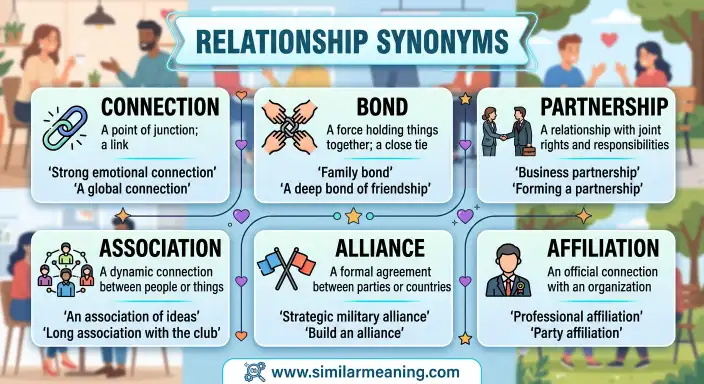
The following 30 words describe different kinds of connections. Some are close synonyms, while others fit specific situations. A bond often suggests emotional closeness, while a link may describe a simple connection between facts or events.
1. Connection (Noun)
US IPA: /kəˈnek.ʃən/ | UK IPA: /kəˈnek.ʃən/
Meaning: A link between people, things, or ideas.
Examples:
- There is a strong connection between sleep and good health.
- Their connection grew through shared interests.
2. Bond (Noun)
US IPA: /bɑːnd/ | UK IPA: /bɒnd/
Meaning: A close emotional connection between people or groups.
Examples:
- The sisters share a strong bond.
- Teamwork helped build a bond between the players.
3. Association (Noun)
US IPA: /əˌsoʊ.siˈeɪ.ʃən/ | UK IPA: /əˌsəʊ.siˈeɪ.ʃən/
Meaning: A connection between people, ideas, events, or things.
Examples:
- There is an association between exercise and better health.
- Her association with the group lasted for many years.
4. Link (Noun)
US IPA: /lɪŋk/ | UK IPA: /lɪŋk/
Meaning: A connection between two or more things.
Examples:
- Researchers found a link between diet and sleep.
- A shared hobby became the link between the two friends.
5. Tie (Noun)
US IPA: /taɪ/ | UK IPA: /taɪ/
Meaning: A connection based on family, friendship, work, or shared interests.
Examples:
- She has close family ties in Pakistan.
- The two schools have strong ties with each other.
6. Bonding (Noun)
US IPA: /ˈbɑːn.dɪŋ/ | UK IPA: /ˈbɒn.dɪŋ/
Meaning: The process of building a close connection with another person or group.
Examples:
- The team spent a day outdoors for bonding.
- Reading together helped with parent child bonding.
7. Affiliation (Noun)
US IPA: /əˌfɪl.iˈeɪ.ʃən/ | UK IPA: /əˌfɪl.iˈeɪ.ʃən/
Meaning: A connection with an organization, group, or institution.
Examples:
- The club has an affiliation with a local university.
- She listed her professional affiliations on the form.
8. Associationism (Noun)
US IPA: /əˌsoʊ.siˈeɪ.ʃəˌnɪz.əm/ | UK IPA: /əˌsəʊ.siˈeɪ.ʃəˌnɪz.əm/
Meaning: A theory that explains how ideas or mental events become connected.
Examples:
- The course introduced students to associationism in psychology.
- Associationism explores how one idea can bring another to mind.
9. Linkage (Noun)
US IPA: /ˈlɪŋ.kɪdʒ/ | UK IPA: /ˈlɪŋ.kɪdʒ/
Meaning: A connection or system of links between things.
Examples:
- The report examined the linkage between education and employment.
- Better transport created stronger linkage between the towns.
10. Rapport (Noun)
US IPA: /ræˈpɔːr/ | UK IPA: /ræˈpɔː/
Meaning: A friendly and trusting connection between people.
Examples:
- The teacher built a good rapport with her students.
- Good communication helped establish rapport with the client.
11. Friendship (Noun)
US IPA: /ˈfrend.ʃɪp/ | UK IPA: /ˈfrend.ʃɪp/
Meaning: A close and caring relationship between friends.
Examples:
- Their friendship began at school.
- Honest communication helped protect their friendship.
12. Partnership (Noun)
US IPA: /ˈpɑːrt.nɚ.ʃɪp/ | UK IPA: /ˈpɑːt.nə.ʃɪp/
Meaning: A relationship in which people or groups work together toward a shared goal.
Examples:
- The two companies formed a partnership.
- Their partnership succeeded because both sides trusted each other.
13. Alliance (Noun)
US IPA: /əˈlaɪ.əns/ | UK IPA: /əˈlaɪ.əns/
Meaning: An agreement or connection between people or groups who support a shared goal.
Examples:
- The organizations formed an alliance to support local families.
- Their alliance helped them complete the project.
14. Interaction (Noun)
US IPA: /ˌɪn.t̬ɚˈæk.ʃən/ | UK IPA: /ˌɪn.tərˈæk.ʃən/
Meaning: An action or exchange between people or things.
Examples:
- Positive interaction helps students learn from one another.
- Their daily interaction improved communication.
15. Rapport Building (Noun Phrase)
US IPA: /ræˈpɔːr ˈbɪl.dɪŋ/ | UK IPA: /ræˈpɔː ˈbɪl.dɪŋ/
Meaning: The process of creating trust and understanding between people.
Examples:
- Rapport building is important when meeting new clients.
- The counselor used careful listening for rapport building.
16. Intimacy (Noun)
US IPA: /ˈɪn.t̬ə.mə.si/ | UK IPA: /ˈɪn.tɪ.mə.si/
Meaning: A state of emotional closeness, trust, or personal understanding.
Examples:
- Honest conversations helped build emotional intimacy.
- Trust can increase intimacy between close family members.
17. Kinship (Noun)
US IPA: /ˈkɪn.ʃɪp/ | UK IPA: /ˈkɪn.ʃɪp/
Meaning: A connection through family, ancestry, or a shared sense of belonging.
Examples:
- The family felt a strong sense of kinship.
- Shared traditions created kinship among the community members.
18. Fellowship (Noun)
US IPA: /ˈfel.oʊ.ʃɪp/ | UK IPA: /ˈfel.əʊ.ʃɪp/
Meaning: A friendly connection among people who share interests, activities, or beliefs.
Examples:
- The club encourages fellowship among its members.
- They enjoyed a sense of fellowship during the community event.
19. Companionship (Noun)
US IPA: /kəmˈpæn.jən.ʃɪp/ | UK IPA: /kəmˈpæn.jən.ʃɪp/
Meaning: The comfort and friendship people receive from being together.
Examples:
- The older man valued the companionship of his friends.
- Their companionship made long journeys more enjoyable.
20. Understanding (Noun)
US IPA: /ˌʌn.dɚˈstæn.dɪŋ/ | UK IPA: /ˌʌn.dəˈstæn.dɪŋ/
Meaning: A shared awareness of each other’s thoughts, feelings, or needs.
Examples:
- Mutual understanding helped them solve the problem.
- Their relationship improved through better understanding.
21. Interdependence (Noun)
US IPA: /ˌɪn.t̬ɚ.dɪˈpen.dəns/ | UK IPA: /ˌɪn.tə.dɪˈpen.dəns/
Meaning: A condition in which people or things depend on each other.
Examples:
- The project showed the interdependence of different teams.
- Healthy communities often rely on interdependence.
22. Correlation (Noun)
US IPA: /ˌkɔːr.əˈleɪ.ʃən/ | UK IPA: /ˌkɒr.əˈleɪ.ʃən/
Meaning: A connection between two things that change or occur together.
Examples:
- The study found a correlation between practice and performance.
- Correlation does not always mean that one thing causes another.
23. Correspondence (Noun)
US IPA: /ˌkɔːr.əˈspɑːn.dəns/ | UK IPA: /ˌkɒr.ɪˈspɒn.dəns/
Meaning: A connection or similarity between two things; it can also mean written communication.
Examples:
- The researchers noticed a correspondence between the two results.
- Their correspondence continued for several years.
24. Interrelation (Noun)
US IPA: /ˌɪn.t̬ɚ.rɪˈleɪ.ʃən/ | UK IPA: /ˌɪn.tə.rɪˈleɪ.ʃən/
Meaning: A connection in which two or more things relate to or affect each other.
Examples:
- The lesson explained the interrelation between language and culture.
- The report explored the interrelation of work and family life.
25. Relatedness (Noun)
US IPA: /rɪˈleɪ.tɪd.nəs/ | UK IPA: /rɪˈleɪ.tɪd.nəs/
Meaning: The state of being connected or linked to something.
Examples:
- The teacher explained the relatedness of the two topics.
- Researchers studied the relatedness of the ideas.
26. Familiarity (Noun)
US IPA: /fəˌmɪl.iˈer.ə.t̬i/ | UK IPA: /fəˌmɪl.iˈær.ə.ti/
Meaning: Knowledge of someone or something gained through experience or repeated contact.
Examples:
- Familiarity helped the new employee feel more comfortable.
- Their growing familiarity made conversations easier.
27. Contact (Noun)
US IPA: /ˈkɑːn.tækt/ | UK IPA: /ˈkɒn.tækt/
Meaning: Communication or interaction between people or groups.
Examples:
- Please keep in contact with your former classmates.
- Regular contact helped the team share updates.
28. Communication (Noun)
US IPA: /kəˌmjuː.nəˈkeɪ.ʃən/ | UK IPA: /kəˌmjuː.nɪˈkeɪ.ʃən/
Meaning: The exchange of information, thoughts, or feelings between people.
Examples:
- Clear communication can improve a working relationship.
- Their communication became easier after they set clear goals.
29. Linkup (Noun)
US IPA: /ˈlɪŋkˌʌp/ | UK IPA: /ˈlɪŋkˌʌp/
Meaning: An informal connection or meeting between people or groups.
Examples:
- The event created a linkup between local artists.
- The two groups planned a linkup to share ideas.
30. Nexus (Noun)
US IPA: /ˈnek.səs/ | UK IPA: /ˈnek.səs/
Meaning: A central connection or set of links between people, ideas, or events.
Examples:
- The report explored the nexus between education and economic growth.
- The city became a nexus for trade and culture.
Prototype Meaning
The most typical meaning of relationship is a connection between people who know, interact with, or affect one another. People often imagine family members, friends, partners, classmates, or coworkers when they hear the word. However, a relationship does not always involve personal feelings. It can also describe a connection between ideas, events, numbers, or systems.
For example, a scientist may study the relationship between sleep and memory. The exact meaning depends on the context. Words such as bond, friendship, and rapport often suggest closeness, while association, link, and correlation can describe more general connections.
Prototype Categorization
Grouping relationship synonyms by meaning helps you choose the best word for each situation.
- Close emotional connections: Bond, intimacy, friendship, and companionship describe closeness, care, and trust.
- Family and belonging: Kinship describes family connections or a shared sense of belonging.
- Friendly social connections: Rapport, fellowship, and understanding focus on trust, shared interests, and mutual respect.
- Work and cooperation: Partnership and alliance describe people or groups working together.
- General connections: Connection, link, tie, and association can describe many types of relationships.
- Communication and contact: Interaction, communication, and contact focus on the ways people exchange information or spend time together.
- Academic and scientific connections: Correlation, correspondence, interrelation, and nexus are useful when discussing facts, ideas, events, or systems.
- Dependence between things: Interdependence describes a connection in which two or more parts rely on each other.
- Knowledge through experience: Familiarity describes how well someone knows a person, subject, or place.
Categorization helps writers avoid using a synonym that does not fit. For example, friendship is suitable for a personal connection, while correlation is more suitable for a scientific finding. Choosing words by meaning makes writing more precise and natural.
Antonyms of Relationship
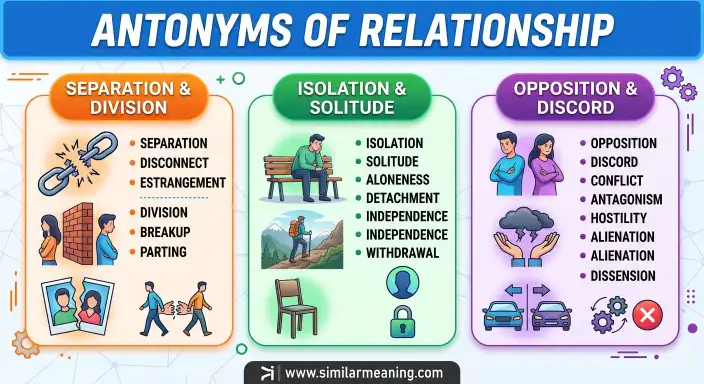
There is no single antonym that works in every situation. The best opposite depends on the type of connection being discussed.
- Separation (noun): The state of being apart from someone or something.
- Disconnection (noun): A state in which a connection is missing or has been broken.
- Isolation (noun): The condition of being separated from others.
- Estrangement (noun): A state in which people who were once close become distant.
- Alienation (noun): A feeling of being separated from or excluded by others.
- Division (noun): A state of separation between people, groups, or ideas.
- Distance (noun): A lack of physical or emotional closeness.
- Disunity (noun): A lack of agreement or togetherness within a group.
- Conflict (noun): A serious disagreement or clash between people or groups.
- Detachment (noun): A state of emotional distance or lack of involvement.
Short Questions and Answers
- What does relationship mean?
A relationship is a connection between people, groups, or things. - When should relationship be used?
Use relationship when discussing personal connections, professional links, social interactions, or connections between ideas and events. - Is relationship positive or negative?
The word is neutral by itself. A relationship can be positive, negative, close, distant, healthy, or difficult. - How is relationship different from similar words?
Bond often suggests a close emotional connection. Association describes a general link. Partnership focuses on working together, while correlation describes how two things are connected statistically or in a pattern.
Conclusion
Learning relationship synonyms helps you express different kinds of connections with greater accuracy. Words such as bond, friendship, and companionship describe personal closeness. Terms such as partnership and alliance are useful in professional settings, while association, correlation, and interrelation often suit academic writing.
A wider vocabulary improves speaking, strengthens writing, and helps you avoid repeating the same word. It also allows you to explain your ideas in a clear and natural way. To improve your English, choose three new synonyms each day and write a sentence with each one.
Notice the context in which each word is used. With regular practice, you can understand subtle differences, choose better words, and communicate with greater confidence.
Discover More Articles!
Sweetheart Synonyms: 30 Words for Every Meaning
Confused Synonyms: 30 Words to Express Confusion
Synonyms for Learns: 30 Words With Meanings and Examples

Justin Cord Hayes is an Adams Media author and co-author of several vocabulary and thesaurus books. His work focuses on synonyms, antonyms, word choice, and expanding English vocabulary. He co-authored Roget’s Thesaurus of Words for Writers, Roget’s Thesaurus of Words for Students, and Roget’s Thesaurus of Words for Intellectuals. His books are designed to help readers find clearer and more effective words for writing and communication.


2 thoughts on “Relationship Synonyms: 30 Powerful Words to Improve Your Vocabulary”