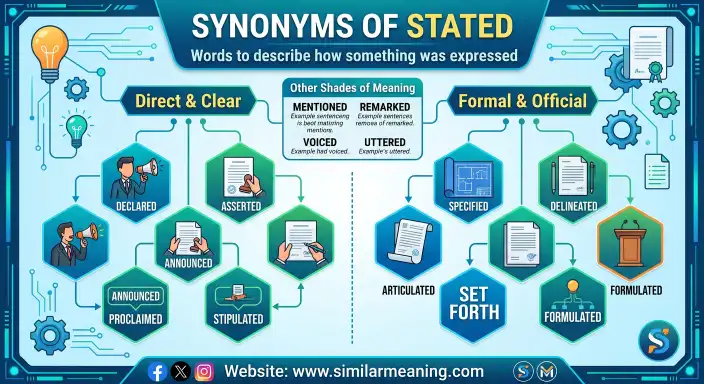
The word stated means expressed something clearly in speech or writing. For example, a teacher may have stated the rules before an exam, or a student may have stated an opinion during a class discussion. We use this word in everyday conversations, academic writing, news reports, and formal documents.
Learning synonyms of stated helps English learners express ideas in different ways. It also helps writers avoid repeating the same word in essays, articles, emails, and reports. However, not every synonym fits every situation. Words such as declared, mentioned, and confirmed have different meanings and levels of strength.
In this guide, you will learn 30 useful synonyms of stated, along with their meanings, pronunciations, and example sentences. You will also explore the word’s grammar, history, connotations, word formation, antonyms, and common uses. These simple explanations will help you choose the right word for clear and natural English.
Meaning of Stated
Definition
Stated (verb, past tense and past participle): Expressed something clearly in speech or writing.
Examples:
- The teacher stated the rules before the lesson began.
- She stated her opinion during the meeting.
Connotative Meaning
Connotation is the feeling or idea that a word suggests beyond its basic meaning.
- Positive tone: Stated can suggest clarity, confidence, and honesty.
- Negative tone: It may sound firm, cold, or forceful when someone makes a strong statement.
- Neutral tone: It often reports information without showing emotion, especially in formal writing.
Etymology of Stated
- Source language: Stated comes from the verb state, which entered English through French and Latin.
- Latin origin: Latin status means condition, position, or standing. The Latin verb stāre means to stand.
- French influence: Old French estat and related forms helped shape the English word state.
- Modern meaning: The verb state developed the meaning of expressing something clearly or formally.
Short History of Stated
Old English (450–1100): The modern verb state was not a common part of Old English. English speakers used other words to express ideas and give information.
Middle English (1100–1500): French influence after the Norman Conquest helped introduce forms related to state. The word developed through contact with French and Latin.
Modern English (1500–Present): State became widely used for expressing facts, opinions, conditions, and official positions. Stated became its regular past tense and past participle form.
Pronunciation of Stated
- US: /ˈsteɪ.tɪd/
- UK: /ˈsteɪ.tɪd/
Syllables
stat ed — 2 syllables.
Affixation Pattern of Stated
- Root/base: State
- Prefix: None
- Suffix: ed, used to form the past tense and past participle of regular verbs.
Word Formation of Stated
- State (verb): To express something clearly.
- Stated (verb): The past tense or past participle of state.
- Stating (verb): The present participle or gerund of state.
- Statement (noun): Something expressed in speech or writing.
- Statement of fact (noun phrase): An expression that presents something as factual.
- State (noun): A condition, situation, or political region.
- Statewide (adjective/adverb): Extending across an entire state.
30 Synonyms of Stated
The best synonym depends on the context. Some words mean that a person expressed an idea, while others suggest that the person made an official announcement, gave details, or confirmed information.
1. Expressed (Verb)
US: /ɪkˈsprɛst/ | UK: /ɪkˈsprɛst/
Meaning: Communicated a thought, feeling, or idea.
Examples:
- She expressed her concerns during the meeting.
- He expressed his views in a short letter.
2. Declared (Verb)
US: /dɪˈklɛrd/ | UK: /dɪˈkleəd/
Meaning: Announced something clearly and firmly.
Examples:
- The leader declared his support for the plan.
- She declared that the decision was final.
3. Announced (Verb)
US: /əˈnaʊnst/ | UK: /əˈnaʊnst/
Meaning: Made information known to people.
Examples:
- The school announced the exam dates.
- They announced their decision yesterday.
4. Mentioned (Verb)
US: /ˈmɛn.ʃənd/ | UK: /ˈmen.ʃənd/
Meaning: Referred to someone or something briefly.
Examples:
- She mentioned the problem during class.
- He mentioned your name in his speech.
5. Reported (Verb)
US: /rɪˈpɔr.tɪd/ | UK: /rɪˈpɔː.tɪd/
Meaning: Gave information about an event or situation.
Examples:
- The newspaper reported the incident.
- She reported that the project was complete.
6. Asserted (Verb)
US: /əˈsɝː.tɪd/ | UK: /əˈsɜː.tɪd/
Meaning: Stated something confidently or firmly.
Examples:
- He asserted that he was telling the truth.
- The lawyer asserted that the evidence was reliable.
7. Claimed (Verb)
US: /kleɪmd/ | UK: /kleɪmd/
Meaning: Said that something was true, sometimes without providing proof.
Examples:
- She claimed that she had seen the event.
- The company claimed that its service was reliable.
8. Affirmed (Verb)
US: /əˈfɝːmd/ | UK: /əˈfɜːmd/
Meaning: Confirmed or stated something positively.
Examples:
- He affirmed his commitment to the project.
- The witness affirmed that the statement was accurate.
9. Confirmed (Verb)
US: /kənˈfɝːmd/ | UK: /kənˈfɜːmd/
Meaning: Verified that something was true or correct.
Examples:
- The school confirmed the new schedule.
- She confirmed that the meeting would take place.
10. Specified (Verb)
US: /ˈspɛs.əˌfaɪd/ | UK: /ˈspes.ɪ.faɪd/
Meaning: Gave exact details about something.
Examples:
- The form specified the required documents.
- He specified the time and place of the event.
11. Indicated (Verb)
US: /ˈɪn.dɪˌkeɪ.tɪd/ | UK: /ˈɪn.dɪ.keɪ.tɪd/
Meaning: Showed, suggested, or pointed out something.
Examples:
- The report indicated a rise in sales.
- She indicated that she was ready to begin.
12. Communicated (Verb)
US: /kəˈmjuː.nɪˌkeɪ.tɪd/ | UK: /kəˈmjuː.nɪ.keɪ.tɪd/
Meaning: Shared information, thoughts, or feelings.
Examples:
- The manager communicated the new rules.
- She communicated her concerns to the team.
13. Conveyed (Verb)
US: /kənˈveɪd/ | UK: /kənˈveɪd/
Meaning: Passed an idea, message, or feeling to someone.
Examples:
- His letter conveyed a clear message.
- She conveyed her thanks to the staff.
14. Disclosed (Verb)
US: /dɪsˈkloʊzd/ | UK: /dɪsˈkləʊzd/
Meaning: Revealed information that was previously hidden or private.
Examples:
- The company disclosed its annual results.
- He disclosed the details of the agreement.
15. Revealed (Verb)
US: /rɪˈviːld/ | UK: /rɪˈviːld/
Meaning: Made something known that was not known before.
Examples:
- The investigation revealed new facts.
- She revealed the reason for her absence.
16. Informed (Verb)
US: /ɪnˈfɔrmd/ | UK: /ɪnˈfɔːmd/
Meaning: Gave someone information about something.
Examples:
- The teacher informed us about the schedule.
- He informed the team that the deadline had changed.
17. Explained (Verb)
US: /ɪkˈspleɪnd/ | UK: /ɪkˈspleɪnd/
Meaning: Made an idea or situation easier to understand.
Examples:
- She explained the rules to the students.
- He explained why the project was delayed.
18. Described (Verb)
US: /dɪˈskraɪbd/ | UK: /dɪˈskraɪbd/
Meaning: Gave details about the features or nature of something.
Examples:
- He described the event in his report.
- She described the problem clearly.
19. Noted (Verb)
US: /ˈnoʊ.tɪd/ | UK: /ˈnəʊ.tɪd/
Meaning: Mentioned or recorded something important.
Examples:
- The report noted several changes.
- She noted that the figures were incomplete.
20. Observed (Verb)
US: /əbˈzɝːvd/ | UK: /əbˈzɜːvd/
Meaning: Remarked on something or noticed it carefully.
Examples:
- The researcher observed that the results had changed.
- He observed that the room was unusually quiet.
21. Emphasized (Verb)
US: /ˈɛm.fəˌsaɪzd/ | UK: /ˈem.fə.saɪzd/
Meaning: Gave special importance to an idea or point.
Examples:
- The teacher emphasized the value of practice.
- She emphasized that safety came first.
22. Stressed (Verb)
US: /strɛst/ | UK: /strest/
Meaning: Highlighted something as especially important.
Examples:
- He stressed the need for careful planning.
- The coach stressed the importance of teamwork.
23. Testified (Verb)
US: /ˈtɛs.təˌfaɪd/ | UK: /ˈtes.tɪ.faɪd/
Meaning: Gave evidence or made a formal statement, especially in court.
Examples:
- The witness testified before the judge.
- She testified that she had seen the car.
24. Admitted (Verb)
US: /ədˈmɪtɪd/ | UK: /ədˈmɪtɪd/
Meaning: Acknowledged that something was true, often something difficult or embarrassing.
Examples:
- He admitted that he had made a mistake.
- She admitted that the task was challenging.
25. Acknowledged (Verb)
US: /əkˈnɑː.lɪdʒd/ | UK: /əkˈnɒl.ɪdʒd/
Meaning: Accepted or recognized that something was true or existed.
Examples:
- The manager acknowledged the team’s hard work.
- She acknowledged that the plan needed changes.
26. Reiterated (Verb)
US: /riˈɪt.əˌreɪ.tɪd/ | UK: /riˈɪt.ə.reɪ.tɪd/
Meaning: Stated something again, often for emphasis.
Examples:
- The principal reiterated the school rules.
- She reiterated her support for the proposal.
27. Recited (Verb)
US: /rɪˈsaɪ.tɪd/ | UK: /rɪˈsaɪ.tɪd/
Meaning: Repeated words or information aloud from memory or a text.
Examples:
- The student recited the poem.
- He recited the main points of the speech.
28. Uttered (Verb)
US: /ˈʌt̬.ɚd/ | UK: /ˈʌt.əd/
Meaning: Spoke or produced words aloud.
Examples:
- She uttered a quiet apology.
- He uttered a few words before leaving.
29. Voiced (Verb)
US: /vɔɪst/ | UK: /vɔɪst/
Meaning: Expressed a thought, concern, or opinion aloud.
Examples:
- The students voiced their concerns.
- She voiced her opinion during the discussion.
30. Formulated (Verb)
US: /ˈfɔr.mjəˌleɪ.tɪd/ | UK: /ˈfɔː.mjə.leɪ.tɪd/
Meaning: Created or expressed an idea, plan, or statement in a clear form.
Examples:
- The team formulated a clear response.
- She formulated her argument before the debate.
Prototype Meaning of Stated
The most typical meaning of stated is that someone expressed information clearly in speech or writing. People often imagine a person giving a direct answer, explaining a position, or presenting a fact in a report. The word is common in formal and academic English because it focuses on what someone said rather than how they felt. For example, “The report stated that costs had increased” presents information in a direct, factual way.
Prototype Categorization of Stated
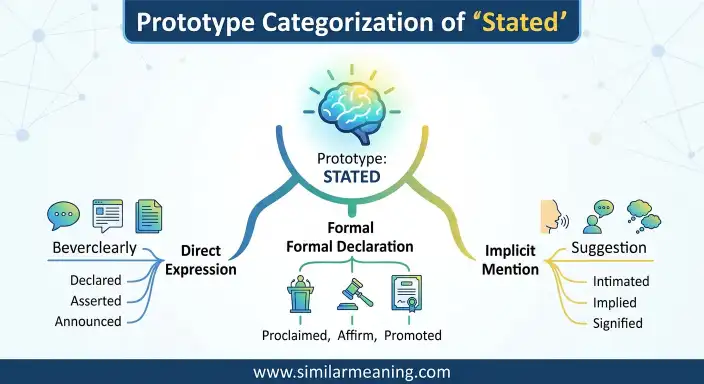
Synonyms of stated can be grouped by their main purpose. This helps writers choose a word that matches the exact meaning they want to express.
- General expression: Expressed, communicated, conveyed, voiced.
- Formal announcements: Declared, announced, proclaimed, asserted.
- Brief references: Mentioned, noted, observed.
- Information and reporting: Reported, informed, described, explained.
- Confirmation and agreement: Confirmed, affirmed, acknowledged.
- Strong emphasis: Emphasized, stressed, reiterated.
- New or private information: Revealed, disclosed.
- Claims and evidence: Claimed, testified, admitted.
- Exact details: Specified, indicated.
- Spoken words: Uttered, recited.
- Developing an idea: Formulated.
Choosing the right synonym matters. For example, mentioned suggests a brief reference, while declared suggests a firm or formal announcement. Confirmed means that information was verified, so it should not replace stated unless confirmation is intended.
Antonyms of Stated
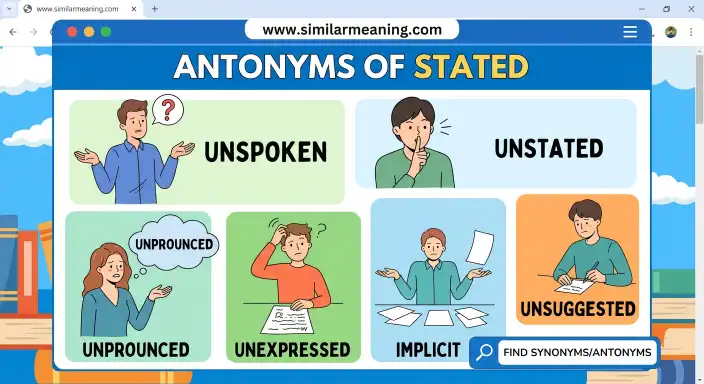
There is no single perfect antonym for stated in every context. The following words express opposite or contrasting actions.
- Withheld (verb): Kept information from being shared. Example: She withheld the details.
- Concealed (verb): Kept something hidden. Example: He concealed the truth.
- Denied (verb): Said that something was not true. Example: She denied the accusation.
- Retracted (verb): Took back a statement. Example: The newspaper retracted its claim.
- Suppressed (verb): Prevented information from being shared or known. Example: The report suppressed important details.
- Silenced (verb): Prevented someone from speaking or expressing an opinion. Example: The rules silenced public criticism.
- Omitted (verb): Left something out. Example: He omitted an important fact.
- Disavowed (verb): Publicly rejected a statement, belief, or action. Example: The group disavowed the claim.
Short Questions and Answers
- What does stated mean?
Stated means expressed something clearly in speech or writing. - When should stated be used?
Use stated when reporting what someone said or wrote, especially in formal, academic, or professional situations. - Is stated positive or negative?
Stated is usually neutral. Its tone depends on the context and the message being reported. - How is stated different from similar words?
Mentioned means referred to something briefly. Declared means announced something firmly. Confirmed means verified that something is true. Explained means made something easier to understand. - What is the best synonym for stated?
Expressed is a useful general alternative. However, reported, declared, mentioned, or confirmed may be better when the context requires a more specific meaning. - Can stated be used in academic writing?
Yes. It is common in academic writing, research reports, essays, and formal summaries.
Conclusion
Learning the synonyms of stated can improve your English vocabulary and help you communicate more clearly. Words such as expressed, declared, mentioned, reported, and confirmed allow you to share information with greater accuracy. Each synonym has a slightly different meaning, so choosing the right one is important.
These words can also strengthen your essays, reports, emails, and everyday conversations. They help you avoid repetition and make your writing sound more natural. Understanding their pronunciation, grammar, tone, and history can further improve your language skills.
To build confidence, practise using two or three synonyms each day. Write simple sentences, read examples, and notice how these words appear in books and articles. With regular practice, you can expand your vocabulary and become a more confident English speaker and write.
Discover More Articles!
Sweetheart Synonyms: 30 Words for Every Meaning
Synonyms for Learns: 30 Words With Meanings and Examples
Serenity Synonyms: 30 Powerful Words to Describe Peace and Calm

Justin Cord Hayes is an Adams Media author and co-author of several vocabulary and thesaurus books. His work focuses on synonyms, antonyms, word choice, and expanding English vocabulary. He co-authored Roget’s Thesaurus of Words for Writers, Roget’s Thesaurus of Words for Students, and Roget’s Thesaurus of Words for Intellectuals. His books are designed to help readers find clearer and more effective words for writing and communication.





3 thoughts on “Synonyms of Stated: 30 Powerful Words to Improve Your Vocabulary”