Serenity is the feeling of being peaceful, calm, and free from mental disturbance. It describes a state in which a person feels relaxed, balanced, and comfortable, even when life becomes challenging.
Learning serenity synonyms can help you describe peace, quietness, emotional balance, and inner calm in more expressive ways. These words are useful in essays, creative writing, everyday conversations, poetry, and personal reflections.
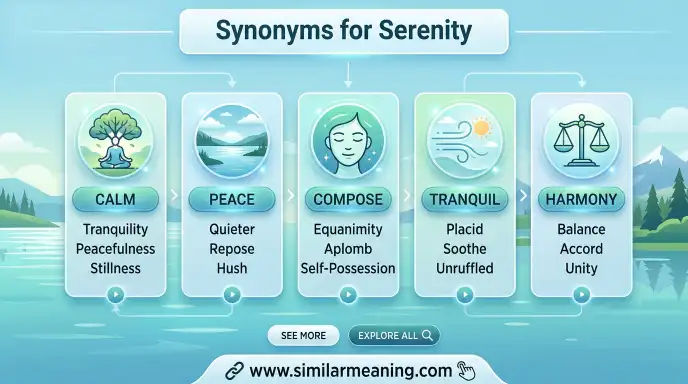
Some common synonyms for serenity include tranquility, peace, calmness, peacefulness, composure, stillness, and placidity. However, each word has a slightly different meaning. For example, tranquility often describes a peaceful environment, while composure refers to remaining calm and in control of your emotions. Similarly, stillness emphasizes a lack of movement or noise rather than a person’s emotional state.
Choosing the right synonym can make your writing clearer and more meaningful. In this guide, you will discover 30 words related to serenity, along with their definitions, pronunciations, examples, and differences. You will also learn how to use these words in different contexts and understand their opposite meanings.
What Does Serenity Mean?
Serenity is a noun that describes a state of peace, calmness, and freedom from disturbance. It can refer to a person’s inner feelings or to a quiet and peaceful place.
For example:
- She enjoyed the serenity of the countryside.
- Meditation helped him find serenity after a stressful day.
- The lake’s serenity made it a perfect place to relax.
Serenity does not necessarily mean that no problems exist. Instead, it describes a peaceful state of mind or surroundings despite the challenges of everyday life.
Pronunciation of Serenity
- American English IPA: /səˈrenəti/
- British English IPA: /səˈrenəti/
- Syllables: se ren i ty
- Part of speech: Noun
- Related adjective: Serene
- Related adverb: Serenely
Connotation of Serenity
Serenity generally has a positive and soothing connotation. It suggests emotional balance, quiet surroundings, inner peace, and freedom from unnecessary worry.
For example, the serenity of the garden suggests a quiet and peaceful place, while her serenity during the crisis describes her calm emotional state.
30 Serenity Synonyms and Their Meanings
The following words are synonyms or closely related expressions. Some can replace serenity in certain sentences, while others describe a particular aspect of peace or calmness.
1. Tranquility
Pronunciation: /træŋˈkwɪləti/ (US), /træŋˈkwɪləti/ (UK)
Meaning: A state of peace and quiet, without disturbance or excitement.
Examples:
- She enjoyed the tranquility of the mountain village.
- The garden offered tranquility after a busy day.
Prototype meaning: Peaceful surroundings or a calm state.
Category: Peace and quiet.
Antonyms: Turmoil, disturbance, agitation.
2. Peace
Pronunciation: /piːs/
Meaning: A state of freedom from conflict, disturbance, or mental stress.
Examples:
- He found peace while walking beside the river.
- She wanted some peace after a demanding day.
Prototype meaning: Being free from conflict or disturbance.
Category: Harmony and calmness.
Antonyms: Conflict, turmoil, unrest.
3. Calmness
Pronunciation: /ˈkɑːmnəs/ (US), /ˈkɑːmnəs/ (UK)
Meaning: The quality of being relaxed and not showing strong nervousness or excitement.
Examples:
- Her calmness helped everyone focus.
- He answered the difficult question with calmness.
Prototype meaning: Remaining relaxed and composed.
Category: Emotional balance.
Antonyms: Agitation, nervousness, excitement.
4. Peacefulness
Pronunciation: /ˈpiːsfəlnəs/
Meaning: The quality of being quiet, gentle, and free from conflict or disturbance.
Examples:
- The peacefulness of the village attracted visitors.
- She appreciated the peacefulness of her home.
Prototype meaning: A quiet and undisturbed state.
Category: Quiet and harmony.
Antonyms: Violence, unrest, disturbance.
5. Composure
Pronunciation: /kəmˈpoʊʒər/ (US), /kəmˈpəʊʒə/ (UK)
Meaning: The ability to remain calm and in control of your emotions.
Examples:
- She maintained her composure during the interview.
- He regained his composure after hearing the news.
Prototype meaning: Staying emotionally controlled under pressure.
Category: Self control and emotional balance.
Antonyms: Panic, agitation, loss of control.
6. Stillness
Pronunciation: /ˈstɪlnəs/
Meaning: A state of having little or no movement, noise, or activity.
Examples:
- The stillness of the forest was refreshing.
- He enjoyed the stillness of the early morning.
Prototype meaning: Quietness without movement or noise.
Category: Silence and quiet surroundings.
Antonyms: Movement, commotion, activity.
7. Placidity
Pronunciation: /pləˈsɪdəti/
Meaning: A state of calmness and an absence of disturbance or strong emotion.
Examples:
- The placidity of the lake made it look beautiful.
- She admired his placidity during the disagreement.
Prototype meaning: A calm and undisturbed state.
Category: Calmness and stability.
Antonyms: Agitation, turbulence, restlessness.
8. Equanimity
Pronunciation: /ˌiːkwəˈnɪməti/
Meaning: Mental calmness and emotional balance, especially during difficult situations.
Examples:
- She faced the unexpected change with equanimity.
- His equanimity helped him make a thoughtful decision.
Prototype meaning: Maintaining emotional balance under pressure.
Category: Emotional stability.
Antonyms: Anxiety, panic, emotional instability.
9. Repose
Pronunciation: /rɪˈpoʊz/ (US), /rɪˈpəʊz/ (UK)
Meaning: A state of rest, relaxation, or peaceful inactivity.
Examples:
- She sat in repose beneath a shady tree.
- The quiet room provided a place of repose.
Prototype meaning: Resting in a peaceful state.
Category: Rest and relaxation.
Antonyms: Activity, agitation, restlessness.
10. Serenity of Mind
Pronunciation: /səˈrenəti əv maɪnd/
Meaning: A state of inner peace and freedom from excessive worry.
Examples:
- Spending time in nature gave her serenity of mind.
- He worked toward serenity of mind through reflection.
Prototype meaning: Feeling peaceful within yourself.
Category: Inner peace.
Antonyms: Mental turmoil, anxiety, distress.
11. Relaxation
Pronunciation: /ˌriːlækˈseɪʃən/
Meaning: The process or state of becoming less tense and more comfortable.
Examples:
- Reading provided relaxation after work.
- The soft music encouraged relaxation.
Prototype meaning: Releasing tension and resting.
Category: Rest and stress relief.
Antonyms: Tension, stress, strain.
12. Harmony
Pronunciation: /ˈhɑːrməni/ (US), /ˈhɑːməni/ (UK)
Meaning: A state of agreement, balance, or peaceful coexistence.
Examples:
- The family lived together in harmony.
- She wanted harmony between her studies and personal life.
Prototype meaning: Living or working together peacefully.
Category: Balance and agreement.
Antonyms: Discord, conflict, disagreement.
13. Contentment
Pronunciation: /kənˈtentmənt/
Meaning: A feeling of satisfaction with your situation or what you have.
Examples:
- He felt contentment while spending time with family.
- Her simple lifestyle brought her contentment.
Prototype meaning: Feeling satisfied and at ease.
Category: Satisfaction and emotional peace.
Antonyms: Dissatisfaction, discontent, frustration.
14. Serenity and Stillness
Pronunciation: /səˈrenəti ænd ˈstɪlnəs/
Meaning: A phrase describing peaceful calmness together with an absence of movement or noise.
Examples:
- The poem captures the serenity and stillness of winter.
- She enjoyed the serenity and stillness of the empty beach.
Prototype meaning: A peaceful environment with little disturbance.
Category: Quiet surroundings.
Antonyms: Noise, commotion, turmoil.
15. Tranquillity of Mind
Pronunciation: /træŋˈkwɪləti əv maɪnd/
Meaning: A state of mental peace without excessive worry or agitation.
Examples:
- A quiet walk helped him regain tranquillity of mind.
- She valued tranquillity of mind more than constant excitement.
Prototype meaning: A peaceful and settled mind.
Category: Inner calm.
Antonyms: Anxiety, worry, mental turmoil.
16. Gentleness
Pronunciation: /ˈdʒentəlnəs/
Meaning: The quality of being kind, mild, or tender rather than harsh or forceful.
Examples:
- Her gentleness made others feel comfortable.
- He spoke with gentleness during the disagreement.
Prototype meaning: A mild and non aggressive manner.
Category: Softness and kindness.
Antonyms: Harshness, aggression, severity.
17. Quietude
Pronunciation: /ˈkwaɪətuːd/
Meaning: A state of quietness, stillness, or peaceful solitude.
Examples:
- She searched for quietude in the countryside.
- The library offered quietude for thoughtful reading.
Prototype meaning: Peaceful quietness.
Category: Silence and solitude.
Antonyms: Noise, commotion, uproar.
18. Mindfulness
Pronunciation: /ˈmaɪndfəlnəs/
Meaning: The practice of paying attention to the present moment with awareness.
Examples:
- Mindfulness helped her notice her thoughts without rushing to judge them.
- He practised mindfulness during his morning routine.
Prototype meaning: Being aware of the present moment.
Category: Awareness and mental balance.
Antonyms: Inattention, distraction, mindlessness.
19. Stability
Pronunciation: /stəˈbɪləti/
Meaning: A state of being steady, secure, or unlikely to change suddenly.
Examples:
- A regular routine gave her a sense of stability.
- Emotional stability helped him handle unexpected changes.
Prototype meaning: Remaining steady rather than becoming unsettled.
Category: Balance and security.
Antonyms: Instability, uncertainty, volatility.
20. Serenity of Spirit
Pronunciation: /səˈrenəti əv ˈspɪrɪt/
Meaning: A phrase describing inner peace, emotional ease, and a settled attitude.
Examples:
- She found serenity of spirit in quiet reflection.
- His serenity of spirit helped him approach life thoughtfully.
Prototype meaning: Feeling peaceful within yourself.
Category: Inner peace and reflection.
Antonyms: Inner turmoil, distress, agitation.
21. Restfulness
Pronunciation: /ˈrestfəlnəs/
Meaning: The quality of being restful, relaxing, or free from activity and strain.
Examples:
- The restfulness of the garden made it ideal for a break.
- She enjoyed the restfulness of a quiet weekend.
Prototype meaning: A state that allows rest and recovery.
Category: Rest and relaxation.
Antonyms: Exhaustion, agitation, busyness.
22. Mildness
Pronunciation: /ˈmaɪldnəs/
Meaning: The quality of being gentle, moderate, or not severe.
Examples:
- The mildness of the evening made the walk pleasant.
- His mildness helped keep the discussion friendly.
Prototype meaning: A gentle or moderate quality.
Category: Gentleness and moderation.
Antonyms: Severity, harshness, intensity.
23. Poise
Pronunciation: /pɔɪz/
Meaning: Graceful self control and confidence, especially in a difficult situation.
Examples:
- She answered the questions with poise.
- His poise impressed the audience.
Prototype meaning: Staying balanced, confident, and composed.
Category: Self control and confidence.
Antonyms: Awkwardness, nervousness, agitation.
24. Solitude
Pronunciation: /ˈsɑːlətuːd/ (US), /ˈsɒlɪtjuːd/ (UK)
Meaning: The state of being alone, often by choice.
Examples:
- She enjoyed solitude while reading in the garden.
- He used solitude to reflect on his goals.
Prototype meaning: Spending time alone in a quiet setting.
Category: Privacy and quiet reflection.
Antonyms: Companionship, company, social activity.
25. Ease
Pronunciation: /iːz/
Meaning: A state of comfort, freedom from difficulty, or absence of tension.
Examples:
- She spoke with ease during the presentation.
- The familiar surroundings gave him a sense of ease.
Prototype meaning: Feeling comfortable rather than tense.
Category: Comfort and relaxation.
Antonyms: Difficulty, tension, discomfort.
26. Quietness
Pronunciation: /ˈkwaɪətnəs/
Meaning: The quality of having little noise or disturbance.
Examples:
- The quietness of the room helped her concentrate.
- He appreciated the quietness of the countryside.
Prototype meaning: An absence of noise and commotion.
Category: Silence and peaceful surroundings.
Antonyms: Loudness, noise, commotion.
27. Reassurance
Pronunciation: /ˌriːəˈʃʊrəns/ (US), /ˌriːəˈʃʊərəns/ (UK)
Meaning: Words or actions that reduce worry and help someone feel more confident.
Examples:
- Her teacher’s reassurance helped her feel calmer.
- A clear explanation gave the family reassurance.
Prototype meaning: Feeling less worried because of support or certainty.
Category: Comfort and emotional security.
Antonyms: Alarm, uncertainty, discouragement.
28. Restfulness of Mind
Pronunciation: /ˈrestfəlnəs əv maɪnd/
Meaning: A state in which the mind feels relaxed and free from unnecessary mental strain.
Examples:
- A peaceful evening gave him restfulness of mind.
- She looked for restfulness of mind after a busy week.
Prototype meaning: A relaxed and untroubled mental state.
Category: Mental relaxation.
Antonyms: Mental strain, worry, agitation.
29. Balance
Pronunciation: /ˈbæləns/
Meaning: A state of stability or a suitable relationship between different parts of life.
Examples:
- She found balance by making time for work and rest.
- A balanced routine helped him feel more settled.
Prototype meaning: Maintaining stability without becoming overwhelmed.
Category: Stability and well being.
Antonyms: Imbalance, instability, excess.
30. Untroubledness
Pronunciation: /ʌnˈtrʌbəldnəs/
Meaning: The state of being free from worry, distress, or disturbance.
Examples:
- The quiet surroundings gave her a sense of untroubledness.
- He valued the untroubledness of his early morning walks.
Prototype meaning: Feeling free from worry or disturbance.
Category: Freedom from worry.
Antonyms: Anxiety, distress, uneasiness.
Types of Serenity Synonyms
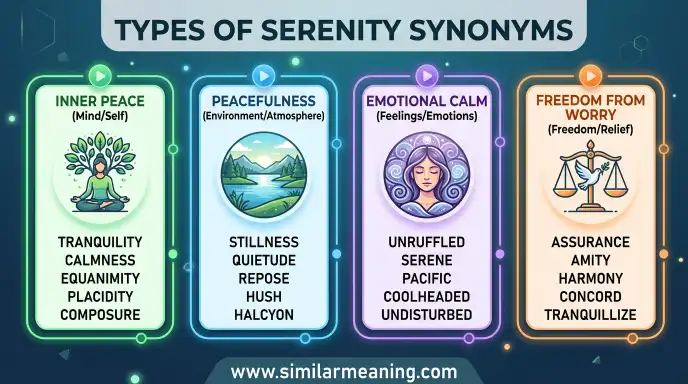
Not every word related to serenity expresses exactly the same idea. Grouping these words by meaning helps you choose the best option for your sentence.
1. Peace and Quiet
These words focus on peaceful surroundings or an absence of disturbance:
- Tranquility
- Peacefulness
- Stillness
- Quietude
- Quietness
- Peace
Example: The tranquility of the countryside offered a welcome break from city noise.
2. Inner Peace and Emotional Balance
These words describe a peaceful state of mind:
- Equanimity
- Composure
- Serenity of mind
- Tranquillity of mind
- Serenity of spirit
- Mindfulness
Example: She maintained her composure during the difficult conversation.
3. Rest and Relaxation
These words emphasize comfort, rest, or freedom from tension:
- Relaxation
- Repose
- Restfulness
- Ease
- Restfulness of mind
Example: Reading in a quiet room gave him a feeling of relaxation.
4. Harmony and Emotional Satisfaction
These words describe balance, agreement, or satisfaction:
- Harmony
- Contentment
- Stability
- Balance
- Reassurance
Example: A balanced routine helped her feel more contentment and stability in everyday life.
5. Gentle and Composed Behavior
These words focus on how someone behaves or responds:
- Calmness
- Placidity
- Gentleness
- Mildness
- Poise
Example: Her poise helped her respond calmly to an unexpected question.
How to Choose the Best Synonym for Serenity
The best synonym depends on the context and the type of peace you want to describe.
| If You Mean… | Best Word | Example |
| A peaceful environment | Tranquility | The tranquility of the lake was beautiful. |
| Inner peace | Serenity of mind | She searched for serenity of mind. |
| Calm behavior under pressure | Composure | He maintained his composure. |
| Emotional balance | Equanimity | She faced the news with equanimity. |
| Freedom from conflict | Peace | They hoped for peace. |
| Satisfaction with life | Contentment | He felt contentment in his simple routine. |
| Quiet surroundings | Quietude | The garden offered quietude. |
| Graceful self control | Poise | She answered with poise. |
| Time spent alone | Solitude | He enjoyed solitude in the countryside. |
| Freedom from tension | Ease | She spoke with ease. |
Remember that these words are related to serenity but are not always interchangeable. For example, solitude means being alone, which may or may not feel peaceful. Contentment means satisfaction, while serenity focuses more directly on peace and calmness.
Serenity Synonyms for Different Writing Styles
Formal Writing
For academic essays, professional documents, and formal descriptions, consider:
- Tranquility
- Equanimity
- Composure
- Emotional balance
- Peacefulness
Example: The ability to maintain composure during uncertainty can support thoughtful decision making.
Everyday Conversations
For casual conversations, these words often sound natural:
- Peace
- Calmness
- Quietness
- Ease
- Relaxation
Example: I enjoy the peace and quiet of my room after a long day.
Creative Writing and Poetry
For poetry, stories, and descriptive writing, consider:
- Tranquility
- Stillness
- Quietude
- Repose
- Serenity of spirit
Example: The stillness of the moonlit lake brought a sense of tranquility to the night.
Antonyms of Serenity
An antonym is a word with an opposite or contrasting meaning. Common antonyms of serenity include:
| Antonym | Meaning | Example |
| Turmoil | A state of confusion or disturbance | The news caused turmoil in the community. |
| Agitation | A state of nervous excitement or upset | He spoke with agitation. |
| Anxiety | Worry or nervousness about something | Her anxiety increased before the interview. |
| Distress | Serious worry, sadness, or discomfort | The sudden change caused distress. |
| Unrest | A state of disturbance or dissatisfaction | The announcement led to unrest. |
| Chaos | Complete disorder or confusion | The unexpected delay created chaos. |
| Turbulence | A state of disturbance or instability | The organization experienced turbulence. |
| Restlessness | An inability to relax or remain still | His restlessness made it hard to concentrate. |
The most suitable opposite depends on the context. Turmoil is a strong contrast when describing a peaceful situation, while agitation is useful when describing someone’s emotional state.
Common Mistakes When Using Serenity Synonyms
Mistake 1: Treating Every Related Word as an Exact Synonym
Incorrect: Solitude and serenity always mean the same thing.
Correct: Solitude means being alone, while serenity means being peaceful and calm.
Why? A person can feel lonely or anxious in solitude, so being alone does not automatically mean feeling serene.
Mistake 2: Confusing Calmness with Contentment
Incorrect: Contentment always means a person is calm.
Correct: Contentment means satisfaction, while calmness means being relaxed or emotionally composed.
Why? A person can be satisfied but excited, or calm without feeling satisfied.
Mistake 3: Using Stillness When You Mean Inner Peace
Incorrect: She found stillness in her thoughts. (when the intended meaning is emotional peace)
More natural: She found inner peace in her thoughts.
Why? Stillness often refers to a lack of movement or noise, while inner peace describes a mental or emotional state.
Mistake 4: Confusing Composure with the Absence of Emotion
Incorrect: Composure means never feeling nervous or sad.
Correct: Composure means remaining in control of your behavior and emotions.
Why? A composed person may still experience strong feelings but can respond thoughtfully.
People Also Ask About Serenity Synonyms
1. What Is the Best Synonym for Serenity?
Tranquility is one of the closest synonyms for serenity. Other useful alternatives include peace, calmness, and peacefulness, depending on the context.
2. What Are Five Synonyms for Serenity?
Five common synonyms are tranquility, peace, calmness, peacefulness, and composure.
3. What Is a Stronger Word for Serenity?
There is no single strongest word for every situation. Equanimity emphasizes emotional balance during difficulties, while tranquility emphasizes a peaceful and undisturbed state.
4. What Is the Opposite of Serenity?
Common opposites include turmoil, agitation, unrest, and distress. The most suitable word depends on if you mean a disturbed environment or an unsettled emotional state.
5. How Can I Describe a Serene Person?
You can describe a serene person as calm, composed, peaceful, collected, or even tempered. Composed is especially useful when the person remains calm under pressure.
6. Is Serenity the Same as Peace?
The words are closely related but not identical. Peace can mean freedom from conflict or disturbance, while serenity often suggests a deeper sense of calmness and quiet.
Frequently Asked Questions (FAQs)
What Is the Meaning of Serenity in Simple Words?
Serenity means being peaceful, calm, and free from disturbance. It can describe how someone feels or how quiet a place is.
What Is a Good Synonym for Serenity in an Essay?
Tranquility, peacefulness, composure, and equanimity are useful alternatives. Choose the word that best fits your sentence.
What Is the Adjective Form of Serenity?
The adjective form is serene.
Example: The lake looked serene in the early morning.
What Is the Adverb Form of Serenity?
The related adverb is serenely.
Example: She serenely watched the sunset.
Can Serenity Describe a Place?
Yes. Serenity can describe a quiet and peaceful place, such as a garden, lake, forest, or countryside.
Example: The serenity of the beach made it an ideal place to relax.
Is Serenity a Feeling or a State?
It can be both. Serenity may describe an inner feeling of peace or a general state of calmness in a person or environment.
Conclusion
Learning serenity synonyms can help you describe peace, calmness, emotional balance, and quiet surroundings more clearly. Words such as tranquility, peace, calmness, peacefulness, and composure are useful alternatives, but each has its own meaning.
Tranquility often describes a peaceful environment, while composure refers to staying in control of your emotions. Equanimity is especially useful when describing calmness during difficult situations.
For formal writing, words such as equanimity and composure can make your sentences more precise. In everyday conversations, peace, calmness, and relaxation often sound natural. For poetry and descriptive writing, stillness, quietude, and repose can help create a gentle atmosphere.
Remember that serenity does not mean that life is free from challenges. It describes a peaceful state of mind or surroundings, even when difficulties exist. By understanding the differences between these 30 words and expressions, you can improve your vocabulary, write more effectively, and express ideas about peace with greater accuracy.
Discover More Articles!
Confused Synonyms: 30 Words to Express Confusion
Synonyms for Learns: 30 Words With Meanings and Examples
Sweetheart Synonyms: 30 Words for Every Meaning

Justin Cord Hayes is an Adams Media author and co-author of several vocabulary and thesaurus books. His work focuses on synonyms, antonyms, word choice, and expanding English vocabulary. He co-authored Roget’s Thesaurus of Words for Writers, Roget’s Thesaurus of Words for Students, and Roget’s Thesaurus of Words for Intellectuals. His books are designed to help readers find clearer and more effective words for writing and communication.







2 thoughts on “Serenity Synonyms: 30 Powerful Words to Describe Peace and Calm”