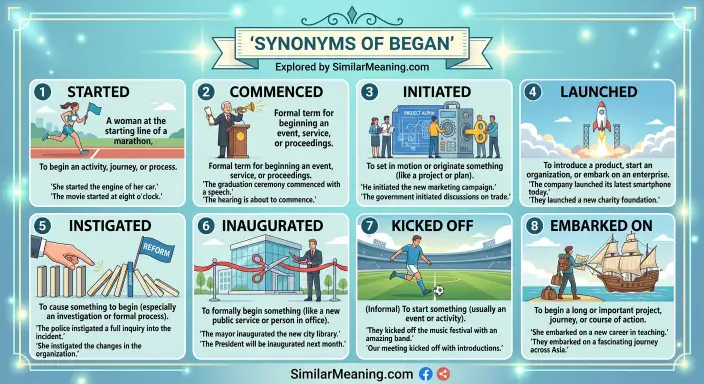
The best synonyms of “began” include started, commenced, initiated, launched, opened, introduced, and embarked on.
These words describe the beginning of an action, activity, event, process, or journey. However, each alternative has a slightly different meaning and works best in particular situations.
For example, “started” is the most common and natural alternative to “began” in everyday English. “Commenced” sounds more formal, while “initiated” often describes starting a process or taking the first step toward a goal. “Launched” is commonly used for businesses, products, campaigns, and projects.
Choosing the right synonym can make your writing clearer, more varied, and more engaging. if you are writing a school assignment, a professional email, a story, or an article, knowing different ways to express the beginning of something can improve your vocabulary.
In this guide, you will discover 30 synonyms of “began,” learn their meanings, and see how to use them in sentences. You will also explore differences between similar words, common grammar mistakes, and answers to frequently asked questions.
Quick Answer: What Are the Best Synonyms of Began?
Here are some useful alternatives to “began”:
- Started
- Commenced
- Initiated
- Launched
- Opened
- Introduced
- Undertook
- Embarked on
- Set out
- Got underway
- Inaugurated
- Instigated
- Activated
- Established
- Kicked off
Best for everyday English: Started.
For formal writing: Commenced.
Best for a new project or product: Launched.
Good for beginning a process: Initiated.
Best for starting a journey or challenge: Embarked on.
Definition and Meaning of Began
What Does Began Mean?
“Began” is the simple past tense of the verb “begin.” It means that an action, activity, event, or process started at a particular time in the past.
Examples:
- She began her homework after dinner.
- The meeting began at nine o’clock.
- They began learning English last year.
- It began to rain in the afternoon.
“Began” is an irregular verb form. Its three main forms are:
- Base form: Begin
- Past tense: Began
- Past participle: Begun
For example, you can say, “I began my work yesterday,” but “I have begun my work” is the correct present perfect construction.
Why Use Synonyms of Began?
Synonyms help you express the same general idea in different ways. They can also make your writing more precise.
For example:
- “The meeting began at noon.”
- “The meeting commenced at noon.”
Both sentences describe a meeting starting, but “commenced” sounds more formal.
Similarly, “The company began a new campaign” and “The company launched a new campaign” are both understandable, but “launched” is particularly natural for campaigns.
30 Synonyms of Began and Their Meanings
The following words and phrases can replace “began” in suitable contexts. Some are direct alternatives, while others describe specific kinds of beginnings.
Note: These expressions are not interchangeable in every sentence. For example, “sparked” and “triggered” usually emphasize causing something to happen, while “commenced” directly means that something began.
Synonyms of Began With Example Sentences
Learning synonyms in context helps you understand their meanings and grammatical patterns.
1. Started
“Started” is the most common synonym of “began.” It works in everyday conversation and most types of writing.
Example: “She started writing her essay after lunch.”
2. Commenced
“Commenced” means began and is often used in formal announcements, reports, or official documents.
Example: “The ceremony commenced at ten o’clock.”
3. Initiated
“Initiated” describes taking the first step in a process, plan, or activity.
Example: “The school initiated a new reading program.”
4. Launched
“Launched” is commonly used when starting a new product, campaign, service, or project.
Example: “The company launched its new website last week.”
5. Opened
“Opened” can mean beginning an event, speech, discussion, or formal session.
Example: “The chairperson opened the meeting with a short speech.”
6. Embarked On
“Embarked on” describes beginning a journey, undertaking, or significant new experience.
Example: “She embarked on a career in teaching.”
7. Kicked Off
“Kicked off” is an informal expression for starting an event, activity, or campaign.
Example: “The festival kicked off with a live music performance.”
8. Undertook
“Undertook” means began or accepted a task, duty, or responsibility.
Example: “He undertook a challenging research project.”
9. Set Out
“Set out” can describe beginning a journey or starting to achieve a particular goal.
Example: “They set out to improve the quality of education.”
10. Set in Motion
This phrase describes causing a process or series of events to begin.
Example: “The new policy set in motion several important changes.”
Synonyms of Began for Different Situations
The best synonym depends on what started and the tone you want to create.
For Everyday English
Use these simple and natural expressions:
- Started
- Got started
- Took up
- Set about
- Kicked off
Examples:
- “I started reading a new book.”
- “She took up painting last summer.”
- “Let’s get started with the lesson.”
For Formal and Academic Writing
These alternatives often work well in official or academic contexts:
- Commenced
- Initiated
- Undertook
- Inaugurated
- Entered upon
Examples:
- “The research commenced in September.”
- “The university initiated a new academic program.”
- “The committee undertook a detailed review.”
For Business and Projects
Choose words that emphasize introducing or setting up something:
- Launched
- Established
- Rolled out
- Activated
- Began operations
Examples:
- “The business launched a new service.”
- “The organization established a training center.”
- “The company rolled out an updated application.”
For Stories and Creative Writing
These words can add variety and help describe how an event started:
- Sparked
- Originated
- Opened
- Set in motion
- Triggered
Examples:
- “A simple question sparked an interesting conversation.”
- “The story opened with a mysterious message.”
- “One small decision set in motion a series of events.”
Began vs Begun vs Started
These words are related, but their grammatical uses differ.
| Word | Grammatical Form | Example |
| Begin | Base form | I begin my work at nine. |
| Began | Simple past tense | I began my work yesterday. |
| Begun | Past participle | I have begun my work. |
| Started | Past tense and past participle of start | I started my work yesterday. |
| Commenced | Past tense and past participle of commence | The event commenced at noon. |
Remember that “began” is not normally used after “have,” “has,” or “had” in standard English. Use “begun” in those constructions.
Correct: “She began the assignment yesterday.”
Correct: “She has begun the assignment.”
Incorrect: “She has began the assignment.”
How to Choose the Right Synonym for Began
Follow these simple tips to select the best alternative.
1. Consider the Context
If you are describing a normal daily activity, “started” is usually the clearest choice.
Example: “I started cooking dinner.”
2. Match the Formality
For an official report, “commenced” or “initiated” may be suitable.
Example: “The investigation commenced on Monday.”
3. Think About the Type of Action
Different verbs naturally fit different activities.
- A company launches a product.
- A chairperson opens a meeting.
- A person embarks on a journey.
- A person takes up a hobby.
- An event gets underway.
4. Choose Accuracy Over Variety
Do not replace “began” with a complicated word simply to sound sophisticated. The best synonym is the one that communicates the intended meaning naturally.
Common Mistakes When Using Synonyms of Began
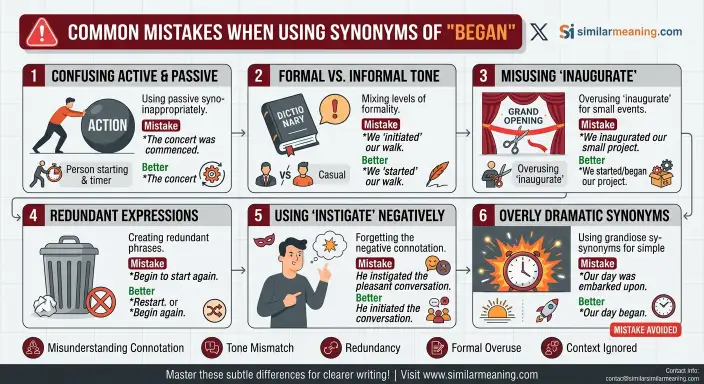
Mistake 1: Using “Began” Instead of “Begun”
Incorrect: “They have began the project.”
Correct: “They have begun the project.”
Why? “Begun” is the past participle used with helping verbs such as “have,” “has,” and “had.”
Mistake 2: Using “Launched” for Every Beginning
“Launch” is especially natural for products, campaigns, initiatives, and projects. It may sound unusual when describing a simple daily activity.
Less natural: “I launched my breakfast at eight.”
Better: “I started my breakfast at eight.”
Mistake 3: Confusing “Sparked” With “Started”
“Sparked” often means caused or triggered something to begin, rather than simply beginning an action.
Example: “Her comment sparked a debate.”
Mistake 4: Using Informal Phrases in Formal Writing
“Kicked off” and “got started” are natural in conversation, but they may be too informal for certain official reports.
Better formal choice: “The conference commenced at nine o’clock.”
Why Learning Synonyms of Began Improves Your Vocabulary
Learning alternatives to “began” helps you express actions and events with greater precision. Instead of repeating the same word, you can select a verb that reflects the type of beginning you are describing.
For example, “launched” works well for a new product, “initiated” suits the first step in a process, and “embarked on” can describe a significant journey or undertaking. These distinctions help make writing more natural and informative.
Synonyms are particularly useful for students, English learners, bloggers, and professional writers. They can improve essays, reports, storytelling, emails, and everyday conversations.
However, a strong vocabulary is not just about knowing more words. It is also about understanding their meanings, grammar, and context. Practice using these expressions in your own sentences to remember them more easily.
Frequently Asked Questions
1. What is the best synonym for began?
“Started” is the most common and versatile synonym. “Commenced,” “initiated,” and “launched” are useful alternatives in more specific contexts.
2. What is a formal synonym for began?
“Commenced” is a common formal alternative. “Initiated” is also useful when describing the beginning of a process or official action.
3. What is another word for began in a story?
“Started,” “opened,” “commenced,” and “originated” may work, depending on the sentence. For example, “The story opened with a surprising discovery.”
4. What is a synonym for began a journey?
“Set out” and “embarked on” are good choices.
Example: “They embarked on a journey across the country.”
5. What is the difference between began and started?
“Began” and “started” usually have the same general meaning. “Started” is especially common in everyday English, while “began” can sound slightly more formal in some contexts.
6. Is commenced a synonym for began?
Yes. “Commenced” means began and is often used in formal or official contexts.
Example: “The examination commenced at nine o’clock.”
7. What is the past participle of begin?
The past participle is “begun.”
Example: “The meeting has begun.”
8. Can launched replace began?
Yes, when the context involves introducing or starting something such as a product, project, campaign, or service.
Example: “The company launched a new campaign.”
9. What is a synonym for began working?
Depending on the sentence, you can use “started working,” “set about working,” or “got to work.”
Example: “She got to work as soon as she arrived.”
10. How can I avoid repeating began in an essay?
Choose alternatives that match the context, such as “started,” “commenced,” “initiated,” or “launched.” Use each word naturally rather than replacing every occurrence mechanically.
Conclusion
The best synonyms of “began” include “started,” “commenced,” “initiated,” “launched,” “opened,” and “embarked on.” Although these words share the general idea of beginning, they are not always interchangeable.
“Started” is suitable for everyday activities, “commenced” is often more formal, and “launched” works particularly well for products, projects, and campaigns.
Choosing the right synonym can make your writing clearer, more varied, and more precise. When describing a journey, you might use “embarked on.” When discussing a formal process, “initiated” may be appropriate. For an ordinary daily activity, “started” is often the simplest and most natural choice.
Remember to pay attention to grammar as well. “Began” is the simple past tense of “begin,” while “begun” is its past participle. Understanding both vocabulary and grammar will help you write more confidently.
Ultimately, the best word is the one that fits your sentence and communicates your meaning accurately. Practice these 30 alternatives to improve your vocabulary and make your English writing more effective.
Discover More Articles!
Adulation Synonyms: 30 Powerful Alternatives
Best Friend Synonyms: 30 Powerful Words to Describe a Close Friend
Beautiful Smile Synonyms: 30 Beautiful Words to Describe a Smile





2 thoughts on “Synonyms of Began: 30 Powerful Words to Improve Your Vocabulary”