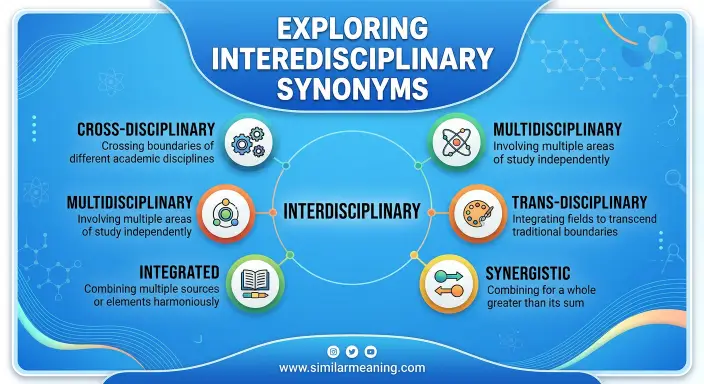
Looking for synonyms for interdisciplinary? Common alternatives include multidisciplinary, cross disciplinary, integrated, collaborative, and holistic. These words describe ways of combining ideas, knowledge, or methods from different fields. However, each word has a slightly different meaning, so the best choice depends on your sentence.
For example, an interdisciplinary project may combine science, technology, and art to solve one problem. A multidisciplinary team may include experts from several subjects who each contribute their own knowledge. Both approaches involve different fields, but they do not always work in the same way.
Understanding these differences can improve your academic writing, professional communication, and everyday vocabulary. It can also help you avoid repeating the same word in essays, research papers, reports, and presentations.
In this guide, you will discover 30 alternatives to interdisciplinary, with simple definitions, example sentences, and notes about how each word is used. You will also learn which synonyms work best in academic writing and how to choose the most accurate word for your needs.
Quick Answer: Interdisciplinary Synonyms
The best synonyms for interdisciplinary include:
- Multidisciplinary: Involving several academic or professional fields.
- Cross disciplinary: Connecting or bringing together different fields.
- Integrated: Combining separate parts into a whole.
- Collaborative: Involving people working together.
- Holistic: Considering the whole rather than only individual parts.
- Transdisciplinary: Going beyond traditional subject boundaries to develop a shared approach.
Example:
An interdisciplinary study combines ideas from biology and computer science to understand a complex problem.
The closest alternative is often multidisciplinary or cross disciplinary, but the right choice depends on the context.
What Does Interdisciplinary Mean?
Interdisciplinary is an adjective that describes an approach combining knowledge, methods, or ideas from two or more academic or professional fields.
It is commonly used in education, research, healthcare, business, and technology.
Definition of Interdisciplinary
The word refers to connections between different disciplines, such as mathematics, history, psychology, biology, and engineering.
Examples:
- The university offers an interdisciplinary research program.
- The project combines art and science in an interdisciplinary way.
- Climate change requires an interdisciplinary approach.
- Students completed an interdisciplinary assignment involving history and technology.
When Is Interdisciplinary Used?
Use interdisciplinary when different subjects or fields contribute to a shared question, project, or solution.
For example, a project that combines psychology and computer science to understand human behavior is interdisciplinary because it uses ideas from both fields.
30 Best Synonyms for Interdisciplinary
The following alternatives are useful in academic, professional, and general writing. Some are close synonyms, while others describe a related approach rather than exactly the same meaning.
1. Multidisciplinary
Meaning: Involving several different subjects or areas of expertise.
Example: The university created a multidisciplinary research team.
Best use: Academic programs, research teams, and projects involving several fields.
2. Cross disciplinary
Meaning: Connecting or bringing together different disciplines.
Example: The course encourages cross disciplinary learning.
Best use: Education, research, and projects that connect different subjects.
3. Transdisciplinary
Meaning: Going beyond the boundaries of individual disciplines to create a shared framework or approach.
Example: The researchers developed a transdisciplinary solution to the city’s water problems.
Best use: Complex research and real world problems requiring knowledge across traditional fields.
4. Integrated
Meaning: Combining separate parts into one connected system.
Example: The school uses an integrated curriculum that connects science and mathematics.
Best use: Curricula, systems, research methods, and learning approaches.
5. Collaborative
Meaning: Involving people working together toward a shared goal.
Example: The team used a collaborative approach to study public health.
Best use: Teamwork and joint research. It describes cooperation rather than necessarily combining disciplines.
6. Holistic
Meaning: Considering the whole situation rather than focusing only on individual parts.
Example: The researchers took a holistic approach to community health.
Best use: Healthcare, education, planning, and systems thinking.
7. Comprehensive
Meaning: Covering many aspects of a subject.
Example: The report provides a comprehensive analysis of education and technology.
Best use: Reports, studies, reviews, and assessments.
8. Combined
Meaning: Joined together or used together.
Example: The project used combined methods from economics and sociology.
Best use: General writing when several methods, ideas, or subjects are brought together.
9. Connected
Meaning: Linked or related to one another.
Example: The course explores connected themes in science and society.
Best use: General explanations of related subjects and ideas.
10. Cooperative
Meaning: Involving people or groups working together.
Example: The cooperative research project brought teachers and scientists together.
Best use: Team projects and shared research efforts.
11. Interconnected
Meaning: Linked in ways that allow different parts to affect one another.
Example: The study examines the interconnected effects of technology and education.
Best use: Complex systems, social issues, and research.
12. Convergent
Meaning: Coming together toward a common point, goal, or conclusion.
Example: The team used convergent methods to examine the problem from different perspectives.
Best use: Research and problem solving when different approaches lead toward a shared result.
13. Synergistic
Meaning: Producing a stronger combined effect through cooperation.
Example: The synergistic relationship between design and engineering improved the product.
Best use: Business, research, and teamwork when combined efforts create added value.
14. Hybrid
Meaning: Combining elements from different sources, types, or systems.
Example: The university introduced a hybrid program combining technical and creative subjects.
Best use: Education, technology, and programs that mix different approaches.
15. Multidimensional
Meaning: Involving several aspects, perspectives, or dimensions.
Example: The researchers developed a multidimensional model of social change.
Best use: Complex topics that require more than one perspective.
16. Interrelated
Meaning: Connected because different parts influence or affect one another.
Example: The study explores interrelated issues in economics and environmental science.
Best use: Explaining relationships between subjects or problems.
17. Cross functional
Meaning: Involving people or activities from different functions or departments.
Example: A cross functional team developed the new learning platform.
Best use: Business, organizations, and product development. It is more organizational than academic.
18. Interprofessional
Meaning: Involving people from different professions working together.
Example: The hospital introduced interprofessional training for healthcare workers.
Best use: Healthcare, social services, and professional teamwork.
19. Multisectoral
Meaning: Involving several sectors, such as health, education, government, and business.
Example: The government launched a multisectoral plan to improve public health.
Best use: Public policy, development, and large scale social projects.
20. Interconnected disciplinary
Meaning: An uncommon descriptive phrase suggesting links between different disciplines.
Example: The course takes an interconnected disciplinary view of social problems.
Best use: Only when a specific technical context supports it. In most writing, interdisciplinary or cross disciplinary is more natural.
21. Inclusive
Meaning: Including different people, ideas, or perspectives.
Example: The research adopted an inclusive approach to community development.
Best use: Projects that value a wide range of viewpoints. It is related in some contexts but is not a direct synonym.
22. Broad based
Meaning: Covering a wide range of subjects or areas.
Example: The students received a broad based education in science and the humanities.
Best use: Education, training, and programs that cover many topics.
23. Wide ranging
Meaning: Covering many subjects, issues, or areas.
Example: The report offers a wide ranging discussion of technology and society.
Best use: Reports, discussions, and research with a broad scope.
24. Versatile
Meaning: Able to adapt to different tasks or uses.
Example: An interdisciplinary background can help graduates become versatile problem solvers.
Best use: Describing people, skills, or tools that work across different areas. It does not mean interdisciplinary by itself.
25. Eclectic
Meaning: Drawing ideas or methods from a variety of sources.
Example: The researcher used an eclectic mix of methods to study learning.
Best use: Writing about approaches that select useful ideas from different traditions or fields.
26. Synthetic
Meaning: Combining different ideas or elements into a unified whole.
Example: The author offered a synthetic account of ideas from philosophy and science.
Best use: Academic writing when separate ideas are brought together into a larger explanation.
27. Unified
Meaning: Joined together to form one coherent whole.
Example: The team developed a unified framework for research and design.
Best use: Models, theories, strategies, and systems that bring different elements together.
28. Cross sectoral
Meaning: Involving or connecting different sectors of society or the economy.
Example: The project used a cross sectoral approach to improve urban transport.
Best use: Public policy and cooperation between sectors. It is not interchangeable with interdisciplinary in every context.
29. Cooperative learning
Meaning: Related to learning activities in which participants work together toward shared goals.
Example: The teacher used cooperative learning activities to connect science and history.
Best use: Educational settings. The standard phrase is usually written as cooperative learning, without a hyphen when used as a noun.
30. Integrated learning
Meaning: Learning that connects ideas, skills, or knowledge from different areas.
Example: Integrated learning helped students apply mathematics to real world science problems.
Best use: Education and curriculum design. The usual expression is integrated learning.
Interdisciplinary Synonyms: Comparison Table
| Synonym | Main meaning | Best context |
| Multidisciplinary | Involving several fields | Research and education |
| Cross disciplinary | Connecting different fields | Academic projects |
| Transdisciplinary | Going beyond subject boundaries | Complex problems |
| Integrated | Combining parts into a whole | Curriculum and systems |
| Collaborative | Working together | Team projects |
| Holistic | Considering the whole | Health and planning |
| Comprehensive | Covering many aspects | Reports and reviews |
| Hybrid | Combining different types | Programs and technology |
| Cross functional | Involving different departments | Business |
| Interprofessional | Connecting different professions | Healthcare |
How to Choose the Right Synonym for Interdisciplinary
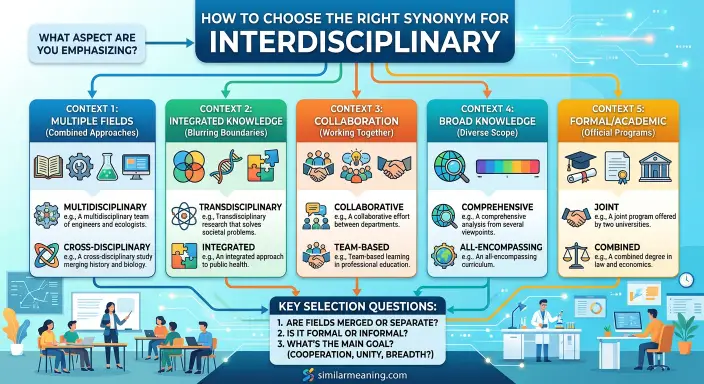
Not every alternative fits every sentence. Choose the word that best describes the relationship between the subjects or people involved.
For Academic Writing
Use multidisciplinary, cross disciplinary, or transdisciplinary when discussing research across fields.
Example: The university launched a multidisciplinary research program.
For Education
Use integrated when subjects or skills are combined in a curriculum.
Example: The school introduced an integrated science and technology course.
For Teamwork
Use collaborative or cross functional when the focus is on people from different backgrounds or departments working together.
Example: A cross functional team developed the new software.
For Complex Problems
Use holistic when you want to consider the entire situation rather than just one part.
Example: The researchers took a holistic approach to environmental protection.
Common Mistakes When Using Interdisciplinary Synonyms
Mistake 1: Treating Every Alternative as an Exact Synonym
Incorrect: The words collaborative and interdisciplinary always mean the same thing.
Correct: A collaborative project involves people working together, while an interdisciplinary project combines knowledge from different fields.
Mistake 2: Confusing Multidisciplinary With Transdisciplinary
Incorrect: Multidisciplinary and transdisciplinary always describe the same approach.
Correct: Multidisciplinary work can involve several fields contributing separately, while transdisciplinary work often goes beyond traditional boundaries to develop a shared approach.
Mistake 3: Using Holistic When You Mean Several Subjects
Incorrect: The course is holistic because it includes biology and history.
Better: The course is interdisciplinary because it combines biology and history.
Use holistic when the focus is on understanding the whole situation.
Mistake 4: Using Complex Words Without a Reason
Incorrect: The school adopted a synergistic, convergent, multidimensional academic structure.
Better: The school adopted an interdisciplinary curriculum.
Choose simple, accurate words instead of adding complicated terms that do not improve the meaning.
Everyday Examples of Interdisciplinary Synonyms
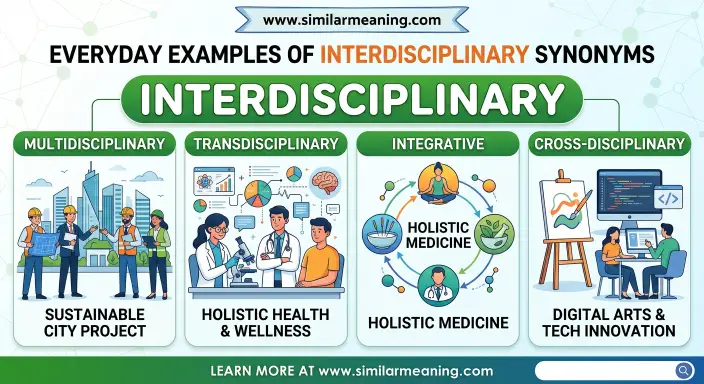
| Original sentence | Alternative | Revised sentence |
| The university offers interdisciplinary courses. | Multidisciplinary | The university offers multidisciplinary courses. |
| The team uses an interdisciplinary approach. | Cross disciplinary | The team uses a cross disciplinary approach. |
| The school combines different subjects. | Integrated | The school uses an integrated curriculum. |
| Experts from several departments worked together. | Cross functional | A cross functional team worked on the project. |
| The study considers the whole problem. | Holistic | The study takes a holistic approach. |
| The research includes different professions. | Interprofessional | The research uses an interprofessional approach. |
Benefits of Interdisciplinary Thinking
Interdisciplinary thinking helps people understand problems from different perspectives. It can connect knowledge that might otherwise remain separate.
Better Problem Solving
Combining ideas from different subjects can reveal new ways to solve difficult problems.
Example: Engineers and environmental scientists worked together to design a cleaner energy system.
More Creative Ideas
Different fields often use different methods. Bringing them together can encourage fresh thinking.
Example: Artists and programmers collaborated to create an interactive learning tool.
Stronger Understanding
An interdisciplinary approach can show how subjects relate to real life.
Example: Students used mathematics, biology, and geography to study local water quality.
Interdisciplinary Synonyms: Common Questions
1. What is the closest synonym for interdisciplinary?
Multidisciplinary and cross disciplinary are often the closest alternatives. The best choice depends on if the focus is on involving several fields or connecting them.
2. What is another word for interdisciplinary approach?
You can use multidisciplinary approach, cross disciplinary approach, or integrated approach, depending on the context.
3. What is the difference between interdisciplinary and multidisciplinary?
Both involve more than one field. Interdisciplinary work often combines ideas or methods across fields, while multidisciplinary work may involve different fields contributing their own perspectives.
4. What does transdisciplinary mean?
Transdisciplinary describes an approach that goes beyond traditional subject boundaries, often bringing different forms of knowledge together around a shared problem.
5. Is collaborative a synonym for interdisciplinary?
Not exactly. Collaborative means people work together. Interdisciplinary means knowledge or methods from different fields are combined. A project can be both.
6. What is an interdisciplinary project?
It is a project that brings together knowledge, ideas, or methods from two or more fields to investigate a question or solve a problem.
7. What is an interdisciplinary curriculum?
An interdisciplinary curriculum connects subjects so students can explore relationships between them and apply knowledge across different areas.
8. What is the opposite of interdisciplinary?
There is no single perfect opposite in every context. Single discipline, discipline specific, and specialized may work when describing an approach focused on one field.
9. Can I use holistic instead of interdisciplinary?
Sometimes, but the meanings are different. Holistic focuses on the whole system or situation, while interdisciplinary focuses on combining different fields.
10. How can I avoid repeating interdisciplinary?
Use an accurate alternative such as multidisciplinary, cross disciplinary, or integrated. You can also restructure your sentence to explain how different subjects work together.
Frequently Asked Questions
What does interdisciplinary mean in simple words?
It means combining knowledge or methods from different subjects to understand a topic or solve a problem.
What are three common synonyms for interdisciplinary?
Three useful alternatives are multidisciplinary, cross disciplinary, and integrated. Their suitability depends on the sentence.
What is the difference between interdisciplinary and cross disciplinary?
Both describe connections between fields. Cross disciplinary often emphasizes crossing subject boundaries, while interdisciplinary commonly emphasizes combining knowledge or methods from different disciplines.
Is interdisciplinary the same as interprofessional?
No. Interdisciplinary usually concerns academic or knowledge fields, while interprofessional focuses on people from different professions working together.
Why is interdisciplinary learning important?
It helps learners connect ideas, see relationships between subjects, and apply knowledge to practical problems.
Conclusion
Choosing the right synonym for interdisciplinary depends on what you want to express. Multidisciplinary is useful when several fields are involved, while cross disciplinary emphasizes connections between different subjects.
Transdisciplinary is often suitable when a project moves beyond traditional subject boundaries, and integrated works when separate parts are combined into one connected whole.
Other words, such as collaborative, holistic, and comprehensive, can also be useful, but they do not mean exactly the same thing. Collaborative focuses on teamwork, holistic focuses on the whole situation, and comprehensive describes something that covers many aspects.
For clear academic and professional writing, choose the word that best matches the context rather than replacing interdisciplinary with a complicated term simply to avoid repetition. Understanding these differences will help you express ideas accurately, improve your vocabulary, and write with greater confidence.
Discover More Articles!
Beautiful Smile Synonyms: 30 Beautiful Words to Describe a Smile
Devoted Child Synonyms: 30 Meaningful Words for a Loving Child
Synonyms of Began: 30 Powerful Words to Improve Your Vocabulary

Justin Cord Hayes is an Adams Media author and co-author of several vocabulary and thesaurus books. His work focuses on synonyms, antonyms, word choice, and expanding English vocabulary. He co-authored Roget’s Thesaurus of Words for Writers, Roget’s Thesaurus of Words for Students, and Roget’s Thesaurus of Words for Intellectuals. His books are designed to help readers find clearer and more effective words for writing and communication.


3 thoughts on “Interdisciplinary Synonyms: 30 Words to Expand Your Vocabulary”