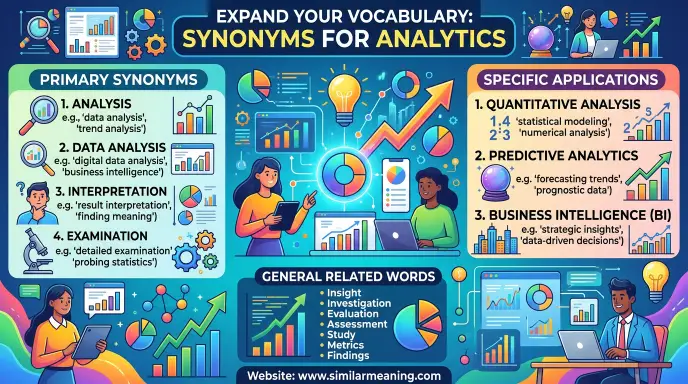
Synonyms for analytics include analysis, evaluation, assessment, interpretation, data analysis, and examination. These words describe ways to study information, understand patterns, and make better decisions. The best alternative depends on the context, such as business, marketing, education, science, or technology.
For example, a company may use analytics to understand customer behavior, measure website traffic, or improve its sales strategy. In these situations, words such as “data analysis,” “evaluation,” and “insight” may communicate a similar idea, although each has a slightly different meaning.
Choosing the right synonym can make your writing clearer and more natural. It can also help you avoid repeating the same word in reports, research papers, presentations, and website content.
In this guide, you will discover 30 synonyms for analytics, their meanings, example sentences, differences, and practical usage tips. You will also learn which alternatives work best in professional and everyday English.
Quick Answer: What Are the Best Synonyms for Analytics?
The best synonyms for analytics depend on what you want to describe. “Analysis” is a useful general alternative, while “data analysis” is more specific to working with information and numbers.
| Synonym | Meaning |
| Analysis | Detailed examination of information |
| Evaluation | Judging the value or effectiveness of something |
| Assessment | Measuring or judging a situation |
| Examination | Careful inspection of information |
| Interpretation | Explaining the meaning of information |
| Data analysis | Studying data to identify useful findings |
| Research | Systematic investigation of a subject |
| Investigation | Detailed inquiry into a question or problem |
| Measurement | Determining the size, amount, or level of something |
| Insights | Useful understanding gained from information |
Best overall choice: “Analysis” is a natural alternative in general writing. Use “data analysis” when you specifically mean studying data to find patterns, relationships, or conclusions.
1. What Does Analytics Mean?
Analytics refers to the systematic examination of data or information to discover patterns, understand trends, draw conclusions, and support decisions.
It is widely used in business, marketing, healthcare, education, finance, science, and technology. Organizations often rely on analytics to understand performance and identify opportunities for improvement.
For example, a website owner may use analytics to determine how many people visit a website, which pages receive the most attention, and where visitors come from.
Definition and Meaning
The word “analytics” is a noun that commonly refers to methods, processes, and tools used to analyze data.
It often involves collecting information, organizing it, examining relationships, and using the findings to answer questions or guide decisions.
Examples:
- Website analytics helps businesses understand visitor behavior.
- Sales analytics reveals changes in customer purchasing patterns.
- Educational analytics can help teachers understand student performance.
- Financial analytics supports the evaluation of financial trends.
Related question: What is another word for analytics?
Depending on the context, useful alternatives include analysis, data analysis, evaluation, assessment, interpretation, and investigation.
2. 30 Powerful Synonyms for Analytics
Here are 30 useful alternatives, grouped by meaning to help you choose the right word for your writing.
A. Synonyms Related to Analysis and Examination
- Analysis — The detailed study of information to understand its parts or meaning.
- The analysis revealed several patterns in customer behavior.
- Examination — A careful inspection of information, evidence, or a situation.
- The examination of website traffic identified several areas for improvement.
- Inspection — A close review to check quality, accuracy, or condition.
- The inspection of the records revealed missing information.
- Review — A structured look at information, performance, or results.
- The team completed a review of its monthly performance.
- Investigation — A detailed inquiry designed to discover facts or explain a problem.
- The investigation helped explain the sudden decline in sales.
- Inquiry — A process of asking questions and gathering information.
- The inquiry focused on changes in customer preferences.
- Scrutiny — Close and careful examination.
- The financial report received careful scrutiny before approval.
- Exploration — An initial or detailed search for patterns, ideas, or relationships.
- Data exploration helped researchers identify possible trends.
B. Synonyms Related to Evaluation and Measurement
- Evaluation — Judging the value, quality, or effectiveness of something.
- The evaluation showed that the marketing campaign performed well.
- Assessment — Examining a situation to understand its condition or importance.
- The assessment highlighted the company’s strongest sales channels.
- Appraisal — An estimate or judgment of value, quality, or performance.
- The appraisal provided an overview of the project’s results.
- Measurement — Determining the amount, size, degree, or level of something.
- Accurate measurement helped the team track its progress.
- Benchmarking — Comparing performance against a standard or other organizations.
- Benchmarking helped the business compare its website performance with competitors.
- Monitoring — Observing information or performance over time.
- Continuous monitoring helped the team identify sudden changes in traffic.
- Auditing — Systematically checking records, processes, or activities.
- The data audit identified inconsistencies in the company’s reports.
- Performance review — Examining how well a person, system, or organization performs.
- The performance review revealed opportunities to improve efficiency.
C. Synonyms Related to Understanding and Interpretation
- Interpretation — Explaining the meaning or significance of information.
- The interpretation of the results helped guide the next decision.
- Insights — Useful understanding gained from studying information.
- Customer insights helped the company improve its products.
- Findings — Results discovered through research or examination.
- The findings revealed a shift in customer preferences.
- Understanding — Knowledge of how something works or what information means.
- A better understanding of user behavior improved the website design.
- Diagnosis — Identifying the cause or nature of a problem.
- The diagnosis of the technical issue helped the team find a solution.
- Inference — A conclusion drawn from evidence or available information.
- The analyst made an inference based on several months of sales data.
D. Synonyms Related to Data and Research
- Data analysis — The process of examining data to identify patterns and conclusions.
- Data analysis helped the researchers test their hypothesis.
- Research — Systematic investigation to develop or expand knowledge.
- Market research revealed what customers expected from the product.
- Statistics — Numerical information or methods used to analyze data.
- The report used statistics to explain changes in demand.
- Data mining — Finding patterns and useful relationships within large datasets.
- Data mining helped identify groups of customers with similar preferences.
- Data interpretation — Explaining what collected data means.
- Data interpretation turned the results into practical recommendations.
- Modeling — Representing a system or process mathematically or computationally.
- Predictive modeling helped estimate future demand.
- Forecasting — Estimating future events or outcomes using available information.
- Sales forecasting helped the business plan its inventory.
- Reporting — Presenting information and results in an organized format.
- Automated reporting gave managers a clear view of weekly performance.
3. Choosing the Right Synonym for Analytics
Not every synonym has exactly the same meaning. The best choice depends on the subject and the point you want to communicate.
| If you mean… | Choose… |
| General study of information | Analysis |
| Measuring effectiveness | Evaluation |
| Judging a situation | Assessment |
| Studying numerical information | Data analysis |
| Explaining results | Interpretation |
| Discovering useful patterns | Data mining |
| Understanding customer needs | Customer insights |
| Comparing results with standards | Benchmarking |
| Estimating future results | Forecasting |
| Presenting results | Reporting |
Which Synonym Is Best for Professional Writing?
For professional reports, “analysis,” “evaluation,” “assessment,” and “data analysis” are useful alternatives.
For example:
- General: The analytics helped us understand customer behavior.
- More specific: The data analysis helped us understand customer behavior.
- Focused on results: The evaluation revealed opportunities to improve customer engagement.
The third sentence emphasizes judgment about performance, while the second focuses on studying data.
4. Analytics Synonyms in Different Industries
The word “analytics” appears in many industries, but its best alternatives may vary by subject.
Business Analytics
Business analytics involves using data to understand performance and support business decisions.
Useful alternatives include:
- Business analysis
- Performance evaluation
- Market assessment
- Business intelligence
- Data interpretation
Example: Business analysis helped the company identify opportunities to increase revenue.
Website and Marketing Analytics
Website and marketing analytics help businesses understand visitors, advertising campaigns, and customer engagement.
Useful alternatives include:
- Web analysis
- Traffic analysis
- Marketing performance evaluation
- Customer insights
- Campaign measurement
Example: Website traffic analysis revealed which pages attracted the most visitors.
Data and Technology Analytics
In technology, analytics often involves processing datasets, identifying patterns, and developing models.
Useful alternatives include:
- Data analysis
- Data mining
- Statistical analysis
- Predictive modeling
- Computational analysis
Example: Statistical analysis helped the research team identify relationships between variables.
Financial Analytics
Financial analytics involves studying financial information to understand performance, risks, and possible future outcomes.
Useful alternatives include:
- Financial analysis
- Risk assessment
- Financial evaluation
- Trend analysis
- Financial forecasting
Example: Financial analysis helped the company understand its expenses and revenue trends.
5. Analytics Synonyms in Everyday Sentences
Here are ten natural examples showing how to use different alternatives in everyday and professional English.
- Analysis: The analysis revealed a steady increase in website visitors.
- Evaluation: The evaluation helped determine if the campaign was successful.
- Assessment: The assessment identified several areas that needed attention.
- Interpretation: The interpretation of the data provided a clearer picture of the results.
- Research: The research explored how customers choose products.
- Monitoring: Regular monitoring helped identify changes in performance.
- Forecasting: Forecasting helped the team prepare for future demand.
- Benchmarking: Benchmarking showed how the company compared with its competitors.
- Insights: Customer insights helped the business improve its services.
- Reporting: Automated reporting made it easier to share the results.
These examples demonstrate that selecting a specific alternative can make your writing more precise.
6. Common Mistakes When Using Analytics Synonyms
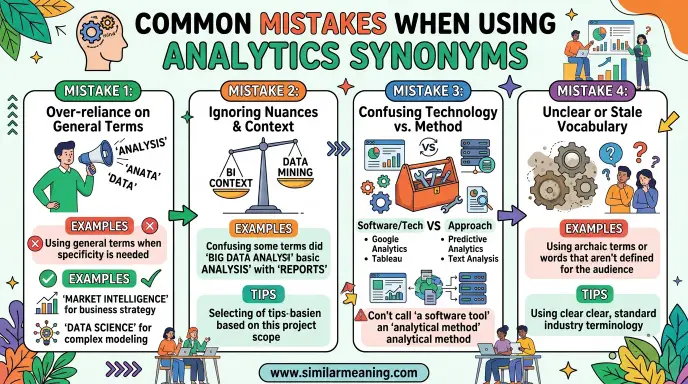
Choosing a synonym without considering its meaning can make a sentence less accurate.
Mistake 1: Treating Every Synonym as Identical
“Analysis,” “evaluation,” and “reporting” describe different activities.
- Analysis involves examining information.
- Evaluation involves judging value or effectiveness.
- Reporting involves presenting information and results.
Better approach: Choose the word that reflects the actual task.
Mistake 2: Using Analytics When You Mean Data
Data refers to the information itself, while analytics refers to methods or processes used to examine information.
Example:
- Less precise: We collected analytics from the survey.
- Clearer: We collected survey data and analyzed the results.
Mistake 3: Confusing Analytics With Statistics
Statistics refers to numerical information and methods for working with it. Analytics is broader and can include statistical methods, visualization, modeling, and interpretation.
The two terms overlap, but they are not interchangeable in every sentence.
Mistake 4: Using Too Many Technical Words
Words such as “predictive modeling,” “data mining,” and “benchmarking” have specific meanings. Using them simply to sound professional can confuse readers.
Better approach: Prefer plain words when they communicate your meaning more clearly.
7. Analysis vs Analytics: What Is the Difference?
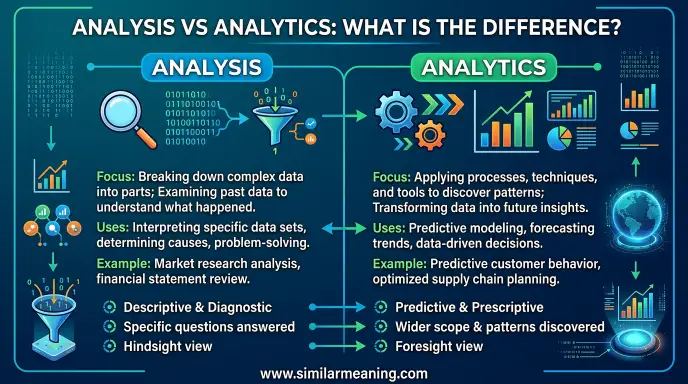
“Analytics” and “analysis” are closely related, but they are not always used in exactly the same way.
| Word | Meaning | Example |
| Analytics | Methods, tools, and processes used to study data | Website analytics tracks visitor behavior. |
| Analysis | A detailed examination of information | The analysis revealed a decline in traffic. |
In everyday writing, the two words sometimes overlap. However, “analytics” is especially common when discussing data driven tools, systems, and business practices.
For example, “marketing analytics” describes a broader area of work, while “marketing analysis” may refer to a particular examination of a campaign or market.
8. Google Trends and Common Search Confusion
People search for synonyms of “analytics” for different reasons. Some want a simpler word for an essay, while others need a professional alternative for a business report, website, or research project.
However, the best synonym depends on the intended meaning rather than how often a term appears in search results.
For writing, use “data analysis,” “insights,” “performance evaluation,” or “reporting” when they accurately describe the subject. Avoid replacing every occurrence of “analytics” with a different word simply to increase keyword variety.
Search interest can help identify vocabulary questions, but it does not establish that one synonym is better than another.
9. FAQs
1. What is the best synonym for analytics?
“Analysis” is a useful general synonym. “Data analysis” is more specific when you mean examining data to identify patterns or conclusions.
2. What is another word for analytics in business?
Business analysis, performance evaluation, business intelligence, and data analysis are useful alternatives, depending on the context.
3. What is a simple word for analytics?
“Analysis” is a straightforward alternative. “Review” may also work when you mean examining information or results.
4. Is analytics the same as analysis?
Not always. Analytics often refers to methods, systems, or processes used to study data, while analysis refers to the examination itself. Their meanings overlap in many contexts.
5. What are synonyms for data analytics?
Common alternatives include data analysis, statistical analysis, data interpretation, data mining, and computational analysis. Each term describes a somewhat different approach.
6. What is another word for marketing analytics?
Marketing analysis, campaign measurement, marketing performance evaluation, and customer insights may work, depending on what is being studied.
7. What is a synonym for website analytics?
Web analysis, website traffic analysis, visitor analysis, and website performance measurement are useful alternatives.
8. What is the opposite of analytics?
There is no single direct opposite. Depending on the context, terms such as guesswork, speculation, or uninformed judgment may contrast with evidence based analytics.
9. What are professional alternatives to analytics?
“Data analysis,” “performance evaluation,” “business intelligence,” and “statistical analysis” are professional alternatives when they accurately describe the work.
10. How can I avoid repeating the word analytics?
Use precise alternatives such as “data analysis,” “evaluation,” “findings,” “insights,” and “performance measurement.” Choose each word according to its meaning rather than replacing the keyword automatically.
Conclusion
The best synonyms for analytics include analysis, evaluation, assessment, interpretation, data analysis, research, and insights. Each term can communicate a related idea, but the right choice depends on what you are describing.
Use “analysis” for a general examination of information, “data analysis” when working directly with datasets, “evaluation” when judging effectiveness, and “insights” when emphasizing useful understanding gained from information.
In business and technology, terms such as “data mining,” “benchmarking,” and “forecasting” can be more precise when they describe the actual process being performed.
Learning these 30 alternatives can help you improve your vocabulary, write clearer reports, create more natural content, and communicate ideas more effectively. The key is to choose words that express your intended meaning accurately.
Discover More Articles!
Beautiful Smile Synonyms: 30 Beautiful Words to Describe a Smile
Devoted Child Synonyms: 30 Meaningful Words for a Loving Child
Synonyms of Began: 30 Powerful Words to Improve Your Vocabulary

Justin Cord Hayes is an Adams Media author and co-author of several vocabulary and thesaurus books. His work focuses on synonyms, antonyms, word choice, and expanding English vocabulary. He co-authored Roget’s Thesaurus of Words for Writers, Roget’s Thesaurus of Words for Students, and Roget’s Thesaurus of Words for Intellectuals. His books are designed to help readers find clearer and more effective words for writing and communication.





3 thoughts on “Synonyms for Analytics: 30 Words to Improve Your Vocabulary”