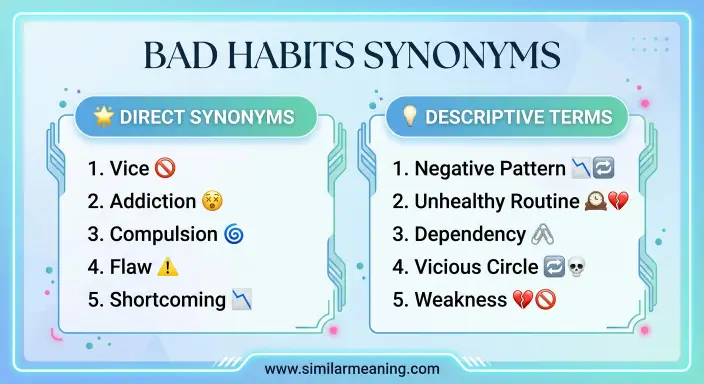
Bad habits are repeated actions or behaviors that can have a harmful or unwanted effect on a person’s life. For example, someone may stay up too late every night, delay important work, or spend too much time on their phone.
These repeated actions can become bad habits when they are difficult to control or stop. The phrase bad habits is common in everyday English because people often talk about behaviors they want to change.
Learning synonyms for bad habits helps English learners and content writers use more precise words. Instead of repeating the same phrase, you can choose words such as vices, flaws, weaknesses, or negative behaviors based on the context. In this article, we will explore the meaning, examples, pronunciation, history, grammar, tone, and 30 useful synonyms for bad habits. These words can help improve both speaking and writing.
Meaning of Bad Habits
Definition
Bad habits (noun phrase): Repeated behaviors or actions that are considered harmful, unhealthy, unwanted, or unhelpful.
Examples
- Staying up late every night can become a bad habit.
- His bad habits make it harder for him to finish his work on time.
Connotative Meaning
- Positive tone: The phrase itself is not normally positive, but discussing bad habits can have a positive purpose when the goal is self improvement.
- Negative tone: It usually suggests behavior that causes harm, problems, or poor results.
- Neutral tone: In educational or psychological discussions, it can simply describe repeated behaviors without strongly judging the person.
What is connotation? (Connotation is the feeling, idea, or emotion that a word suggests beyond its basic meaning.)
Etymology
- Bad: The word comes from Middle English badde or related forms, with meanings connected to something poor, harmful, or undesirable.
- Habit: Habit comes through Old French abit from Latin habitus, meaning “condition,” “character,” or “way of being.”
- Bad habits: The phrase combines these two words to describe repeated behaviors that are undesirable or harmful.
Short History
- Old English (450–1100): The modern form of bad was not yet established, while related words were used to describe poor or undesirable conditions. Ideas related to habitual behavior were expressed through other terms.
- Middle English (1100–1500): Forms related to bad became more established. Habit entered English through French and was connected with behavior, condition, or customary action.
- Modern English (1500–Present): Bad habits became a common phrase for repeated behaviors that people consider undesirable or harmful.
Pronunciation
US: /bæd ˈhæbɪts/
UK: /bæd ˈhæbɪts/
Syllables
bad hab its
Affixation Pattern of Bad Habits
Root:
- bad an adjective meaning undesirable or harmful
- habit a noun referring to a repeated behavior
Prefix:
- None in the basic phrase.
Suffix:
- s in habits, marking the plural form.
Word formation:
- bad adjective
- habit noun
- habits plural noun
- bad habit noun phrase
- bad habits plural noun phrase
- badly adverb formed from bad + ly
Synonyms of Bad Habits
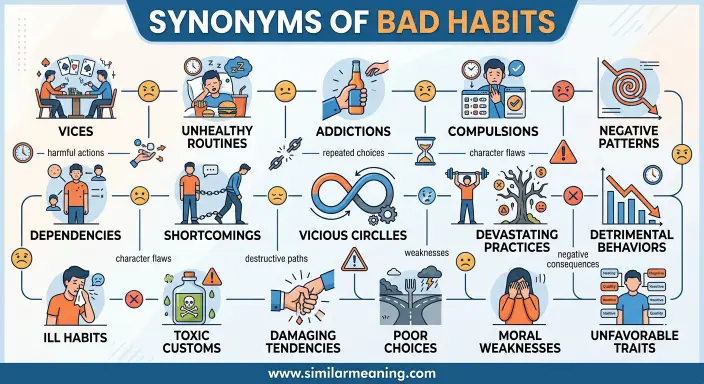
1. Vices (Noun)
US: /ˈvaɪsɪz/ | UK: /ˈvaɪsɪz/
Meaning: Harmful or immoral habits or behaviors that a person may repeatedly follow.
Examples:
- Smoking and excessive drinking are often described as vices.
- He decided to leave his old vices behind.
2. Weaknesses (Noun)
US: /ˈwiːknəsɪz/ | UK: /ˈwiːknəsɪz/
Meaning: Personal habits or traits that make it harder to act in a better way.
Examples:
- Everyone has personal weaknesses they can work on.
- Procrastination is one of her biggest weaknesses.
3. Flaws (Noun)
US: /flɔːz/ | UK: /flɔːz/
Meaning: Faults or unwanted qualities in a person’s behavior.
Examples:
- Everyone has flaws they can improve.
- His habit of interrupting others is one of his flaws.
4. Faults (Noun)
US: /fɔːlts/ | UK: /fɔːlts/
Meaning: Unwanted behaviors or personal shortcomings.
Examples:
- She openly talks about her faults.
- Being careless is one of his main faults.
5. Shortcomings (Noun)
US: /ˈʃɔːrtˌkʌmɪŋz/ | UK: /ˈʃɔːtˌkʌmɪŋz/
Meaning: Weak points or areas where a person’s behavior is not good enough.
Examples:
- He is trying to correct his personal shortcomings.
- Laziness can become a serious shortcoming.
6. Negative Behaviors (Noun)
US: /ˈnɛɡətɪv bɪˈheɪvjərz/ | UK: /ˈneɡətɪv bɪˈheɪvjəz/
Meaning: Actions or patterns of behavior that have unwanted effects.
Examples:
- Parents can help children recognize negative behaviors.
- Negative behaviors can affect relationships.
7. Unhealthy Habits (Noun)
US: /ʌnˈhɛlθi ˈhæbɪts/ | UK: /ʌnˈhelθi ˈhæbɪts/
Meaning: Repeated behaviors that may harm physical or mental well being.
Examples:
- Eating too quickly can become an unhealthy habit.
- He is trying to replace unhealthy habits with better routines.
8. Poor Habits (Noun)
US: /pʊr ˈhæbɪts/ | UK: /pɔː ˈhæbɪts/
Meaning: Repeated behaviors that produce poor or unwanted results.
Examples:
- Poor study habits can affect academic performance.
- She wants to improve her poor sleeping habits.
9. Harmful Habits (Noun)
US: /ˈhɑːrmfəl ˈhæbɪts/ | UK: /ˈhɑːmfəl ˈhæbɪts/
Meaning: Repeated actions that can cause harm or negative effects.
Examples:
- He is working to stop his harmful habits.
- Some harmful habits develop slowly over time.
10. Destructive Behaviors (Noun)
US: /dɪˈstrʌktɪv bɪˈheɪvjərz/ | UK: /dɪˈstrʌktɪv bɪˈheɪvjəz/
Meaning: Behaviors that cause serious damage or negative consequences.
Examples:
- Anger can sometimes lead to destructive behaviors.
- He learned to recognize destructive behaviors early.
11. Negative Patterns (Noun)
US: /ˈnɛɡətɪv ˈpætərnz/ | UK: /ˈneɡətɪv ˈpætənz/
Meaning: Repeated ways of acting that lead to unwanted results.
Examples:
- She noticed negative patterns in her daily routine.
- Breaking negative patterns takes time and effort.
12. Bad Practices (Noun)
US: /bæd ˈpræktɪsɪz/ | UK: /bæd ˈpræktɪsɪz/
Meaning: Actions or methods that are considered poor, harmful, or unsuitable.
Examples:
- The company worked to remove bad practices.
- Poor planning can become a bad practice.
13. Negative Routines (Noun)
US: /ˈnɛɡətɪv ruːˈtiːnz/ | UK: /ˈneɡətɪv ruːˈtiːnz/
Meaning: Regular patterns of action that have unwanted effects.
Examples:
- He is trying to break his negative routines.
- Negative routines can waste valuable time.
14. Undesirable Behaviors (Noun)
US: /ˌʌndɪˈzaɪərəbəl bɪˈheɪvjərz/ | UK: /ˌʌndɪˈzaɪərəbəl bɪˈheɪvjəz/
Meaning: Behaviors that are not wanted or viewed as acceptable.
Examples:
- Teachers can help students understand undesirable behaviors.
- The program focuses on changing undesirable behaviors.
15. Unwanted Behaviors (Noun)
US: /ʌnˈwɑːntɪd bɪˈheɪvjərz/ | UK: /ʌnˈwɒntɪd bɪˈheɪvjəz/
Meaning: Actions or habits that a person or group does not want.
Examples:
- He is trying to reduce unwanted behaviors.
- The lesson explains how unwanted behaviors develop.
16. Negative Tendencies (Noun)
US: /ˈnɛɡətɪv ˈtɛndənsiz/ | UK: /ˈneɡətɪv ˈtendənsiz/
Meaning: A repeated tendency to behave in an unwanted way.
Examples:
- He is aware of his negative tendencies.
- Negative tendencies can become stronger without attention.
17. Bad Tendencies (Noun)
US: /bæd ˈtɛndənsiz/ | UK: /bæd ˈtendənsiz/
Meaning: Regular tendencies toward unwanted behavior.
Examples:
- He has a bad tendency to delay important tasks.
- Recognizing bad tendencies can help people change them.
18. Vicious Habits (Noun)
US: /ˈvɪʃəs ˈhæbɪts/ | UK: /ˈvɪʃəs ˈhæbɪts/
Meaning: Very harmful or difficult habits that can create serious problems.
Examples:
- He wanted to escape his vicious habits.
- Some vicious habits can affect many parts of life.
19. Indulgences (Noun)
US: /ɪnˈdʌldʒənsɪz/ | UK: /ɪnˈdʌldʒənsɪz/
Meaning: Activities or pleasures that someone allows themselves to enjoy too much.
Examples:
- Sweet foods were one of his favorite indulgences.
- Small indulgences are different from harmful habits.
20. Excesses (Noun)
US: /ɪkˈsɛsɪz/ | UK: /ɪkˈsesɪz/
Meaning: Behaviors that go beyond a reasonable or healthy limit.
Examples:
- He decided to control his daily excesses.
- Excesses can turn a simple pleasure into a problem.
21. Compulsions (Noun)
US: /kəmˈpʌlʃənz/ | UK: /kəmˈpʌlʃənz/
Meaning: Strong urges to perform an action repeatedly.
Examples:
- Some people struggle with repeated compulsions.
- He wanted to understand his compulsions better.
22. Addictions (Noun)
US: /əˈdɪkʃənz/ | UK: /əˈdɪkʃənz/
Meaning: Strong and difficult to control dependence on a substance or behavior.
Examples:
- Some addictions require professional support.
- Digital addictions can interfere with daily activities.
23. Misbehaviors (Noun)
US: /ˌmɪsbɪˈheɪvjərz/ | UK: /ˌmɪsbɪˈheɪvjəz/
Meaning: Actions that are considered improper or badly behaved.
Examples:
- The teacher discussed common classroom misbehaviors.
- Parents can address misbehaviors with clear rules.
24. Misconduct (Noun)
US: /mɪsˈkɑːndʌkt/ | UK: /mɪsˈkɒndʌkt/
Meaning: Wrong or improper behavior, especially in a formal setting.
Examples:
- The company has rules against workplace misconduct.
- The report examined several cases of misconduct.
25. Negligence (Noun)
US: /ˈneɡlɪdʒəns/ | UK: /ˈneɡlɪdʒəns/
Meaning: Failure to give proper care or attention to something.
Examples:
- His negligence caused several avoidable problems.
- Negligence can become a serious work habit.
26. Carelessness (Noun)
US: /ˈkerləsnəs/ | UK: /ˈkeələsnəs/
Meaning: A repeated lack of care or attention.
Examples:
- Carelessness can lead to simple mistakes.
- His carelessness made the task harder.
27. Laziness (Noun)
US: /ˈleɪzinəs/ | UK: /ˈleɪzinəs/
Meaning: A lack of effort or willingness to do necessary work.
Examples:
- Laziness can make simple tasks seem difficult.
- He is trying to overcome his habit of laziness.
28. Procrastination (Noun)
US: /proʊˌkræstəˈneɪʃən/ | UK: /prəʊˌkræstəˈneɪʃən/
Meaning: The habit of delaying something that should be done.
Examples:
- Procrastination can reduce productivity.
- She is working on reducing procrastination.
29. Self Sabotage (Noun)
US: /ˌself ˈsæbəˌtɑːʒ/ | UK: /ˌself ˈsæbəˌtɑːʒ/
Meaning: Actions that make it harder for someone to reach their own goals.
Examples:
- Negative thinking can sometimes lead to self sabotage.
- He recognized his habit of self sabotage.
30. Poor Behaviors (Noun)
US: /pʊr bɪˈheɪvjərz/ | UK: /pɔː bɪˈheɪvjəz/
Meaning: Actions or behavior that are considered unsuitable, harmful, or unhelpful.
Examples:
- Parents can teach children how to replace poor behaviors.
- Poor behaviors can affect relationships and work.
Prototype Meaning
The most typical meaning of bad habits is repeated behavior that a person knows is unwanted but continues to do. When people hear this phrase, they often imagine actions such as procrastinating, staying up too late, wasting time, being careless, or following an unhealthy routine. The phrase usually focuses on a pattern rather than one single mistake.
Prototype Categorization
- Personal weaknesses: weaknesses, flaws, faults, shortcomings useful when discussing personal areas that need improvement.
- Harmful habits: vices, harmful habits, vicious habits, addictions useful when the behavior can cause serious harm.
- Behavioral terms: negative behaviors, poor behaviors, undesirable behaviors, misbehaviors useful in education and general discussions.
- Work and responsibility: negligence, carelessness, procrastination, bad practices useful when discussing work, study, or responsibility.
- Repeated patterns: negative patterns, negative routines, negative tendencies, bad tendencies useful when focusing on repetition.
- Strong or formal terms: misconduct, compulsions, excesses, self sabotage useful when a more specific or formal word is needed.
Categorizing synonyms helps writers choose the right word instead of replacing bad habits with a word that does not have the same meaning. For example, procrastination is more specific than bad habits, while misconduct is more formal and usually refers to improper behavior in a particular setting.
Antonyms of Bad Habits
- Good habits (noun): Positive repeated behaviors that support a healthy or useful routine.
- Healthy habits (noun): Regular behaviors that support physical or mental well being.
- Good practices (noun): Useful and effective ways of doing something.
- Positive behaviors (noun): Actions that produce helpful or desirable results.
- Strengths (noun): Positive qualities or abilities that help a person succeed.
- Virtues (noun): Good moral qualities or behaviors.
- Discipline (noun): The ability to control actions and follow useful routines.
- Self control (noun): The ability to control feelings, actions, and impulses.
- Productivity (noun): The ability to use time and effort effectively.
Short Questions and Answers
- What do bad habits mean?
Bad habits are repeated actions or behaviors that are unwanted, harmful, or unhelpful. - When should bad habits be used?
Use bad habits when talking about repeated behaviors that create problems or produce unwanted results. - Are bad habits positive or negative?
The phrase normally has a negative meaning because it describes unwanted behavior. - How is bad habits different from similar words?
Bad habits is a broad phrase. Words such as procrastination, negligence, and addiction describe more specific types of unwanted behavior. - What is the difference between bad habits and vices?
Bad habits can describe many unwanted routines, while vices often suggests morally wrong or seriously harmful behavior. - What is a synonym for bad habits in formal English?
Negative behaviors, undesirable behaviors, shortcomings, and poor practices can work in formal contexts depending on the meaning. - Is procrastination a bad habit?
Yes. Procrastination can be described as a bad habit because it involves repeatedly delaying tasks.
Conclusion
Learning synonyms for bad habits gives English learners more ways to describe unwanted behaviors clearly. Words such as vices, weaknesses, flaws, shortcomings, procrastination, and negative behaviors do not always have exactly the same meaning, so choosing the right word is important.
These synonyms can make writing more natural and help speakers express ideas with greater precision. They also reduce repetition when writing essays, blog posts, reports, and everyday messages.
Understanding tone and context makes these words easier to use correctly. Regular vocabulary practice can improve English confidence and make both speaking and writing stronger. Try learning a few synonyms each day and use them in your own sentences. Over time, this simple practice can build a richer and more useful English vocabulary.
Discover More Articles!
Hidding or Hiding: Which Spelling Is Correct?(2026)
67 Meaning : Spelling, Facts, and How to Write It Correctly
Immigration or Emigration: What Is the Difference?

Justin Cord Hayes is an Adams Media author and co-author of several vocabulary and thesaurus books. His work focuses on synonyms, antonyms, word choice, and expanding English vocabulary. He co-authored Roget’s Thesaurus of Words for Writers, Roget’s Thesaurus of Words for Students, and Roget’s Thesaurus of Words for Intellectuals. His books are designed to help readers find clearer and more effective words for writing and communication.


2 thoughts on “Bad Habits Synonyms: 30 Useful Words for Better English”